“Originals” Quotes

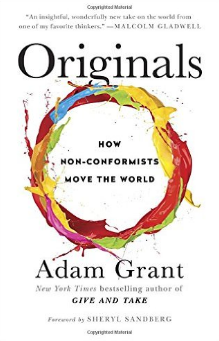
Originals CoverI recently read “Originals: How Nonconformists Move The World” by Adam Grant. Below are the quotes I found most interesting. If you like them, buy the book here.

“After finding that disadvantaged groups consistently support the status quo more than advantaged groups, Jost and his colleagues concluded: “People who suffer the most from a given state of affairs are paradoxically the least likely to question, challenge, reject, or change it.”” (6)

“Justifying the default system serves a soothing function. It’s an emotional painkiller: If the world is supposed to be this way, we don’t need to be dissatisfied with it.” (7)

“The hallmark of originality is rejecting the default and exploring whether a better option exists.” (7)

“Although child prodigies are often rich in both talent and ambition, what holds them back from moving the world forward is that they don’t learn to be original. As they perform in Carnegie Hall, win the science Olympics, and become chess champions, something tragic happens: Practice makes perfect, but it doesn’t make new.” (9)

“Entrepreneurs who kept their day jobs had 33 percent lower odds of failure than those who quit. If you’re risk averse and have some doubts about the feasibility of your ideas, it’s likely that your business will be built to last. If you’re a freewheeling gambler, your startup is far more fragile.” (17)

“Polaroid founder Edwin Land remarked, “No person could possibly be original in one area unless he were possessed of the emotional and social stability that comes from fixed attitudes in all areas other than the one in which he is being original.”” (19)

“Having a sense of security in one realm gives us the freedom to be original in another.” (19)

“The biggest barrier to originality is not idea generation – it’s idea selection.” (31)

“Simonton finds that on average, creative geniuses weren’t qualitatively better in their fields than their peers. They simply produced a greater volume of work, which game them more variation and a higher chance of originality.” (35)

“If you want to be original, “the most important possible thing you could do,” says Ira Glass, the producer of This American Life and the podcast Serial, “is do a lot of work. Do a huge volume of work.” (37)

“Across fields, Simonton reports that the most prolific people nto only have the highest originality; they also generate their most original output during the periods in which they produce the largest volume.” (37)

“Many people fail to achieve originality because they generate a few ideas and then obsess about refining them to perfection.” (37)

“When artists assessed one another’s performances, they were about twice as accurate as managers and test audiences in predicting how often the videos would be shared.” (42)

“Our intuitions are only accurate in domains where we have a lot of experience.” (51)

“Physicists, accountants, insurance analysts, and chess masters – they all work in fields where cause-and-effect relationships are fairly consistent. But admissions officers, court judges, intelligence analysts, psychiatrists, and stock brokers didn’t benefit much from experience. In a rapidly changing world, the lessons of experience can easily point us in the wrong direction. And because the pace of change is accelerating, our environments are becoming ever more unpredictable.” (53)

“The more successful people have been in the past, the worse they perform when they enter a new environment. They become overconfident, and they’re less likely to seek critical feedback even though the context is radically different.” (54)

“When people sought to exert influence but lacked respect, others perceived them as difficult, coercive, and self-serving. Since they haven’t earned our admiration, we don’t feel they have the right to tell us what to do, and we push back.” (65)

“Francis Ford Coppola observed, “the way to come to power is not always to merely challenge the Establishment, but first make a place in it and then challenge and double-cross the Establishment.”” (66)

“Most of us assume that to be persuasive, we ought to emphasize our strengths and minimize our weaknesses. That kind of powerful communication makes sense if the audience is supportive. But when you’re pitching a novel idea or speaking up with a suggestion for change, your audience is likely to be skeptical. Investors are looking to poke holes in your arguments; managers are hunting for reasons why your suggestion won’t work. Under those circumstances, for at least for reasons, it’s actually more effective to adopt Griscom’s form of powerless communication by accentuating the flaws in your idea.” (69)

“The first advantage is that leading with weaknesses disarms the audience.” (69)

“If you’re perched at the top, you’re expected to be different and therefore have the license to deviate. Likewise, if you’re still at the bottom of a status hierarchy, you have little to lose and everything to gain by being original. But the middle segment of that hierarchy – where the majority of people in an organization are found – is dominated by insecurity.” (82)

“In the long run, research shows that the mistakes we regret are not errors of commission, but errors of omission. If we could do things over, most of us would censor ourselves less and express our ideas more.” (91)

“If you’re feeling pressured to start working on a creative task when you’re wide awake, it might be worth delaying it until you’re a little sleepier.” (97)

“People have a better memory for incomplete than complete tasks. Once a task is finished, we stop thinking about it. But when it is interrupted and left undone, it stays active in our minds.” (99)

“In the majority of circumstances, your odds of success aren’t higher if you go first. And when the market is uncertain, unknown, or underdeveloped, being a pioneer has pronounced disadvantages.” (108)

“The originals who start a movement will often be its most radical members, whose ideas and ideals will prove too hot for those who follow their lead.” (117)

“Simon Sinek argues that if we want to inspire people, we should start with why. If we communicate the vision behind our ideas, the purpose guiding our products, people will flock to us. This is excellent advice – unless you’re doing something original that challenges the status quo.” (124)

“For insiders, the key representative is the person who is most central and connected in the group… But for outsiders, the person who represents the group is the one with the most extreme views.” (128)

“The most promising ideas begin from novelty and then add familiarity.” (136)

“Instead of assuming that others share our principles, or trying to convince them to adopt ours, we ought to present our values as a means of pursuing theirs. It’s hard to change other people’s ideals. It’s much easier to link our agendas to familiar values that people already hold.” (140)

“Rob Minkoff explains: If it’s not original enough, it’s boring or trite. If it’s too original, it may be hard for the audience to understand. The goal is to push the envelope, not tear the envelope.” (141)

“Predicting personality is more challenging with only children than with children who have siblings. Like firstborns, only children grow up in a world of adults and identify with parents. Like lastborns, they are protected fiercely, which leaves them “free to become radicals themselves.”” (162)

“Reasoning communicates a message of respect… it implies that had children but known better or understood more, they would not have acted in an inappropriate way. It is a mark of esteem for the listener; an indication of faith in his or her ability to comprehend, develop, and improve.” (164)

“Parents of highly creative children had an average of less than one rule and tended to “place emphasis on moral values, rather than on specific rules.”” (164)

“When we praise children for their intelligence, they develop a fixed view of ability, which leads them to give up in the face of failure. Instead of telling them how smart they are, it’s wise to praise their effort, which encourages them to see their abilities as malleable and persist to overcome obstacles.” (169)

“The most inspiring way to convey a vision is to outsource it to the people who are actually affected by it.” (221)

“People are inspired to achieve the highest performance when leaders describe a vision and then invite a customer to bring it to life with a personal story. The leader’s message provides an overarching vision to start the car, and the user’s story offers an emotional appeal that steps on the accelerator.” (222)

“Merely knowing that you’re not the only resistor makes it substantially easier to reject the crowd. Emotional strength can be found even in small numbers.” (225)

Liked the quotes? Click here to buy the book

“Nobrow” Quotes

Nobrow coverI recently read “Nobrow: The culture of marketing – the marketing of culture” by John Seabrook. Below are the quotes I found most interesting. If you like the quotes, buy the book here.

“For more than a century, this was how status had worked in America. You made some money in one commercial enterprise or another, and then to solidify your social position and to distinguish yourself from others, you cultivated a distaste for the cheap amusements and common spectacles that made up the mass culture.” (17)

“The old cultural arbiters, whose job was to decide what was “good” in the sense of “valuable,” were being replaced by a new type of arbiter, whose skill was to define “good” in terms of “popular.”” (26)

“In the United States, making hierarchical distinctions about culture was the only acceptable way for people to talk openly about class.” (27)

“One of Tina’s gifts as an editor was that she saw the American cultural hierarchy for what it really was: not a hierarchy of taste at all, but a hierarchy of power that used taste to cloak its real agenda.” (32)

“He knew how little difference between the Hileses and the Seabrooks there really was – which was precisely why these cultural distinctions were so important. This was true all over America. No one wanted to talk about social class – it’s in poor taste, even among the rich – so people used High-Low distinctions instead. As long as this system existed, it permitted considerable equality between the classes. Strip away that old cultural hierarchy, and social relations between different socioeconomic levels were harsher, because they were only about money.” (46-47)

”From Wordsworth to Rage Against the Machine, art created for idealistic reasons, in apparent disregard for the marketplace, was judged superior to art made to sell. For the artist, it was not enough to have a gift for giving the people what they wanted; to insure fame, the artist had to pretend not to care what the people wanted. This was difficult to do, for the artist, of every type, is as desperate for public approval as any human being.” (68)

“Oscar Wilde wrote, “A work of art is the unique result of a unique temperament. Its beauty comes from the fact that the author is what he is. It has nothing to do with the fact that other people want what they want. The moment that an artist takes notice of what other people want, and tries to supply the demand, he ceases to be an artist and becomes a dull or an amusing craftsman, an honest or dishonest tradesman.” (69)

“MTV helped make rebelliousness and anti authoritarianism a mainstream commodity.” (89)

“The kind of pop-cultural fanship that seemed so unnatural to Nathanael West and Ray Bradbury is just everyday life in the 90s. Without pop culture to build your identity around, what have you got?” (96)

“The artists themselves, who had once taken orders from the producers, now took orders from the marketers.” (106)

“Ironically, while the artists had won the means of production, in the resulting cultural deluge they’d lost the means of getting the audience to notice them.” (106)

“George C. Wolfe told me, “The whole concept of the journeyman artist has disappeared. You are not allowed to go on a journey. There is no journey. You’re either extraordinarily brilliant or you’re dead.”” (109)

“The irony of Star Wars was that as a result of its success, a movie as fresh and unknowing as Star Wars couldn’t get made twenty years later.” (150)

“The marketing is the culture and the culture the marketing.” (153)

“In Nobrow, judgements about which brand of jeans to wear are more like judgments of identity than quality.” (170)

“The purpose (at The Pottery Barn) is to create a dominant, mainstream identity that’s too bland to be really unique, but is enough to make these mass-produced objects feel special.” (173)

“Jimmy Lovine told me, “We all know that David Geffen’s really smart and really talented, but he’s also not afraid, or if he is he doesn’t show it. He’s more than willing to put all the chips on something he really believes in. ANd that doesn’t exist in the record business anymore. Because most people are afraid for their jobs, of the impact someone else can have on them.” (189)

“Because Geffen was not afraid, he was greatly feared.” (190)

“”Money does corrupt,” Jackson Browne told me. “God, as soon as you have a lot of money, you’ve got to figure out how to stay in touch with what you write and why you write. And if you always had the idea that money was going ot make a difference in your life, now you have to contend with the idea that it doesn’t.”” (191)

Liked the quotes? Click here to buy the book
“No Fears, No Excuses” Quotes

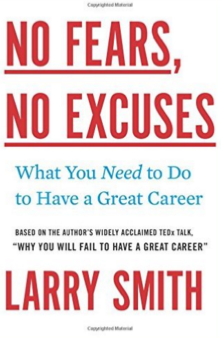
No Fears, No Excuses coverI recently read “No Fears, No Excuses: What You Need To Do To Have A Great Career” by Larry Smith. Below are the quotes I found most interesting. If you like the quotes, click here to buy the book.

(Disclosure: The publisher sent me a free, advance copy of this book. I don’t think it influenced what I found interesting, but who knows.)

“The strategy most often employed is this: Get an education. More competition? Get more education. More competition? Get some relevant experience. More competition? Get even more experience. But everyone else is adding experience at the same rate. Believing you can advance your career solely by celebrating another birthday does not seem a very sophisticated strategy for the twenty-first century.
I asked John what the flaw of this approach was. He understood that the primary problem was that almost everyone else was doing it. The only way it could work is if you outlasted everyone: Career by endurance.
“Think about the consequences,” I said. “As the situation becomes ever more competitive, you make yourself like everyone else? In what world would that make sense? You’ve essentially made yourself into a commodity, and one that’s interchangeable. And the commodity worker is bid down to the lowest price possible.” (13)

“In a competitive market, there will always be salespeople.” (18)

“This route (becoming a physician, lawyer, engineer, accountant) seems ideal to the immigrant parents who took substantial and personal risks to improve the lives of their children, who now are supposed to take no risks at all. Leaving aside the inconsistency of the approach (risk-taking parents who are surprised they raised risk-taking children), all the traditional professions are under siege by technology and global competition.” (27)

“Any particular skill set is subject to becoming obsolete with little notice.” (28)

“The only question that counts is, Have you achieved the best result? Not just a good or acceptable result. Did the investment hearn the highest reward open to you? IF not, you failed.” (33)

“Skill does matter… But it is not the starting place for the best use of talent. Passion is, and passion makes the highest skills possible.” (33)

“Relying on pure luck is an invitation to disaster. Most people will have to fight to find their way. They’ll have to earn it in a way the lucky will never fully appreciate. Indeed, for most, the path is filled with twists and turns. It’s hard. But so what? Again, the important point is that it’s worth it.” (40)

“Teachers know that the best students learn easily because they love the subject. “Easily” does not mean quickly; “easily” does not mean without frustration and errors. What it means is that these students are driven to find answers, to overcome whatever obstacle appears. They learn their subjects because they have to.” (58)

“Remember that a great career requires having impact. And to have impact in any of your passions, you must persist in one of them at a time.” (68)

“Anyone entering a competitive field – which is now almost all fields and will shortly be all fields – needs to stop just doing what all the other students and applicants are doing.” (78)

“If your passion leads you to be in a competitive field, the sooner you start thinking of a way you can stand out or distinguish yourself from the rest of the competition, the better and happier and more successful you’ll be. That doesn’t necessarily mean just being at the top of your class. It’s more about finding that perfect opportunity to apply your skills in a way that allows you to truly follow your passion.” (78)

“If all you can produce from your work is a good result, you’re not generating a competitive response. You’re no better than most everyone else. So why would you expect to get any special advantage? You have to develop an attribute beyond skill. This means you need to create solutions that are highly innovative, solutions that are found in few other places, if any.” (107)

“Unfortunately, we are no longer in an era of “good enough.” (110)

“All the other steps are in vain unless you can mount an effective marketing campaign for yourself. The good news is you don’t have to say, “I am so great! Look at me!” but instead you can say, “I have some great ideas – what do you think about these/” Because if a person or company loves your ideas, they will want you.” (125)

“Words define you to the world and to yourself.” (131)

“You are an entrepreneur. And your venture is yourself – it’s a venture that has to be defined, polished, and marketed. The truth is, successful ventures and successful careers are much closer together than you might have thought. So put your startup face on, and let’s learn how to pitch yourself.” (131)

“The goal of the pitch is to invite further dialogue, dialogue with a purpose.” (132)

“A good pitch should be 1. Short 2. Distinctive (“I do something others do not.”) 3. Expressed in a way that invites the listener to ask for more information” (133)

“The goal is to be precise about the body of work you wish to create.” (135)

“The same is true in networking/marketing sessions. THe relationship between the person advancing an idea and the person listening to the argument is tenuous. So Bart, in response to the listener’s vague expression of interest, needed first to solidify that interest, as did Violet. The best way to do that is to surprise the listener with a relevant fact, not an opinion. One of the fastest ways to impress anyone is to tell them something that’s much different from what they would have assumed. No you look interesting, not just your idea. The listener is implicitly wondering what other surprises will be revealed. Offer just one surprising fact, not a blizzard of them.” (136)

“We live in the Age of Victimization. We are all victims now. There are so many victims, in fact, it’s hard to find the oppressors.” (167)

“Harvard University helmed a study of 50,000 adults in 25 countries that showed that the daughters of working mothers had more education, were more likely to be employed and in supervisory roles, and had more robust incomes than daughters of stay-at-home mothers.” (173)

“By focusing only on your role as a parent, you have given up being a role model for your kids’ career life. The best thing to do is to lead by example, so that you are never in the situation where your child comes to talk to you about his dream job and you think, I had a dream once too, kid, but then you were born.” (174)

“A great career means that there’s not just one path available to you.” (177)

“Balance presumes that you spend your life in separate compartments labeled life and work, and you move time between them. I reject this goal. You should be trying to integrate your work and your life so each supports the other, making the whole stronger as a result.” (181)

“A great career means at the end of it and at the end of your life, you leave your mark behind. You leave your work behind to speak for you.” (187)

“IF she wanted to make a living at her passion, she needed to see herself in the context of what others would pay for her work. For many in the artistic and performing worlds, this is a radical thought.” (201)

“Just being competent, and being certified as competent, does not get you your job, which is especially true in a field where there are few openings.” (203)

“If you’re the child of an immigrant family that took great risk to leave a familiar place to resettle in a foreign land, recognize the sacrifice that your family made for your benefit. Of course, you are at liberty to point out their inconsistent position: that they want you to take no risk, even as they took a major risk.” (235)

“When your child is using his talent to its fullest, he is most likely to be both happy and successful.” (236)

Liked the quotes? Buy the book here.

“Hooked” Quotes

I recently read “Hooked: How to Build Habit-Forming Products” by Nir Eyal with Ryan Hoover. Below are the quotes I found most interesting. If you like the quotes, buy the book.

“Habits form when the brain takes a shortcut and stops actively deliberating over what to do next. The brain quickly learns to codify behaviors that provide a solution to whatever situation it encounters.” (16)

“Many entrepreneurs fall into the trap of building products that are only marginally better than existing solutions, hoping their innovation will be good enough to woo customers away from existing products. But when it comes to shaking consumers’ old habits, these naive entrepreneurs often find that better products don’t always win – especially if a large number of users have already adopted a competing product.” (23)

“John Gourville stipulates that “many innovations fail because consumers irrationally overvalue the old while companies irrationally overvalue the new.” (23)

“If you have ever grumbled at your mother when she tells you to put on a coat or felt your blood pressure rise when your boss micromanages you, you have experienced what psychologists term reactance, the hair-trigger response to threats to your autonomy.” ((121)

“To change behavior, products must ensure the users feel in control. People must want to use the service, not feel they have to.” (125)

“Businesses that leverage user effort confer higher value to their products simply because their users have put work into them. The users have invested in the products through their labor.” (138)

“The incessant need for a smoke in what was once a majority of the adult U.S. population has been replaced by a nearly equal compulsion to constantly check our electronic devices.” (175)

Liked the quotes? Click here to buy the book.

“The Song Machine” Quotes

I recently read The Song Machine: Inside The Hit Factory by John Seabrook. The quotes I found most interesting are below. If you like the quotes, click here to buy the book.

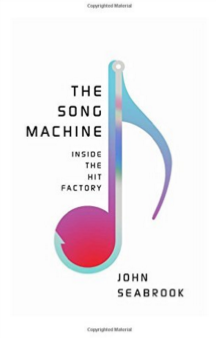
The Song Machine cover“CDs spawned a generation of record executives whose skill was in putting together compilations of existing music rather than discovering new artists.” (25)

Denniz PoP told a reporter, “It’s easy to say producing this music is equal to pushing a button in the studio. But that’s like saying writing a novel is a simple push of a button on your typewriter.” Denniz liked to say that no matter how technically adept you were at programming, sometimes you just had to “let art win.”” (32)

“Sweden had these farmers out there who were good at writing songs, but had no one to sing them. Songwriting was just a thing you did on your own when you were watching the cows, a kind of meditation. You didn’t focus as much on your ability as a performer as you did on the structure and craft of the songs. Which is really not the case in the US, where your charm and your voice and your powers as a performer come immediately into play.”” (38)

“A nation of songwriters endowed with melodic gifts, and who were meticulous about craft, but who were reluctant to perform their own songs, was a potential gold mine for a nation of wannabe pop stars who don’t write their own materials.” (38)

“Denniz once said, “It’s much more difficult to make it simple, especially achieving a simplicity without having it sound incredibly trivial.”” (39)

“Denniz put it, “A great pop song should be interesting, in some way. That means that certain people will hate it immediately and certain people will love it, but only as long as it isn’t boring and meaningless. Then it’s not a pop song any longer; then it’s something else. It’s just music.”” (39)

“Lyrics don’t need to mean anything much; the disco era had shown that. Lyrics that command too much attention are likely to kill the dancing.” (40)

“I think it was to our advantage that English was not our mother language,” Ekberg says, “because we are able to treat English very respectless, and just look for the word that sounded good with the melody.” Freed from making sense, the lyricists’ horizons are boundless.” (40)

“Cheiron studio needed an American act… not accidental stars with baggage, but lifers who would do whatever it takes to get to the top and stay there.” (46)

“At the beginning, the artists are regarded as mere hired hands by the writers and the producers, who are the real artists in the operation. But with success, the artists come to feel that they are, in fact, real artists – everything about the way they are sold to the world confirms it. They demand, at a minimum, more respect from their songwriters and producers, and they usually insist on more creative control over the songs. Some want to write their own material, often with disastrous results.” (68)

“They kept the labels’ names but little of their cool. The music business slowly changed from an art-house business run by men with ears into a corporate enterprise of quarterly earnings and timely results.” (116)

“Jimmy always says it’s all about the connection between the artist and the fans,” he says. “This whole business, it’s just about that connection.” (166)

“At the very least, that a pudgy guy with a goofy horse-riding dance (PSY’s Gangnam Style) could succeed where the most brilliantly engineered idol groups have not suggest that cultural technology can only get you so far. In the end, as Denniz PoP used to say, sometimes you have to let art win.” (167)

“Her main qualification as a singer was that she wanted to be one so badly. Rogers sensed that ambition ran deep – “I saw it in her eyes,” he says. But what was “it,” exactly? No mere girlish desire for fame; it was more likely a much more urgent need to escape from the anxieties of a violent home life into the illusion of security and boundless love that a life onstage seemed to offer. That desire, more than any inborn talent, is what fans will connect to, and that is what record men look for in a new artist. It’s the one thing they can’t manufacture.” (177)

“After appearing on several established rappers’ records, most notably Big Daddy Kane’s, Jay tried to get his own record deal, but the labels he approached, including Def Jam, turned him down. So he and his boys started their own label. They didn’t have a distribution deal; they sold their music out of the back of people’s cars in Brooklyn.” (181)

“All your instincts that make you successful, at some point in anyone’s life, those instincts will be wrong.” (235)

“Lenny Pickett says, “He has very good music skills, especially in the areas he needed to have them for producing music. Equally important, he had very good social skills, because if you don’t have those, doesn’t matter how good your tracks are, you’re going to end up being somebody’s helper.” (245)

“A fMRI study of people listening to music found that familiarity with a song reflexively causes emotional engagement; it doesn’t matter what you think of the song.” (303)

Kotecha says, “I always think in my head, if Max Martin was an American, he would have fizzled out a long time ago. He would have believed his own hype. But because he’s Swedish, he’s able to contain himself. He just focuses on being the best writer and producer and mentor he can be.” (306)

Liked the quotes? Buy the book here.

Verified by ExactMetrics