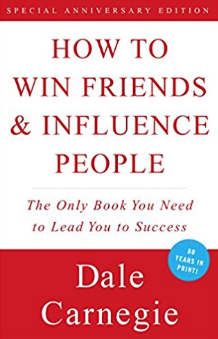
“How To Win Friends” Quotes

I recently read “How To Win Friends and Influence People” by Dale Carnegie. Below are the quotes I found most interesting. If you like them, buy the book.

“99 times out of 100, people don’t criticize themselves for anything, no matter how wrong it may be.” (32)

“Criticism is futile because it puts a person on the defensive and usually makes him strive to justify himself.” (32)

“When dealing with people, let us remember we are not dealing with creatures of logic. We are dealing with creatures of emotion, creatures bristling with prejudices and motivated by pride and vanity.” (39)

“Any fool can criticize, condemn and complain – and most fools do. But it takes character and self-control to be understanding and forgiving. “A man show his greatness,” said Carlyle, “by the way he treats little men.”” (39)

“As Dr. Johnson said: “God himself, sir, does not propose to judge man until the end of his days.” Why should you and I?” (42)

“Principle 1: Don’t criticize, condemn or complain.” (42)

“There is only one way under high heaven to get anybody to do an
Ything. Did you ever stop to think of that? Yes, just one way. And that is by making the other person want to do it.” (43)

“The desire for a feeling of importance is one of the chief distinguishing differences between mankind and the animals.” (44)

“Many people who go insane find in insanity a feeling of importance that they were unable to achieve in the world of reality.” (47)

“Schwab said, “There is nothing else that so kills the ambitions of a person as criticisms from superiors. I never criticize anyone. I believe in giving a person incentive to work. So I am anxious to praise but loath to find fault. If I like anything, I am hearty in my approbation and lavish in my praise.”” (48)

“Principle 2: Give honest and sincere appreciation.” (54)

“The only way to influence people is to talk in terms of what the other person wants.” (57)

“Before you speak, pause and ask yourself, “How can I make this person want to do it?” (58)

“Thousands of salespeople are pounding the pavements today, tired, discouraged and underpaid. Why? Because they are always thinking only of what they want. They don’t realize that neither you nor I want to buy anything. If we did, we would go out and buy it. But both of us are eternally interested in solving our problems. And if salespeople can show us how their services or merchandise will help us solve our problems, they won’t need to sell us. We’ll buy. And customers like to feel that they are buying – not being sold.” (65)

“The world is full of people who are grabbing and self-seeking. So the rare individual who unselfishly tries to serve others has an enormous advantage. He has little competition.” (66)

“Principle 3: Arouse in the other person an eager want.” (70)

“You can make more friends in two months by becoming interested in other people than you can in two years by trying to get other people interested in you.” (74)

“If the author doesn’t like people, people won’t like his or her stories.” (75)

“Every time he went on stage Thurston said to himself “I am grateful because these people come to see me. They make it possible for me to make my living in a very agreeable way. I’m going to give them the very best I possibly can.” He declared he never stepped in front of the footlights without first saying to himself over and over: “I love my audience. I love my audience.”” (76-77)

“Principle 1: Become genuinely interested in other people.” (84)

“He said I was really human when I smiled.” (88)

“Everybody in the world is seeking happiness – and there is one sure way to find it. That is by controlling your thoughts.” (89)

“Jim Farley discovered early in life that the average person is more interested in his or her own name than in all the other names on earth put together.” (93)

“Principle 3: Remember that a person’s name is to that person the sweetest and most important sound in any language.” (99)

“Principle 4: Be a good listener. Encourage others to talk about themselves.” (108)

“Principle 5: Talk in terms of the other person’s interests.” (112)

“Principle 6: Make the other person feel important – and do it sincerely.” (123)

“Nine times out of ten, an argument ends with each of the contestants more firmly convinced than ever that he is absolutely right.” (127)

“There’s magic, positive magic, in such phrases as: “I may be wrong. I frequently am. Let’s examine the facts.” (133)

“From James Harvey Robinson’s enlightening book The Mind in the Making:
“We sometimes find ourselves changing our minds without any resistance or heavy emotion, but if we are told we are wrong, we resent the imputation and harden our hearts. We are incredibly heedless in the formation of our beliefs, but find ourselves filled with an illicit passion for them when anyone proposes to rob us of their companionship. It is obviously not the ideas themselves that are dear to us, but our self-esteem which is threatened….” (135)

“Principle 2: Show respect for the other person’s opinion. Never say “You’re wrong.”” (141)

“Say about yourself all the derogatory things you know the other person is thinking or wants to say or intends to say – and say them before that person has a chance to say them.” (143)

“If you would win a man to your cause, first convince him that you are his sincere friend.” (151)

“In talking with people, don’t begin by discussing the things on which you differ. Begin by emphasizing – and keep on emphasizing – the things on which you agree.” (157)

“A magic phrase that would stop arguments, eliminate ill feeling, create good will and make the other person listen attentively: I don’t blame you one iota for feeling as you do. If I were you I would undoubtedly feel just as you do.”” (177)

“A person usually has two reasons for doing a thing: one that sounds good and a real one.” (184)

“Because he had singled out a specific accomplishment, rather than just making general flattering remarks, his praise became much more meaningful to the person to whom it was given. Everybody likes to be praised, but when praise is specific, it comes across as sincere – not something the other person may be saying just to make one feel good.” (221)

“Abilities wither under criticism; they blossom under encouragement.” (222)

Liked the quotes? Then buy the book.

“Captivate” Quotes

I recently read “Captivate: The Science of Succeeding with People” by Vanessa Van Edwards. Below are the quotes I found most interesting. If you like the quotes, buy the book here.

“First impressions are fundamental to everything else I can teach you.” (3)

“Once you join up with your colleagues, friends, or acquaintances, it is incredibly challenging to get out and meet new people. The best thing to do is wave or give your friends a quick huge when you arrive, and then say you will circle back to them. You can hang out with them as the crowd thins out, but capitalize on your fresh energy at the beginning of an event to hit the Social Zone.” (28)

“The best place to start working a room is right where people exit the bar.” (29)

“The absolute easiest thing you can do to improve your first impression is to keep your hands visible.” (42)

“Whenever possible, keep your hands above the desk in a boardroom, on the table during a coffee meeting, and out of your purse during an event.” (42)

“Power Posing” is when we raise our arms over our head, expand our chest, and tilt our head up.” (45)

“Whenever you are talking to people, use your Launch Stance:
Keep your shoulders down and back.
Aim your chin, chest, and forehead straight in front of you or slightly up.
Keep space between your arms and torso.
Make sure your hands are visible.” (46)”

“The best conversational sparks were:
What was the highlight of your day?
What personal passion project are you working on?
Have anything exciting come up in your life?” (59)

“To remember someone’s name: Repeat it back right away. Then spell it out. Tie the name to someone else you know with the same name. If it’s a unique name, tie it to a word that most closely resembles it.” (69)

“When donors are told that they are above-average givers (even if they are not), they in turn donate more to become above-average givers.” (79)

“Being a highlighter is about constantly searching for the good in people. When you tell people they are good, they become better. When you search for what’s good, you feel great.” (82)

“Being memorable is not about bringing up your high points. It’s about highlighting theirs. Don’t try to impress people, let them impress you.” (83)

“Being an amazing listener is not just about what you hear, it’s how you respond to what you hear.” (84)

“He found that his most successful messages mentioned at least three commonalities he had with the person.” (86)

“One of the biggest mistakes I see people make is inadvertently pointing out differences while trying to connect. Whenever you say a version of “Not me!” you are handicapping your connection from the start.“ (89)

“One study found we are more likely to help people who are dressed like us.” (90)

“I typically end most of my great meetings with a single question: Can I help you with anything?” (98)

“About 35 to 50 percent of your personality is wired into your genetic makeup. Your upbringing, another factor you have zero say in, also shapes you considerably.” (130)

“5 Love Languages:
Words of Affirmation: People with this love language express their care through spoken or written word – love letters, texts, and verbal expression of love.
Gifts: People with this love language express their care through small gifts or tokens of appreciation – jewelry, candy, or flowers.
Physical Touch: People with this love language express their care through touch – hugs, cuddles, pats on the back, loving embraces.
Acts of Service: People with this love language express their care by doing things for others – cooking their spouse dinner, running errands, or crafting something for them.
Quality Time: People with this love language express their care with their time. They want to simply be in the presence of the people they care about” (158)

“As a conversation starter: Have you ever heard about the 5 Love Languages? I’m reading this book about it and was curious if you had heard of them. Then you can get into a great conversation about which they think they are. I love to try to guess my friends’ and colleagues’ and have them guess mine.” (163)

“Power can be measured as the amount of resources you have to give others.” (176)

“Most people’s choice make sense to them. When they don’t make sense to you, it’s usually because you are being driven by a different primary value.” (184)

“Story telling: Start with a hook, champion a struggle, utilize provocative words.” (205)

“Always use the word “because” when asking for something.” (217)

“The best “because” benefits the listener. What’s the payoff? What’s the end result? What’s the advantage?” (217)

“Skill solicitation is when you ask people to self-identify based on capability: Is anyone good at _? Do you know anything about _? I need someone who is strong with _.” (221)

“Sharing our most vulnerable stories is a courageous act that channels intimacy with others and builds lasting relationships.” (231)

“Don’t be afraid to ask for advice, share a vulnerability, or admit a weakness, they bond you to people.” (236)

“Perfection is a strange bast. We strive to be perfect so others will like us but don’t like people who try too hard to be perfect. THe pursuit of perfection not only makes it nearly impossible to connect with people, it also makes us unattractive.” (240)

“We all have weaknesses. The right people will like you for them.” (241)

“The more a student smiled at their classmates, the more their classmates smiled back at them. This made them feel liked, which made them like that student even more.” (264)

“The key to being popular: Like more people.” (265)

Did you like the quotes? Then buy the book here.

“Steve Jobs” Quotes

I recently read “Steve Jobs” by Walter Isaacson. Below are the quotes I found most interesting. If you like the quotes, buy the book here.

“Pretend to be completely in control and people will assume that you are.” (55)

“Markkula emphasized that you should never start a company with the goal of getting rich. Your goal should be making something you believe in and making a company that will last.” (78)

“Among Xerox’s visionaries was the scientist Alan Kay, who had two great maxims that Jobs embraced: “The best way to predict the future is to invent it” and “People who are serious about software should make their own hardware.” (95)

““Jobs thought of himself as an artist, and he encouraged the design team to think of ourselves that way too,” said Hertzfeld. “The goal was never to beat the competition, or to make a lot of money. It was to do the greatest thing possible, or even a little greater.”” (123)

“”I’ve learned over the years that when you have really good people you don’t have to baby them,” Jobs later explained. “By expecting them to do great things, you can get them to do great things. The original Mac team taught me that A-plus players like to work together, and they don’t like it if you tolerate B work. Ask any member of that Mac team. They will tell you it was worth the pain.”” (124)

“The journey is the reward.” (143)

“It’s better to be a pirate than join the navy.” (144)

“You have to be ruthless if you want to build a team of A players. “It’s too easy, as a team grows, to put up with a few B players, and they then attract a few more B players, and soon you will even have some C players,” Atkinson recalled.” (181)

“If you want to live your life in a creative way, as an artist, you have to not look back too much. You have to be willing to take whatever you’ve done and whoever you were and throw them away.” (190)

“The more the outside world tries to reinforce an image of you, the harder it is to continue to be an artist, which is why a lot of times, artists have to say, “Bye. I have to go. I’m going crazy and I’m getting out of here.” And they go hibernate somewhere. Maybe later they re-emerge a little differently.” (190)

“A great company must be able to impute its values from the first impression it makes.” (220)

“When it came time to announce the price of the new machine, Jobs did what he would often do in product demonstrations: reel off the features, describe them as being “worth thousands and thousands of dollars,” and get the audience to imagine how expensive it really should be. Then he announced what he hoped would seem like a low price.” (235)

“Steve created the only lifestyle brand in the tech industry,” Larry Ellison said. “There are cars people are proud to have – Porsche, Ferrari, Prius – because what I drive says something about me. People feel the same way about an Apple product.” (332)

“If something isn’t right, you can’t just ignore it and say you’ll fix it later. That’s what other companies do.” (374)

“The older I get, the more I see how much motivations matter. The Zune was crappy because the people at Microsoft don’t really love music or art the way we do. We won because we personally love music. We made the iPod for ourselves, and when you’re doing something for yourself, or your best friend or family, you’re not going to cheese out. If you don’t love something, you’re not going to go the extra mile, work the extra weekend, challenge the status quo as much.” (407)

“One of Jobs’s business rules was to never be afraid of cannibalizing yourself. “If you don’t cannibalize yourself, someone else will.” (408)

“There’s a classic thing in business, which is the second-product syndrome,” Jobs later said. It comes from not understanding what made your first product so successful.” (430)

Liked the quotes? Buy the book here.

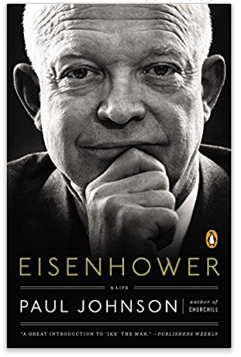
“Eisenhower: A Life” Quotes

I recently read “Eisenhower: A Life” by Paul Johnson. Below are the quotes I found most interesting. If you like the quotes, buy the book here.

“The report should have made unnecessary the subsequent investigation, marred by acrimonious disagreements between the police and the attorney general. But unfortunately, little of it was reproduced in the press. What Ike learned from this episode was the absolute necessity to keep journalists well informed and friendly, and the lesson was one he applied with outstanding success throughout his public career.” (14)

“MacArthur would dismiss Ike as “the apotheosis of mediocrity” and “a highly literate nincompoop.” (17)

“He was offensive minded, and he always concentrated on the opportunities rather than the difficulties in any given situation.” (20)

“His formula was simple: careful, conservative dress, uniform freshly pressed. Always stand erect. Square your shoulders. Hold your head high. Speak bluntly but clearly. Use homely expressions. Look the camera straight in the eye.” (29)

“Jim Hagerty, Ike’s press secretary at the White House, said that “Being President Eisenhower’s press secretary was as easy and likeable a job as you could possibly imagine.” He made things cozy. At his very first press conference, he told the reporters: “You are quasi members of my staff. Part of the team.” (29)

“Ike went on the record with this definition of an intellectual: “A man who takes more words than is necessary to tell more than he knows.” (66)

“The United States at midcentury was unarguably the most powerful nation on earth. It was the largest petroleum producer in the world and supplied more oil than the rest of the world’s nations together. It harvested one third of the world’s grain and half its cotton. It was the world’s largest producer of phosphates, iron ore, zinc, lead, copper, salt and precious metals, including uranium. It had 90 percent of the world’s natural gas production… Almost half of the world’s manufactured goods came from the United States.” (77)

“Ike did not exactly choose to mislead people about his abilities, but when they underrated him, he certainly made no attempt, as a rule, to correct their impression. He seems to have found it convenient and useful for people to get him wrong. He chuckled within himself.” (82)

“Ike recorded in his diary: “No one should be appointed to political office if he is a seeker after it.”” (93)

“Ike consistently misled the press not so much on specific matters but in giving a general impression that he worked much less than he did. He felt that if he made reporters believe he spent as much time as possible on the golf course, they would not push him too hard on particular issues and would et him get away with vagueness.” (95)

“Things are often unsure. “Deliberate ambiguity and deception” were the key. He wanted as many options as possible all the time, and he got them.” (103)

“Ike summed up: America is a rich country. Provided we can avoid war, keep tension low, and avoid absurdly high defense budgets, we will prosper, sure enough.” (108)

“Ike was not color conscious. He was not exactly color-blind either. He tended to take the view that acute color problems usually grew out of wide disparities of wealth and that rising prosperity would reduce them to a tolerable level. His job, as president, was to keep the wealth flowing, to ensure that it was widely distributed and that Americans sw the system as, broadly speaking, “fair.” (118)

“He thought the United States was known in the world for its military strength rather than its uniqueness as a democratic haven of freedom. The military strength, and imprudent leadership, could lead the country into interventions all over the world, encouraged by the arms lobby and the military chiefs who were its puppets, and the result would be an overextension of resources and economic ruin.” (120)

“Ike said that someone had to defend the economy as a whole because “it is the nature of our government that everyone, except for a thin layer at the top, is working knowingly or unknowingly, to damage our economy, the reason being that they see the need for more and more resources for their own service or agency, and the valuable results that can be achieved through added effort in their own particular element.” (122)

Liked the quotes? Click here to buy the book.

“God’s Debris” Quotes

I recently read “God’s Debris: A Thought Experiment” by Scott Adams. Below are the quotes I found most interesting. If you like the quotes, consider buying the book here.

“Every generation of humans believed it had all the answers it needed, except for a few mysteries they assumed would be solved at any moment. And they all believed their ancestors were simplistic and deluded. What are the odds that you are the first generation of humans who will understand reality?” (21)

“Four billion people say they believe in God, but few genuinely believe. If people believed in God, they would live every minute of their lives in support of that belief. Rich people would give their wealth to the needy. Everyone would be frantic to determine which religion was the true one.” (27)

“It is not belief to say God exists and then continue sinning and hoarding your wealth while innocent people die of starvation. When belief does not control your most important decisions, it is not belief in the underlying reality, it is belief in the the usefulness of believing.” (29)

“People claim to believe in God, but most don’t literally believe. They only act as though tye believe because there are earthly benefits in doing so.” (29)

“The best any human can do is to pick a delusion that helps him get through the day.” (29)

“It is beyond the human brain to understand the world and its environment, so the brain compensates by creating simplified illusions that act as a replacement for understanding. When the illusions work well and the human who subscribes to the illusion survives, those illusions are passed to new generations.” (34)

“I can conceive of only one challenge for an omnipotent being – the challenge of destroying himself.” (42)

“Are you saying we’re evolving into God?”
“I’m saying we’re the building blocks of God, in the early stages of reassembling.”
“I think I’d know it if we were part of an omnipotent being,” I said.
“Would you? Your skin cells are not aware that they are part of a human being. Skin cells are not equipped for that knowledge. They are equipped to do what they do and nothing more. Likewise, if we humans – and all the plants and animals and dirt and rocks – were components of God, would we have the capacity to know it?” (53)

“Luck conforms to normal probability curves. Most people will have average luck and some people will experience extra good luck or extra bad luck. A handful will have good luck so extraordinary that it will be indistinguishable from magic.” (76)

“We like to believe that other people have the same level of urges as we do, despite all evidence to the contrary. We convince ourselves that people differ only in their degree of morality or willpower, or a combination of the two. But urges are real, and they differ wildly for every individual. Morality and willpower are illusions. For any human being, the highest urge always wins and willpower never enters into it. Willpower is a delusion.” (94)

“Women believe that men are, in a sense, defection versions of women. Men believe that women are defective versions of men. Both genders are trapped in a delusion that their personal viewpoints are universal. That viewpoint – that each gender is a defective version of the other – is the root of all misunderstandings.” (110)

“Women define themselves by their relationships and men define themselves by whom they are helping. Women believe value is created by sacrifice. If you are willing to give up your favorite activities to be with her, she will trust you.” (110)

“Men believe value is created by accomplishment, and they have objectives for the women in their lives. If a woman meets the objectives, he assumes she loves him.” (111)

“The best you can hope for in a relationship is to find someone whose flaws are the sort you don’t mind. It is futile to look for someone who has no flaws, or someone who is capable of significant change; that sort of person only exists in our imaginations.” (112)

“A woman needs to be told that you would sacrifice anything for her. A man needs to be told he is being useful. When the man or woman strays from that formula, the other loses trust. When trust is lost, communication falls apart.” (112)

“You should lie about your talents and accomplishments, describing your victories in dismissive terms as if they were the result of luck. And you should exaggerate your flaws.” (113)

“Your problem is that you view conversation as a way to exchange information… conversation is more than the sum of the words. It is also a way of signaling the importance of another person by showing your willingness to give that person your rarest resource: time. It is a way of conveying respect. Conversation reminds us that we are part of a great whole, connected in some way that transcend duty or bloodline or commerce. Conversation can be many things, but it can never be useless.” (113-114)

“Don’t judge people by their mistakes; rather, judge them by how they respond to their mistakes.” (114)

“People who do affirmations will have the sensation that they are causing the environment to conform to their will. This is an immensely enjoyable feeling because the illusion of control is one of the best illusions you can have.” (119)

“Not all leaders are irrational,” I argued.
“The most effective ones are. You don’t often see math geniuses or logic professors become great leaders. Logic is a detriment to leadership.” (127)

Liked the quotes? Buy the book here.
Verified by ExactMetrics