
“This Is How Your Marriage Ends” Quotes

I recently read “This Is How Your Marriage Ends: A Hopeful Approach To Saving Relationships” by Matthew Fray. Below are the quotes I found most interesting. If you like them, buy the book here.
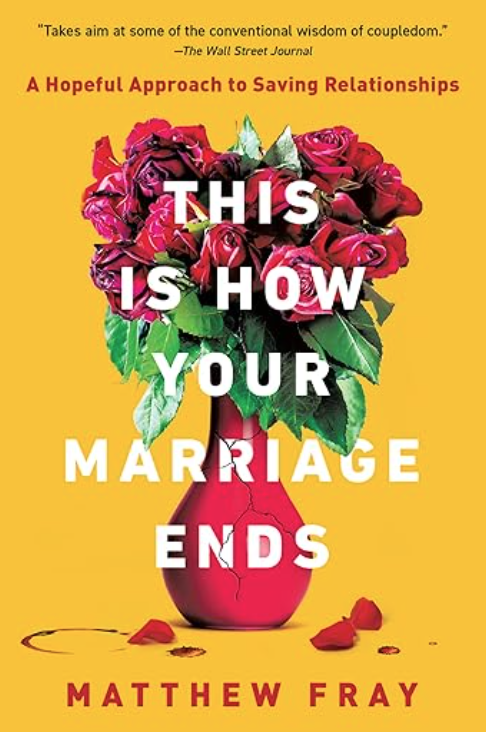
“My overarching premise is that good people who want to be married accidentally hurt one another and betray each other’s trust without either partner being aware of it as it is happening until their marriage slowly becomes toxic and/or ends.” (8)

“His wife is always overreacting, he said. It’s as if he can never predict the next thing that will upset her.” (12)

“No good deed is ever enough. No sacrifice I make proves my commitment. No amount of love nor any kindness I feel or display is ever acknowledged.” (13)

“I hadn’t changed. She had. And it didn’t seem fair that she had “roped me into marriage” under the pretense that we were great for one another and loved each other as we were, but years later, I was no longer good enough.” (13)

“I can’t live like this, they say. It’s so unfair that I’m always made out to be the bad guy and that nothing I do is ever good enough.” (16)

“Yet, no matter how hard they try to explain themselves to one another, nothing seems to get better. The hurt keeps growing slowly in intensity as frustration mounts and resentment grows.” (16)

“We enter marriage totally unaware that unpleasant preexisting conditions in our dating relationships that we calculate to be tolerable or something that might dissipate in time will often metastasize in marriage and eventually kill whatever we used to be.” (20)

“We are set up to fail in our most critical, foundational human relationships.” (21)

“In the United States alone, there are about 6,200 marriages per day. The inverse is that there re about 3,000 divorces per day.” (24)

“Holy shit. Feelings can HURT, I thought. And if feelings can hurt this much, and this is how my wife was feeling, and every time she tried to help me understand her pain I responded as if she was dumb, weak, or crazy, all while refusing to adjust any of my behaviors-doesn’t it make sense that she wanted to end our marriage? If I were in her position and were experiencing that same level of pain while not receiving any support or concern from her regarding my suffering, wouldn’t I have made the same choice that she did?” (33)

“Hundreds, maybe thousands of times, my wife tried to communicate that something was wrong. That something hurt.
But that doesn’t make sense. I’m not trying to hurt her; therefore, she shouldn’t feel hurt.
We didn’t go down in a fiery explosion. We bled out from 10,000 paper cuts.” (35)

“Spouses who frequently, if not always, remember to consider each other in your decision-making each day are the kind of people who trust one another and who trust that their marriage will go the distance.” (36)

“marriage is essentially the equivalent of everyone we invite to our wedding being on the same jumbo plane with us and bidding us farewell as we parachute onto some island that we think we understand but actually know next to nothing about.” (37)

“Imagine being in culinary school and whipping together a shitty omelet with runny eggs, rotting vegetables, doused in rancid vinegar, and then protesting your cooking instructor hating the food you made on the basis that you’re a well-liked person who supports local charities.
That must have been how I sounded to my wife.” (41)

“She felt unloved, she said. Uhhh. But I literally love you more than anyone. Can’t you tell by the fact that I married you and give everything I have to you and exchanged my previous fun, single life to spend the rest of my life with you? Imagine being this ungrateful and tone-deaf. Dudes are out there hitting their wives, sleeping with their co-workers, committing crimes, staying out all night drinking, etc., and I’m not a good husband?!
I don’t do all of these horrible things that bad men do-that bad husbands do! Why is she always complaining about the negative things I do without ever acknowledging any of the positives?” (42)

“While I explained how I was so smart and righteous to do whatever I had done, my wife was hearing me more or less promise that, in all similar future scenarios, her pain-her feelings of being loved, respected, cared for-would not matter as much to me as whatever super-smart and logical calculation I had made.
My wife, over and over again, heard me promise to hurt her again in the future. I thought I was intelligently sharing a different way to think about it so that my wife could adjust her silly feelings so she wouldn’t be inconvenienced by them.
I don’t need to change because I’m a good person who didn’t do anything wrong. SHE needs to change because it isn’t fair that she’s making her emotions MY responsibility!” (48-49)

“Good people telling the truth as they see it. Do you see the problem? THAT is how marriages get destroyed.” (49)

“There is only one reason I will ever stop leaving that glass by the sink, and it’s a lesson I learned much too late: because I love and respect my partner, and it really matters to them.” (54)

“I needed to understand what was important to her and what was not important to her. And then demonstrate respect for things on her This Is Important to Me list.” (55)

“me loving my wife in my brain and feeling love for my wife in my chest wasn’t nearly as important as conveying that idea through acts of love.” (55)

“We don’t think it’s fair that our partner’s preferences should always win out over ours.” (56)

“I’m grateful for another opportunity to demonstrate to my wife that she comes first and that I can be counted on to be there for her and that she needn’t look elsewhere for happiness and fulfillment.” (58)

“She hated it and asked me not to. I treated her as if she were wrong or crazy for always needing her preferences to win over mine.” (59)

“Maslow called this craving for the approval of others the Lower form of Esteem. Leveraging others’ opinions as evidence that we are good enough. Checks out.
He called it the Lower form of Esteem because we can never legitimately feel respected and accepted until we decide to respect and accept ourselves. Self-respect, Maslow said, is the Higher form of Esteem.” (67)

“Poor self-esteem can result in us interpreting our partner’s actions in the most negative terms possible because we subconsciously question whether we’re worthy of their love. This condition results in feelings of anxiety and the expectation of rejection, the result of which is us interpreting neutral or benign actions as rejecting or “mean.”” (67)

“Some people, for many reasons, live entire lives without feeling loved, without respecting themselves, and never really feeling safe or comfortable in their own skin.” (68)

“And the simple truth is this: When we are obstacles to our partners’ pursuit of their own needs, or when we neglect to fulfill any needs that fall to us as their partners, we are complicit in their decisions to pursue those needs elsewhere.” (68)

“This is the result of unmet needs further down the pyramid. Expensive gifts, flirty texts, and earnest efforts to contribute more around the house do not feel like thoughtful acts of love and intimacy when they are coming from the same person who triggers feelings of mistrust and a lack of safety.” (70)

“I figured I don’t cheat, I don’t physically abuse, I don’t gamble away our living-expense money, I’m not an addict, and I’m not a threat to abandon her or our children. I’m trustworthy!
But that is not the equation for Trust. The equation is: Safety + Belonging + Mattering = TRUST” (71)

“For the rest of the conversation, neither person is talking about the same thing.” (74)

“In a conversation with my wife about the dish by the sink, I would think, “What kind of insane person would want to have a horrible fight and ruin our night and make our marriage out to be a train wreck over something as insignificant as laundry or a dirty dish? I am never this irrational! If she thinks laundry and dishes are more important than our marriage, her priorities are warped, and she must not love me.
And my wife, much like Tara’s partner, would think, “I cannot trust this man. I can’t count on him. He does NOT respect me. He never apologizes for hurting me because he doesn’t think it’s a big deal. He always tells me how what I think and feel is wrong or dumb. I have all these feelings and I know I’m not crazy, but he NEVER acknowledges them as important or worth his attention. He thinks proving’ his point and winning our arguments are more important than my feelings. He doesn’t care. He must not love me.” (74-75)

“Our parents never told us otherwise, probably because they didn’t want us to know how many times they almost divorced or wanted to have sex with someone else.” (76)

“My wife communicated pain and frustration over the frequent reminders she encountered that told her over and over and over again just how little she was considered when I made decisions.” (77)

“Feelings matter whether or not we want them to. This was an unpopular idea with the twentysomething version of me.
How I feel today is not necessarily how I will feel tomorrow. Sometimes I feel angry about someone or something, but after a good night’s sleep that often goes away. Sometimes I feel like being alone but other times I want to be with people. Sometimes I feel like listening to rap and other times I feel like listening to guitar rock. Because feelings are ever-changing, they can’t be what I use to guide my decisions. I’m going to be bigger and better and stronger than that!
But then we wake up as adults and, sooner or later, must face the
truth—our feelings matter. They do.” (81)

“Most of our relationship problems are not logical problems. They are emotional ones.” (82)

“The more common version of thi story involves one of us trying to convince our partner that they’re overreacting – that whatever transpired SHOULDN’T be a big deal to them. That if they realize how insignificant the incident/comment/interaction/conversation was, or how silly the fight is, then they can stop feeling bad about it. No one’s upset anymore! Problem solved!
That’s what I did. I tried to make my wife feel better by explaining my feelings, believing I guess that she might adopt my version of events, thereby relieving her of the inconvenient pain, anger, or sadness she was feeling.” (87-88)

“I spent years defending myself against my wife’s grievances by imploring her to grant me more patience and forgiveness on account of me loving her and having her best interests at heart.
And so instead of validating her pain and seeking to understand it more fully, I’d pivot the conversation to how unfairly she was treating me. It’s because I was really bad at husband-ing.
But imagine if she KNEW that I wasn’t hurting her intentionally?
The way she knew her infant son wasn’t trying to sabotage a peaceful night of sleep when he woke up crying.”

“If you value your relationship with someone, it will be helpful to come to terms with this truth. When we love people, we must honor THEIR experiences-THEIR reality-to connect with them on an emotionally healthy level.” (107)

“let’s pretend we generally feel comfortable in 65 degrees but know that our partner feels cold in the same air temperature.
This is about acknowledging your partner’s experience in 65 degrees with thoughtful action rather than invalidating it with a sales pitch about how she or he is wrong to feel uncomfortable since it’s an obviously comfortable temperature given your individual feelings about it.” (114)

“Could it be that what our loved ones actually crave is to be considered in our decision-making? To be worthy, in our minds and hearts, of always being important enough to include in our calculations-no matter how deceptively minor or inconsequential we might believe these calculations to be?” (115)

“My marriage fights mostly consisted of me invalidating my wifes complaints under the premise that I considered them petty or unwor-thy. I treated her arguments as illogical. And because, in my mind, her arguments lacked logic and reason, I categorized them as wrong.
I was right. She was wrong. And since I believed that, she was the real rabble-rouser in the marriage and nothing was ever my fault.” (116)

“When we’re in it-fighting with our spouses and feeling betrayed because they don’t seem to be loving us as they promised to on our wedding day—we sometimes feel like they’re deliberately causing us harm.
And that hurts more than the thing they’re doing. That feeling that they would WANT to hurt us. That’s what hurts the most.” (118)

“Until your partner demonstrates beyond doubt that they can articulate accurately your point of view, you can safely conclude that THEY DON’T KNOW HOW YOU REALLY FEEL. The significance of that can’t be overstated.” (119)

“Everyone has a different list of things that can hurt them. Our pains are not universal, just as our level of comfort in 65-degree air is going to vary from person to person.
When we don’t know our spouses—when we’re not experts about who they are, what harms them, and what brings them pleasure or joy-then we are a constant threat to hurt them regardless of how much love we feel for them and regardless of our intentions.” (121)

“A marriage destined to fail and one that will last fifty-plus years will look and sound the same to other couples at the party or dinner table.” (125)

“Two common occurrences are responsible for destroying trust in our relationships:

  1. An event or situation in which one or both partners feel hurt by the other, and
  2. The conversation we have about that hurtful event or situation.
    The event is one thing, but the conversation is usually where shit hits the fan. And after that happens enough times, people often want to divorce because of how badly they hurt.” (126)

“Constantly and most of the time unconsciously, we invalidate the lived experiences of the people we love. With great con-viction, we tell them to their faces that their thoughts and beliefs are wrong. We tell them that their feelings are wrong. And we tell them that their treatment of us is wrong-that it’s unfair.” (127)

“Underneath all the specifics is a simple and difficult truth: I didn’t remember to actively love my spouse.” (134)

“When I judged my wife’s thoughts-her opinion or interpretation about something that happened-to be “correct,” I was loving and supportive.
When I judged her thoughts to be Less Than somehow, I contradicted her. Invalidation. I didn’t mean it this way, but my wife must have heard “No, you dumb, silly person! Your brain isn’t working correctly! Here’s the smart-person way to think about this.” (138)

“I don’t believe it’s morally reprehensible to disagree with someone, which they may experience as invalidation. I don’t think it’s “evil,” or even “bad.”
What I do think is that it erodes trust. Every time. And after enough trust erosion, marriage breaks. Any meaningful relationship will break.” (139)

“I needed to learn how to care that whomever I’m speaking with is suffering in some way and how to respond to them in a way they would experience as understanding and supportive. I needed to learn how to care about that rather than running the situation through my personal litmus tests. SHOULD this person feel that way? SHOULD they believe this? Isn’t that weak or silly or unhealthy or wrong?” (140)

“We need to replace this habit of judgment with something else. Curiosity. Empathy. Encouragement. Anything but judgment.” (141)

“Screw being right. It’s bullshit. I mean, knock yourself out if winning these little knowledge battles with others gives your life meaning and completeness, but once I saw this toxic pattern I seemed forever stuck in, I committed to trying to abandon this habit of wanting to be right.” (144)

“it’s up to me to have the awareness and discipline to choose to show up in that way, even when I believe someone else might be mistaken or that they are feeling emotions that don’t quite make sense to me as they’re happening.” (147)

“But when I think about my behavior-and others’ behavior-not as some genetic fatal flaw I’m stuck with but as a habit I can practice changing to something positive and healthy, I find my sense of direction. A North Star.” (148)

“And this is one of the most important realizations I’ve ever had: So long as I process everything my wife is doing and saying through the filter of MY thoughts and MY feelings, then I’m always going to have reason to defend myself.” (151)

“I never really had a chance to restore or maintain trust with my wife because I NEVER set aside my own thoughts and feelings to try to experience the moment as she was. I never considered HER as the protagonist in the story. I never wondered What if I’m the villain here?” (152)

“You’re deciding whether another person’s mental and emotional experiences are valid, and I hope you’ll consider the inherent disrespect and self-absorption involved in that-determining that everything we think and feel is superior and more important than others’ thoughts and feelings.” (154)

“instead of judging someone else’s experience to be wrong and trying to convince them of my mental and emotional superiority, I will try to understand all of the ways in which it makes perfect sense for them to feel as they do.” (156)

“I can care that someone who matters to me is experiencing something they perceive to be bad or painful or terrifying, and I can choose to express some empathy and remorse that they feel bad somehow, and then I can do the work of learning WHY a particular event or a particular statement triggered the negative emotion.” (157)

“I can always choose the quality of the relationship over my individual thoughts and feelings. And doing so is the difference between having relationships with trust and emotional intimacy and relationships without.” (158)

“If my wife has a high-pressure business presentation coming up next Friday, is fighting a cold, and is grieving the loss of her grandmother with whom she had a really close relationship, then maybe the most effective way to communicate my love and support for my spouse is to make sure the kids, family pets, and-ESPECIALLY-me are not taxing her mental and emotional energy beyond their limits.” (159)

“I can talk with her. I can let her know that I see how much she’s carrying-that I’m tuned in, connected, aware-and that I have her back.” (159)

“Attacking a well-intentioned person’s character—or NOT taking care to word things in ways that communicate to someone else that we don’t believe them to be bad people hurting us on purpose—is a sure-fire way to generate a defensive response.
And defensive responses invalidate. And invalidation always erodes trust. And trust erosion always leads to shitty relationships. And shitty relationships beget divorce and sad kids and future shitty relationships.” (161)

“How to Compose a Successful Critical Commentary

  1. You should attempt to re-express your target’s position so clearly, vividly, and fairly that your target says, “Thanks, I wish I’d thought of putting it that way.”
  2. You should list any points of agreement (especially if they are not matters of general or widespread agreement.
  3. You should mention anything you have learned from your target.
  4. Only then are you permitted to say so much as a word of rebuttal or criticism.” (164)

“One of the tools she or my brother-in-law use when they feel their temperatures rising during an argument is to leverage their mutual love of music and endearing immaturity to signal a peace treaty to the other in the middle of the conversation.” (165)

“And since a body in motion continues to move at a constant velocity unless acted upon by an external force, two people doing nothing AREN’T sitting still. They’re drifting apart at a constant velocity until someone does something about it.
We are always either moving toward each other or away from each other.” (169)

“I don’t like the word “blame” I don’t believe relationship conflict is the result of people doing bad things. I believe relationship conflict is the result of people failing to understand and accurately calculate for how their partner will experience something they say or do (or fail to say or do).” (175)

“”But Matt! What about the kids?! Shouldn’t they always come first?!” Nope. They shouldn’t. And, as a father who loves his son more than anything else on this planet, I struggle writing those words. It twists my insides a little. That’s usually how I know something is true-when it feels uncomfortable and inconvenient.
Prioritizing anyone or anything over your wife or husband is the most surefire way I know to destroy your family.” (176)

“When we teach our children that they are the most important things in life and that if they want our attention they will always get it and that if they want or need something we always drop everything we’re doing so that it is magically done for them and that the marriage between Mom and Dad isn’t the top priority, what happens?
Bad news: You end up getting someone like me. (Sorry, Mom.)
You raise kids who grow up believing they’re uniquely special even though they’re not. You raise kids who lack self-sufficiency as well as self-awareness and who grow up expecting their partners to do things for them that their parents used to, but then also get mad at their partners anytime they feel as if they are being treated like a kid.” (177)

“When we don’t prioritize the relationship between Mom and Dad, we inadvertently raise kids who have no idea what a loving, high-functioning, healthy, mutually respectful marriage looks like.” (177)

“I was happy. I felt good. People liked me. I had friends. My life was amazing. And I gave up virtually all of it and promised you forever, and all you do is treat me like a failure every day.” (184)

“We’ve created billions of very decent human beings who unknowingly walk around every day trying their God’s-honest best but are accidentally napalming their homes and closest relationships.” (188)

“2. Husbands Who Are Good Men. All good men who are married fall into one of two camps.

GOOD HUSBANDS. A good husband performs the duties of marriage with skill and competence. His success is usually most apparent to his wife, who feels loved and secure most days of her life and who loves and respects him in ways she’s only ever felt for her children and her very closest family members. He is often appreciated by his in-laws, admired by his friends and neighbors, secretly or not-so-secretly wanted by women who covet the things he provides his wife and family in their own lives, and has very little conflict-related drama or life stresses at home with his wife and family.

BAD HUSBANDS. A bad husband is shitty at marriage. No matter how GOOD of a human being he is, he sucks at the complexities of human relationships. (Note: This puts him in the 95 percent of everyone who at times struggles with the complexities of human relationships. This does not make him stupid or incompetent or unfit necessarily for anything good men are suited for. It just makes him bad at marriage. Throughout human history, good men have been bad at many things, like singing and dancing or constructing high-rise buildings or playing the piano or carving ice sculptures or solving advanced mathematics.)


  1. Good Men Who Are Shitty Husbands. All good men who are bad husbands fall into one of two camps.
    
MEN WHO DON’T KNOW THEY ARE BAD HUSBANDS. Either these men don’t know they’re bad husbands because they don’t know what shitty husband-ing is and/or no one has ever taught him that he’s one OR anytime someone (usually his wife) says that he is, he doesn’t actually believe it. (Note: I believe, of all married men in existence, the VAST majority-I’m talking 85-ish percent-fall into this category.)
    
MEN WHO KNOW THEY ARE BAD HUSBANDS BUT WANT TO BE GOOD. This is a very bad spot to be in because, to arrive here, one usually has to have a miserable, failing marriage wreaking so much emotional havoc, stress, and anxiety in our home lives that we FINALLY decide to ask ourselves the right question: What can I do to help fix this?” (196)

“REALIZATION #1
Wow. Our problems are so common that generic, made-up stories in a self-help book totally NAIL my marriage. These exact same marriage problems are affecting almost everybody.

REALIZATION #2
If these relationship problems are this common, that means my wife and I aren’t somehow fatally flawed. We’re not NOT soul mates or freaks unfit for marriage. These problems are practically universal and we don’t have to feel ashamed for having them.

REALIZATION #3
If nearly all marriages suffer these common problems, then that means it’s foolish to get divorced with the intention of replacing your spouse with someone else. Because these same problems will ALSO exist with that other person. If my wife and I love each other, our son, and both generally prefer marriage to being single, the most logical course is to work hard on this marriage rather than trying to start new relationships as middle-aged, divorced, single parents only to inevitably have to work hard on THAT relationship, but with the added suck of all the family and friends breakage and losing so much time with our children.” (198)

“Is it really fair to ask me to adjust everything I do, think, feel, and say simply because it hurts my wife’s incorrect feelings when all she has to do is realize her mistake and simply STOP feeling bad about silly things?
After writing about marriage and divorce for several years, I’ve come to believe that the above sentiment is among the top marriage killers in the world. It’s an invisible, quiet belief that triggers the Invalidation Triple Threat response pattern, regardless of gender.” (204)

“I loved my wife. But I didn’t RESPECT her individual experiences as being equally valid to mine.” (205)

“A healthy sexual relationship pis a pillar on which lasting marriages are built.” (216)

“I was dishonest with my wife about sex-related things in our mar-riage. I was, in general, uncomfortable discussing sex audibly in conver-sation. But I was mostly afraid of disclosing everything that I thought and felt and feared and fantasized and wanted or didn’t want.” (245)

“I only know what I thought and felt, but what adulthood has taught me is that when you think and feel something, you tend to discover that millions of other people think and feel those things too.” (247)

“COMPATIBILITY IN DATING AND MARRIAGE ISN’T HOW ALIKE WE ARE
COM•PAT•I•BIL-I•TY-noun-1. a state in which two things are able to exist or occur together without problem or conflict 2. a feeling of sympathy and friendship; like-mindedness.” (268)

“I often ask the people I coach to take the personality test an additional time but, that second time, answering the questions as they believe their partner would.
I love the insights and conversations that naturally occur when we discover the gaps between what we believe about someone else (or ourselves) and what’s actually real. The majority of conflict that exists between two romantic partners lies in that gap between what we think we know and the truth.” (272)

“Ted Hudson, a researcher at the University of Texas, conducted a longitudinal study on romantic compatibility in couples who had been married for several years.
“My research shows that there is no difference in the objective compatibility between those couples who are unhappy and those who are happy,” Hudson wrote.
Couples who feel content and positivity within their relationships said that compatibility wasn’t an issue for them. The happy couples in Hudson’s study said it was their own willful behavior that made the relationship successful—not personality compatibility.
When the unhappy couples in the study were asked about compatibility, they all said that compatibility was extremely important to having a successful marriage. And in the midst of their failing marriages, they didn’t believe they were compatible with their partners.
When the unhappy couples said, “We’re incompatible,” what they actually meant was “We don’t get along very well,” Hudson wrote.” (274)

“She wants to talk about it. It makes her feel better.
He doesn’t want to talk about it. It makes him feel worse.
Are they incompatible?
Or.
Does being compatible really mean that she fundamentally understands how stressful and difficult conversations that may be cathartic for her can feel difficult and damaging for him, and then approaches conversations with him with that in mind?
And does being compatible really mean that he fundamentally understands that listening to what she has to say, even if it’s inconvenient or a little bit frustrating for him, will strengthen the intimate bond between them, so he’s going to make whatever concessions are necessary to achieve that?” (275)

“Love them for who they are, not for what they do for you.” (276)

“Why is she trying to make me responsible for her emotions? I’d wonder. This is absolute bullshit.” (279)

“People with poor boundaries typically come in two flavors: those who take too much responsibility for the emotions/actions of others, and those who expect others to take too much responsibility for their own emotions/actions,” Mark Manson writes.” (285)

Liked the quotes? Buy the full book here.

“Slow Productivity” Quotes

I recently read “Slow Productivity: The Lost Art of Accomplishment Without Burnout” by Cal Newport. Below are the quotes I found most interesting. If you like them, buy the book here.

“The details of CBS’s turnaround provide a useful contrast berween / differing conceptions of productivity. Moonves tried to save his network by pushing his employees to work more. What ended up mattering, however, was instead the obsessive efforts of an eccentric creative talent who spent over three years nurturing a vision, coming at it again and again in an attempt to create something special… It should be noted, of course, that the eventual realization of Zuiker’s creative efforts also required the bold support of CBS executive Nina Tassler. This massive contribution from Tassler had little to do with working late or demonstrating busyness. It was instead much more about the application of creative instincts forged through long experience. These are the types of actions that ultimately make the difference in breakout success, not dramatic demonstrations of work ethic.” (28-29)

“Slow Productivity is a philosophy for organizing knowledge work efforts in a sustainable and meaningful manner, based on the following three principles:

  1. Do fewer things.
  2. Work at a natural pace.
  3. Obsess over quality.” (41)

“Strive to reduce your obligations to the point where you can easily imagine accomplishing them with time to spare. Leverage this reduced load to more fully embrace and advance the small number of projects that matter most.” (53)

“When you agree to a new commitment, it brings a certain amount of ongoing administrative overhead: back-and-forth email threads needed to gather information, for example, or meetings scheduled to synchronize with your collaborators. This overhead tax activates as soon as you take on a new responsibility. As your to-do list grows, so does the total amount of overhead tax you’re paying. Because the number of hours in the day is fixed, these administrative chores will take more and more time away from your core work, slowing down the rate at which these objectives are accomplished. At moderate workloads, this effect might be frustrating: a general sense that completing your work is taking longer than it should. As your workload increases, however, the overhead tax you’re paying will eventually pass a tipping point, beyond which logistical efforts will devour so much of your schedule that you cannot complete old tasks fast enough to keep up with the new.” (56)

“Most workers who are fortunate enough to exert some control over their efforts-such as knowledge workers, small-business entrepreneurs, or freelancers-tend to avoid taking on so much work that they crash and burn, but also tend to avoid working a reasonable amount. They exist at that point of maximum sustainable overhead tax that seems to represent the worst of all configurations, as it maintains the pain of having too much to do, but keeps this pain just manageable enough to avoid reform.” (61)

“There’s a calibrated steadiness to working on just one major initiative a day. Real progress accrues, while anxiety is subdued.” (76)

“taming the impact of small details in your professional life opens up space to pursue bigger goals.” (80)

“Small tasks, in sufficient quantity, can act like productivity termites, destabilizing the whole foundation of what you’re trying to build. It’s worth going to great lengths to tame them.” (82)

“The general goal for this proposition is to help you avoid working at a constant state of anxious high energy, with little change, throughout the entire year. Summering at Lake George can disrupt this unnatural rhythm, but so can taking off a random weekday once or twice a month. I call these latter, more modest efforts small seasonality.” (147)

“Don’t schedule appointments on Mondays.” (147)

“There’s something about entering a movie theater on a weekday afternoon that resets your mind. The context is so novel – “most people are at work right now!” – that it shakes you loose form your standard state of anxious reactivity.” (148)

“As your calendar continues to fill during busy periods, a sense of mild despair can arise. How will I ever get this all done? A clever way to balance this stress is to pair each major work project with a corresponding rest project. The idea is simple: after putting aside time on your calendar for a major work project, schedule in the days or weeks immediately following it time to pursue something leisurely and unrelated to your work.” (149)

“The key is to obtain a proportional balance. Hard leads to fun. The more hardness you face, the more fun you will enjoy soon after.” (149)

“When seeking out where you work, be wary of the overly familiar.” (160)

“Obsess over the quality of what you produce, even if this means missing opportunities in the short term. Leverage the value of these results to gain more and more freedom in your efforts over the long term.” (173)

“Doing fewer things and working at a natural pace are both absolutely necessary components of this philosophy, but if those earlier principles are implemented on their own, without an accompanying obsession with quality, they might serve only to fray your relationship to work over time— casting your professional efforts as an imposition that you must tame.” (174)

“A little quality work every day will produce more and more satisfying results than frantic work piled on top of frantic work.” (177)

“Obsession requires you to get lost in your head, convinced that you can do just a little bit better given some more time. Greatness requires the ability to subsequently pull yourself out of your self-critical reverie before it’s too late.” (198)

“Give yourself enough time to produce something great, but not unlimited time. Focus on creating something good enough to catch the attention of those whose taste you care about, but relieve yourself of the need to forge a masterpiece. Progress is what matters. Not perfection.” (199)

“As Ballard later recalled about working with Morissette:
She just wanted to be an artist. She didn’t want the system to tell her they “didn’t need her anymore.” She just wanted to say what she felt…. She just wanted to write songs and express herself.” (200)

“These authors demonstrate one of the more approachable strategies for betting on yourself: temporarily dedicating significant amounts of free time to the project in question.” (204)

“It’s in these details that we find a balanced strategy. Don’t haphazardly quit your job to pursue a more meaningful project. Wait instead to make a major change until you have concrete evidence that your new interest satisfies the following two properties: first, people are willing to give you money for it, and second, you can replicate the result.” (207)

“But the fancy cameras alone don’t explain the movie’s success. The pressure and drive to satisfy Akkad, who had invested serious money in the project, helped push Carpenter’s craftsmanship to new levels. His goal with Assault was to showcase his talents. His goal with Halloween was to create a classic movie. This is an important difference.” (210)

“When someone has invested in your project, you’ll experience amplified motivation to pay back their trust.” (210)

“Attracting other people to invest in you and your idea is a dramatic bet on yourself and your ability to not let others down. In the drive to avoid this disappointment, greatness can be found.” (211)

“McPhee would photocopy these pages, and then use a pair of scissors to cut out each self-contained chunk of notes into its own “sliver” of paper. (When McPhee eventually bought a personal computer in the 1980s and began using an electronic system to organize his notes, he referred to the machine as a “five-thousand-dollar pair of scissors.”)” (214)

“Productivity at the large scale doesn’t require frantic busyness at the small.” (217)

“John McPhee marveled at the idea that anyone might think of him as being unusually hardworking: And if somebody says to me, “You’re a prolific writer”—it seems so odd. It’s like the difference between geological time and human time. On a certain scale, it does look like I do a lot. But that’s my day, all day long, sitting there wondering when I’m going to be able to get started. And the routine of doing this six days a week puts a little drop in a bucket each day, and that’s the key. Because if you put a drop in a bucket every day, after three hundred and sixty-five days, the bucket’s going to have some water in it.” (218-219)

“Slow productivity, more than anything else, is a plea to step back from the frenzied activity of the daily grind. It’s not that these efforts are arbitrary: our anxious days include tasks and appointments that really do need to get done. But once you realize, as McPhee did, that this exhausted scrambling is often orthogonal to the activities that matter, your perspective changes. A slower approach to work is not only feasible, but is likely superior to the ad hoc pseudo-productivity that dictates the professional lives of so many today.” (219)

Liked the quotes? Buy the book here.

“The Anxious Generation” Quotes

“If your body was turned over to just anyone, you would doubtless take exception. Why aren’t you ashamed that you have made your mind vulnerable to anyone who happens to criticize you, so that it automatically becomes confused and upset?” -Epictetus (16)

“Don’t waste the rest of your time here worrying about other people— unless it affects the common good. It will keep you from doing anything useful. You’ll be too preoccupied with what so-and-so is doing, and why, and what they’re saying, and what they’re think-ing, and what they’re up to, and all the other things that throw you off and keep you from focusing on your own mind.” -Marcus Aurelius (16)

“People don’t get depressed when they face threats collectively; they get depressed when they feel isolated, lonely, or useless.” (38)

“Everything may seem broken, but that was just as true when I was growing up in the 1970s and when my parents were growing up in the 1930s. It is the story of humanity.“ (38)

“It’s as if we gave our infants iPads loaded with movies about walking, but the movies were so engrossing that kids never put in the time or effort to practice walking.” (54)

“Girls especially come to delight in singing songs together, jumping rope together, or playing rhyming and clapping games (such as pat-a-cake) in which high-speed hand motions are perfectly matched between the partners while high-speed nonsense songs are sung at the same time. Such games have no explicit goal or way to win. They are pleasurable because they use the ancient power of synchrony to create communion between unrelated people.” (57)

“The European explorers of the 16th and 17th centuries found that on every continent, communities performed rituals in which everyone moved together to drumming, chanting, or beat-heavy music.l8 Such rituals were widely said to renew trust and mend frayed social relations.” (57)

“For girls, the worst years for using social media were 11 to 13; for boys, it was 14 to 15.” (64)

“Children are born with two innate learning programs that help them to acquire their local culture. Conformist bias motivates them to copy whatever seems to be most common. Prestige bias motivates them to copy whoever seems to be the most accomplished and pres-tigious. Social media platforms, which are engineered for engage-ment, hijack social learning and drown out the culture of one’s family and local community while locking children’s eyes onto influencers of questionable value.” (66)

“As the Stoics and Buddhists taught long ago, happiness cannot be reached by eliminating all “triggers” from life; rather, happiness comes from learning to deprive external events of the power to trigger negative emotions in you.” (73)

“the risk of injury per hour of physical play is lower than the risk per hour of playing adult-guided sports, while conferring many more developmental benefits.” (80)

“Performance was best the phones were left in the other room, and worst when phones were visible, with pocketed phones in between.” (128)

“If an experimenter assigns some adolescents to abstain from social media for a month while all of their friends are still on it, then the abstainers are going to be more socially isolated for that month. Yet even still, in several studies, getting off social media improves their mental health.” (149)

“Depression was significantly more contagious than happiness or good mental health. The second twist was that depression spread only from women.” (161)

“When a woman became depressed, it increased the odds of depression in her close friends (male and female) by 142%. When a man became depressed, it had no measurable effect on his friends.“ (161)

“This is the great irony of social media: the more you immerse yourself in it, the more lonely and depressed you become.” (170)

“Though researchers have not found evidence that prayer works to change outcomes in the world, such as curing a child of cancer, DeSteno found that there is abundant evidence that keeping up certain spiritual practices improves well-being. The mechanism often involves reducing self-focus and selfishness, which prepares a person to merge with or be open to something beyond the self.“ (202)

“Rituals require bodies in motion. Prayer or meditation can be silent and motionless, but religions usually prescribe some kind of movement.” (204)

“synchronous movement during religious rituals is not only very common; it is also an experimentally validated technique for enhancing feelings of communion, similarity, and trust, which means it makes a group of disparate individuals feel as though they have merged into one.” (205)

“Humans evolved to be religious by being together and moving together.” (205)

“We are too quick to anger and too slow to forgive. We are also hypocrites who judge others harshly while automatically justifying our own bad behavior.” (209)

“The things you think about determine the quality of your mind. Your soul takes on the color of your thoughts.” -Marcus Aurelius (216)

“I would never say that we need internet-free schools or students. It’s the personal devices that students carry with them throughout the school day that have the worst cost-benefit ratio.” (251)

“Those are the two whales: going phone-free and giving a lot more unstructured free play. A school that is phone-free and play-full is investing in prevention.” (253)

“We shouldn’t blame parents for “helicoptering.” We should blame – and change – a culture that tells parents that they must helicopter.” (254)

“When we give trust to kids, they soar.” (256)

“We should all be aghast that the average American elementary school students gets only 27 minutes of recess a day. In maximum security federal prisons in the United States, inmates are guaranteed two hours of outdoor time per day.” (256)

“If your children are spending a lot of time in person with friends, such as on spots teams or in unstructre play or hangouts, if they are getting plenty of sleep, and if they show no signs of addiction or problematic use on any devices, then you may be able to loosen up on the screen-time limit.” (278)

“Most of my students say that the last thing they do at night before closing their eyes is to check their texts and social media accounts. It’s also the first thing they do in the morning before getting out of bed. Don’t let your children develop this habit.” (285)

“The four foundational reforms are:

1. No smartphones before high school

2. No social media before 16

3. Phone-free schools

4. Far more unsupervised play and childhood independence” (290)

Liked the quotes? Buy the book here.

“Sapiens” Quotes

“from about 2 million years ago until around 10,000 years ago, the world was home, at one and the same time, to several human species.” (8)

“The fact is that a jumbo brain is a jumbo drain on the body.” (9)

“In Homo sapiens, the brain accounts for about 2-3 per cent of total body weight, but it consumes 25 per cent of the body’s energy when the body is at rest. By comparison, the brains of other apes require only 8 per cent of rest-time energy.” (9)

“That spectacular leap from the middle to the top had enormous consequences. Other animals at the top of the pyramid, such as lions and sharks, evolved into that position very gradually, over millions of years. This enabled the ecosystem to develop checks and balances that prevent lions and sharks from wreaking too much havoc. As lions became deadlier, so gazelles evolved to run faster, hyenas to cooperate better, and rhinoceroses to be more bad-tempered. In contrast, humankind ascended to the top so quickly that the ecosystem was not given time to adjust.” (11)

“Moreover, humans themselves failed to adjust. Most top predators of the planet are majestic creatures. Millions of years of dominion have filled them with self-confidence.
Sapiens by contrast is more like a banana republic dictator. Having so recently been one of the underdogs of the savannah, we are full of fears and anxieties over our position, which makes us doubly cruel and dangerous. Many historical calamities, from deadly wars to ecological catastrophes, have resulted from this over-hasty jump.” (12)

“If the Replacement Theory is correct, all living humans have roughly the same genetic baggage, and racial distinctions among them are negligible. But if the Interbreeding Theory is right, there might well be genetic differences between Africans, Europeans and Asians that go back hundreds of thousands of years.” (15)

“Neanderthals and archaic Homo sapiens probably also had a hard time talking behind each other’s backs – a much maligned ability which is in fact essential for cooperation in large numbers.” (23)

“This ability to speak about fictions is the most unique feature of Sapiens language.” (24)

“To summarize the relationship between biology and history after the Cognitive Revolution:
a. Biology sets the basic parameters for the behaviour and capacities of Homo sapiens. The whole of history takes place within the bounds of this biological arena.
b. However, this arena is extraordinarily large, allowing Sapiens to play an astounding variety of games. Thanks to their ability to invent fiction, Sapiens create more and more complex games, which each generation develops and elaborates even further.” (39)

“In other words, while anthropological observations of modern foragers can help us understand some of the possibilities available to ancient foragers, the ancient horizon of possibilities was much broader, and most of it is hidden from our view.*” (45)

“The heated debates about Homo sapiens ‘natural way of life miss the main point. Ever since the Cognitive Revolution, there hasn’t been a single natural way of life for Sapiens. There are only cultural choices, from among a bewildering palette of possibilities.” (45)

“The Sapiens population was thinly spread over vast territories. Before the Agricultural Revolution, the human population of the entire planet was smaller than that of today’s Cairo.” (47)

“Don’t believe tree-huggers who claim that our ancestors lived in harmony with nature. Long before the Industrial Revolution, Homo sapiens held the record among all organisms for driving the most plant and animal species to their extinctions.” (74)

“Rather than heralding a new era of easy living, the Agricultural Revolution left farmers with lives generally more difficult and less satisfying than those of foragers. Hunter-gatherers spent their time in more stimulating and varied ways, and were less in danger of starvation and disease. The Agricultural Revolution certainly enlarged the sum total of food at the disposal of humankind, but the extra food did not translate into a better diet or more leisure.
Rather, it translated into population explosions and pampered elites.” (79)

“Moreover, the new agricultural tasks demanded so much time that people were forced to settle permanently next to their wheat fields. This completely changed their way of life. We did not domesticate wheat. It domesticated us.” (81)

“What then did wheat offer agriculturists, including that malnourished Chinese girl? It offered nothing for people as individuals.
Ver it did bestow something on Homo sapiens as a species. Cultivating wheat provided much more food per unit of territory, and thereby enabled Homo sapiens to multiply exponentially.” (83)

“The currency of evolution is neither hunger nor pain, but rather copies of DNA helixes. Just as the economic success of a company is measured only by the number of dollars in its bank account, nor by the happiness of its employees, so the evolutionary success of a species is measured by the number of copies of its DNA.” (83)

“This is the essence of the Agricultural Revolution: the ability to keep more people alive under worse conditions.” (83)

“Then why didn’t humans abandon farming when the plan back-fired? Partly because it took generations for the small changes to accumulate and transform society and, by then, nobody remembered that they had ever lived differently. And partly because population growth burned humanity’s boats.” (87)

“One of history’s few iron laws is that luxuries tend to become necessities and to spawn new obligations. Once people get used to a certain luxury, they take it for granted. Then they begin to count on it. Finally they reach a point where they can’t live without it.” (87)

“Since farming created the conditions for swift demographic growth, farmers could usually overcome foragers by sheer weight of numbers.” (88)

“Nevertheless, in the subsistence economy of hunting and gathering, there was an obvious limit to such long-term planning. Paradoxically, it saved foragers a lot of anxieties. There was no sense in worrying about things that they could not influence.” (100)

“Everywhere, rulers and elites sprang up, living off the peasants’ surplus food and leaving them with only a bare subsistence.” (101)

“These forfeited food surpluses fuelled politics, wars, art and philosophy. They built palaces, forts, monuments and temples. Until the late modern era, more than 90 per cent of humans were peasants who rose each morning to till the land by the sweat of their brows. The extra they produced fed the tiny minority of elites – kings, government officials, soldiers, priests, artists and thinkers – who fill the history books. History is something that very few people have been doing while everyone else was ploughing fields and carrying water buckets.” (101)

“Voltaire said about God that there is no God, but don’t tell that to my servant, lest he murder me at night’.” (111)

“A natural order is a stable order… In contrast, an imagined order is always in danger of collapse, because it depends upon myths, and myths vanish once people stop believing in them.” (111)

“This is why cynics don’t build empires and why an imagined order can be maintained only if large segments of the population – and in particular large segments of the elite and the security forces – truly believe in it. Christianity would not have lasted 2,000 years if the majority of bishops and priests failed to believe in Christ. American democracy would not have lasted almost 250 years if the majority of presidents and congressmen failed to believe in human rights. The modern economic system would not have lasted a single day if the majority of investors and bankers failed to believe in capitalism.” (112)

“How do you cause people to believe in an imagined order such as Christianity, democracy or capitalism? First, you never admit that the order is imagined. You always insist that the order sustaining society is an objective reality created by the great gods or by the laws of nature.” (112)

“Like the elite of ancient Egypt, most people in most cultures dedicate their lives to building pyramids. Only the names, shapes and sizes of these pyramids change from one culture to the other.
They may take the form, for example, of a suburban cottage with a swimming pool and an evergreen lawn, or a gleaming penthouse with an enviable view.” (116)

“Similarly, the dollar, human rights and the United States of America exist in the shared imagination of billions, and no single Individual can threaten their existence. If I alone were to stop believIng in the dollar, in human rights, or in the United States, it wouldn’t much matter. These imagined orders are inter-subjective, so in order to change them we must simultaneously change the consciousness of billions of people, which is not easy, A change of such magnitude can be accomplished only with the help of a complex organisation, such as a political party, an ideological movement, or a religious cult.
However, in order to establish such complex organisations, it’s necessary to convince many strangers to cooperate with one another. And this will happen only if these strangers believe in some shared myths. It follows that in order to change an existing imagined order, we must first believe in an alternative imagined order.” (118)

“There is no way out of the imagined order. When we break down our prison walls and run towards freedom, we are in fact running into the more spacious exercise yard of a bigger prison.” (118)

“The most important impact of script on human history is precisely this: it has gradually changed the way humans think and view the world. Free association and holistic thought have given way to compartmentalisation and bureaucracy.” (130)

“it is an iron rule of history that every imagined hierarchy disavows its fictional origins and claims to be natural and inevitable.” (134)

“Most people claim that their social hierarchy is natural and just, while those of other societies are based on false and ridiculous criteria.” (136)

“Hierarchies serve an important function. They enable complete strangers to know how to treat one another without wasting the time and energy needed to become personally acquainted.” (136)

“In most cases the hierarchy originated as the result of a set of accidental historical circumstances and was then perpetuated and refined over many generations as different groups developed vested interests in it.” (138)

“American plantations in places such as Virginia, Haiti and Brazil were plagued by malaria and yellow fever, which had originated in Africa. Africans had acquired over the generations a partial genetic immunity to these diseases, whereas Europeans were totally defenceless and died in droves. It was consequently wiser for a plantation owner to invest his money in an African slave than in a European slave or indentured labourer. Paradoxically, genetic superiority (in terms of immunity) translated into social inferiority: precisely because Africans were fitter in tropical climates than Europeans, they ended up as the slaves of European masters!” (140)

“They thereby created artificial instincts that enabled millions of strangers to cooperate effectively. This network of artificial instincts is called culture.” (163)

“Every culture has its typical beliefs, norms and values, but these are in constant flux. The culture may transform itself in response to changes in its environment or through interaction with neighbouring cultures. But cultures also undergo transitions due to their own internal dynamics.” (163)

“Another example is the modern political order. Ever since the French Revolution, people throughout the world have gradually come to see both social equality and individual freedom as fundamental values. Yet the two values contradict each other. Equality can be ensured only by curtailing the freedoms of those who are better off. Guaranteeing that every individual will be free to do as he wishes inevitably short-changes equality. The entire political history of the world since 1789 can be seen as a series of attempts to reconcile this contradiction.” (164)

“Just as medieval culture did not manage to square chivalry with Christianity, so the modern world fails to square liberty with equality. But this is no defect. Such contradictions are an inseparable part of every human culture. In fact, they are the engines of cultural development, responsible for the creativity and dynamism of our species. Discord in our thoughts, ideas and values compel us to think, reevaluate and criticise. Consistency is the playground of dull minds.” (165)

“Can you name a single great work of art which is not about conflict?” (165)

“a human being who belongs to any particular culture must hold contradictory beliefs and be driven by incompatible values.” (165)

“Over the millennia, small, simple cultures gradually coalesce into bigger and more complex civilisations, so that the world contains fewer and fewer mega-cultures, each of which is bigger and more complex.” (166)

“At the micro level, it seems that for every group of cultures that coalesces into a mega-culture, there’s a mega-culture that breaks up into pieces.” (166)

“Merchants, conquerors and prophets were the first people who managed to transcend the binary evolutionary division, us vs them’, and to foresee the potential unity of humankind. For the merchants, the entire world was a single market and all humans were potential customers. They tried to establish an economic order that would apply to all, everywhere. For the conquerors, the entire world was a single empire and all humans were potential subjects, and for the prophets, the entire world held a single truth and all humans were potential believers. “ (172)

“ ‘Everyone would work according to their abilities, and receive according to their needs’ turned out in practice into everyone would work as little as they can get away with, and receive as much as they could grab’.” (176)

“The sum total of money in the world is about $6o trillion, yet the sum total of coins and banknotes is less than $6 trillion. More than 90 per cent of all money – more than $50 trillion appearing in our accounts – exists only on computer servers.” (178)

“money is the most universal and most efficient system of mutual trust ever devised.” (180)

“Christians and Muslims who could not agree on religious beliefs could nevertheless agree on a monetary belief, because whereas religion asks us to believe in something, money asks us to believe that other people believe in something.” (185)

“An empire that cannot sustain a blow and remain standing is not really an empire.” (189)

“The truth is that empire has been the world’s most common form of political organisation for the last 2,500 years. Most humans during these two and a half millennia have lived in empires. Empire is also a very stable form of government. Most empires have found it alarmingly easy to put down rebellions. In general, they have been toppled only by external invasion or by a split within the ruling elite.” (192)

“Since all social orders and hierarchies are imagined, they are all fragile, and the larger the society, the more fragile it is. The crucial historical role of religion has been to give superhuman legitimacy to these fragile structures. Religions assert that our laws are not the result of human caprice, but are ordained by an absolute and indisputable authority. This helps place at least some fundamental laws beyond challenge, thereby ensuring social stability.” (210)

“The fundamental insight of polytheism, which distinguishes it from monotheism, is that the supreme power governing the world is devoid of interests and biases, and therefore it is unconcerned wich the mundane desires, cares and worries of humans. It’s pointless to ask this power for victory in war, for health or for rain, because from its all-encompassing vantage point, it makes no difference whether a particular kingdom wins or loses, whether a particular city prospers or withers, whether a particular person recuperates or dies.” (214)

“Precisely because their powers are partial rather than all-encompassing, gods such as Ganesha, Lakshmi and Saraswati have interests and biases. Humans can therefore make deals wich these partial powers and rely on their help in order to win wars and recuperate from illness.” (214)

“The insight of polytheism is conducive to far-reaching religious tolerance. Since polytheists believe, on the one hand, in one supreme and completely disinterested power, and on the other hand in many partial and biased powers, there is no difficulty for the devotees of one god to accept the existence and efficacy of other gods. Polytheism is inherently open-minded, and rarely persecutes ‘heretics’ and “infidels”.” (215)

“In the 300 years from the crucifixion of Christ to the conversion of Emperor Constantine, polytheistic Roman emperors initiated no more than four general persecutions of Christians. Local administrators and governors incited some anti-Christian violence of their own. Still, if we combine all the victims of all these persecutions, it turns out that in these three centuries, the polytheistic Romans killed no more than a few thousand Christians.’ In contrast, over the course of the next 1,500 years, Christians slaughtered Christians by the millions to defend slightly different interpretations of the religion of love and compassion.”(215-216)

“The average Christian believes in the monotheist God, but also in the dualist Devil, in polytheist saints, and in animist ghosts. Scholars of religion have a name for this simultaneous avowal of different and even contradictory ideas and the combination of rituals and practices taken from different sources. It’s called syncretism. Syncretism might, in fact, be the single great world religion.” (223)

“Without recourse to eternal souls and a Creator God, it becomes embarrassingly difficult for liberals to explain what is so special about individual Sapiens.” (231)

“The idea that all humans are equal is a revamped version of the monotheist conviction that all souls are equal before God.” (232)

“This is one of the distinguishing marks of history as an academic discipline – the better you know a particular historical period, the harder it becomes to explain why things happened one way and not another. Those who have only a superficial knowledge of a certain period tend to focus only on the possibility that was eventually realised. They offer a just-so story to explain with hindsight why that outcome was inevitable.” (238)

“To acknowledge that history is not deterministic is to acknowledge that it is just a coincidence that most people today believe in nationalism, capitalism and human rights.” (240)

“Cultures are mental parasites that emerge accidentally, and thereafter take advantage of all people infected by them. This approach is sometimes called memetics.” (242)

“most late-modern religions and ideologies have already taken death and the afterlife out of the equation.” (271)

“Until the eighteenth century, religions considered death and its aftermath central to the meaning of life.” (271)

“Beginning in the eighteenth century, religions and ideologies such as liberalism, socialism and feminism lost all interest in the afterlife. What, exactly, happens to a Communist after he or she dies? What happens to a capitalist? What happens to a feminist?” (271)

“The only modern ideology that still awards death a central role is nationalism. In its more poetic and desperate moments, nationalism promises that whoever dies for the nation will forever live in its collective memory. Yet this promise is so fuzzy that even most nationalists do not really know what to make of it.” (271)

“Most scientific studies are funded because somebody believes they can help attain some political, economic or religious goal.” (272)

“Scientists themselves are not always aware of the political, economic and religious interests that control the flow of money; many scientists do, in fact, act out of pure intellectual curiosity. However, only rarely do scientists dictate the scientific agenda.” (273)

“Science can explain what exists in the world, how things work, and what might be in the future. By definition, it has no pretensions to knowing what should be in the future. Only religions and ideologies seek to answer such questions.” (273)

“Science is unable to set its own priorities. It is also incapable of determining what to do with its discoveries.” (274)

“In short, scientific research can flourish only in alliance with some religion or ideology.” (274)

“As time went by, the conquest of knowledge and the conquest of territory became ever more tightly intertwined. In the eighteenth and nineteenth centuries, almost every important military expedition that left Europe for distant lands had on board scientists who set out not to fight but to make scientific discoveries.” (284)

“For thousands of years, not only the greatest thinkers and scholars but also the infallible Scriptures had known only Europe, Africa and Asia. Could they all have been wrong? Could the Bible have missed half the world?” (287)

“In his refusal to admit ignorance, Columbus was still a medieval man. He was convinced he knew the whole world, and even his momentous discovery failed to convince him otherwise.
The first modern man was Amerigo Vespucci, an Italian sailor who took part in several expeditions to America in the years 1499-1504. Between 1502 and 1504, two texts describing these expeditions were published in Europe. They were attributed to Vespucci.
These texts argued that the new lands discovered by Columbus were not islands off the East Asian coast, but rather an entire continent unknown to the Scriptures, classical geographers and contemporary Europeans. In 1507, convinced by these arguments, a respected mapmaker named Martin Waldseemüller published an updated world map, the first to show the place where Europe’s westward-sailing fleets had landed as a separate continent. Having drawn it, Waldseemüller had to give it a name. Erroneously believing that Amerigo Vespucci had been the person who discovered it, Waldseemüller named the continent in his honour – America. The Waldseemüller map became very popular and was copied by many other cartographers, spreading the name he had given the new land.
There is poetic justice in the fact that a quarter of the world, and two of its seven continents, are named after a little-known Italian whose sole claim to fame is that he had the courage to say, ‘We don’t know?’ (288)

“It took them 400 years to get from Rome to London. In 350 BC, no Roman would have conceived of sailing directly to Britain and conquering it.” (290)

“The Zheng He expeditions prove that Europe did not enjoy an outstanding technological edge. What made Europeans exceptional was their unparalleled and insatiable ambition to explore and conquer.” (291)

“The oddity is that early modern Europeans caught a fever that drove them to sail to distant and completely unknown lands full of alien cultures, take one step on to their beaches, and immediately declare, ‘I claim all these territories for my king!’” (291)

“The European empires did so many different things on such a large scale, that you can find plenty of examples to support whatever you want to say about them.” (302)

“Banks are allowed to loan $1o for every dollar they actually possess, which means that 90 per cent of all the money in our bank accounts is not covered by actual coins and notes.” (306)

“What enables banks – and the entire economy – to survive and flourish is our trust in the future. This trust is the sole backing for most of the money in the world.” (307)

“Over the last 5o0 years the idea of progress convinced people to put more and more trust in the future. This trust created credit; credit brought real economic growth; and growth strengthened the trust in the future and opened the way for even more credit.” (310)

“That’s why capitalism is called ‘capitalism’. Capitalism distinguishes ‘capital’ from mere wealth’. Capital consists of money, goods and resources that are invested in production. Wealth, on the other hand, is buried in the ground or wasted on unproductive activities.” (312)

“Financing wars through taxes and plunder (without making fine distinctions between the two, they owed little to credit systems, and they cared even less about the interests of bankers and investors.
In Europe, on the other hand, kings and generals gradually adopted the mercantile way of thinking, until merchants and bankers became the ruling elite. The European conquest of the world was increasingly financed through credit rather than taxes, and was increasingly directed by capitalists whose main ambition was to receive maximum returns on their investments. The empires built by bankers and merchants in frock coats and top hats defeated the empires built by kings and noblemen in gold clothes and shining armour. The mercantile empires were simply much shrewder in financing their conquests. Nobody wants to pay taxes, but everyone is happy to invest.” (316)

“This was the magic circle of imperial capitalism: credit financed new discoveries; discoveries led to colonies; colonies provided profits; profits built trust; and trust translated into more credit.” (317)

“Capital trickles away from dictatorial states that fail to defend private individuals and their property. Instead, it flows into states upholding the rule of law and private property.” (318)

“In such ways did the king of Spain squander the trust of investors at the same time that Dutch merchants gained their confidence. And it was the Dutch merchants – not the Dutch state – who built the Dutch Empire.” (320)

“The king of Spain kept on trying to finance and maintain his conquests by raising unpopular taxes from a disgruntled populace. The Dutch merchants financed conquest by getting loans, and increasingly also by selling shares in their companies that entitled their holders to receive a portion of the company’s profits.” (320)

“Western governments were becoming a capitalist trade union.” (325)

“This is why today a country’s credit rating is far more important to its economic well-being than are its natural resources.” (328)

“There simply is no such thing as a market free of all political bias. The most important economic resource is trust in the future, and this resource is constantly threatened by thieves and charlatans. Markets by themselves offer no protection against fraud, theft and violence. It is the job of political systems to ensure trust by legislating sanctions against cheats and to establish and support police forces, courts and jails which will enforce the law. When kings fail to do their jobs and regulate the markets properly, it leads to loss of trust, dwindling credit and economic depression.” (329)

“This is the fly in the ointment of free-market capitalism, It cannot ensure that profits are gained in a fair way, or distributed in a fair manner. On the contrary, the craving to increase profits and production blinds people to anything that might stand in the way, When growth becomes a supreme good, unrestricted by any other ethical considerations, it can easily lead to catastrophe.” (331)

“Some religions, such as Christianity and Nazism, have killed millions out of burning hatred, Capitalism has killed millions out of cold indifference coupled with greed.” (331)

“The Atlantic slave trade did not stem from racist hatred towards Africans. The individuals who bought the shares, the brokers who sold them, and the managers of the slave trade companies rarely thought about the Africans, Nor did the owners of the sugar plantations. Many owners lived far from their plantations, and the only information they demanded were neat ledgers of profits and losses.” (331)

“Today in the United States, only 2 per cent of the population makes a living from agriculture, yet this 2 per cent produces enough not only to feed the entire US population, but also to export surpluses to the rest of the world.” (346)

“Obesity is a double victory for consumerism. Instead of eating little, which will lead to economic contraction, people eat too much and then buy diet products – contributing to economic growth twice over.” (348)

“The capitalist and consumerist ethics are two sides of the same coin, a merger of two commandments. The supreme commandment of the rich is ‘Invest!’ The supreme commandment of the rest of us is ‘Buy!’” (349)

“The new ethic promises paradise on condition that the rich remain greedy and spend their time making more money, and that the masses give free rein to their cravings and passions – and buy more and more. This is the first religion in history whose followers actually do what they are asked to do.” (349)

“Yet all of these upheavals are dwarfed by the most momentous social revolution that ever befell humankind: the collapse of the family and the local community and their replacement by the state and the market.” (355)

“The state and the market are the mother and father of the individual, and the individual can survive only thanks to them. The market provides us with work, insurance and a pension.” (359)

“Consumerism and nationalism work extra hours to make us imagine that millions of strangers belong to the same community as ourselves, that we all have a common past, common interests and a common future. This isn’t a lie. It’s imagination. Like money, limited liability companies and human rights, nations and consumer tribes are inter-subjective realities. They exist only in our collective imagin-ation, yet their power is immense.” (363)

“In the battle for human loyalty, national communities have to compete with tribes of customers. People who do not know one another intimately but share the same consumption habits and interests often feel part of the same consumer tribe – and define themselves as such. Madonna fans, for example, constitute a consumer tribe.” (364)

“Secondly, while the price of war soared, its profits declined. For most of history, polities could enrich themselves by looting or annexing enemy territories. Most wealth consisted of material things like fields, cattle, slaves and gold, so it was easy to loot it or occupy it. Today, wealth consists mainly of human capital and organizational know-how. Consequently it is difficult to carry it off or conquer it by military force.” (372)

“It is not coincidental that the few full-scale international wars that still take place in the world, such as the Iraqi invasion of Kuwait, occur in places were wealth is old-fashioned material wealth. The Kuwaiti sheikhs could flee abroad, but the oil fields stayed put and were occupied.” (373)

“There is a positive feedback loop between all these four factors.
The threat of nuclear holocaust fosters pacifism; when pacifism spreads, war recedes and trade flourishes; and trade increases both the profits of peace and the costs of war.” (374)

“Family and community seem to have more impact on our happiness than money and health. People with strong families who live in tight-knit and supportive communities are significantly happier than people whose families are dysfunctional and who have never found (or never sought) a community to be part of. Marriage is particularly important. Repeated studies have found that there is a very close correlation between good marriages and high subjective well-being, and between bad marriages and misery. This holds true irrespective of economic or even physical conditions.” (382)

“This raises the possibility that the immense improvement in material conditions over the last two centuries was offset by the collapse of the family and the community. If so, the average person might well be no happier today than in 1800. Even the freedom we value so highly may be working against us. We can choose our spouses, friends and neighbours, but they can choose to leave us. With the individual wielding unprecedented power to decide her own path in Jife, we find it ever harder to make commitments. We thus live in an increasingly lonely world of unravelling communities and families.” (382)

“We moderns have an arsenal of tranquillisers and painkillers at our disposal, but our expectations of ease and pleasure, and our intolerance of inconvenience and dis-comfort, have increased to such an extent that we may well suffer from pain more than our ancestors ever did.” (383)

“You might say that we didn’t need a bunch of psychologists and their questionnaires to discover this. Prophets, poets and philosophers realised thousands of years ago that being satisfied with what you already have is far more important than getting more of what you want. Still, it’s nice when modern research – bolstered by lots of numbers and charts – reaches the same conclusions the ancients did.” (383)

“Some scholars compare human biochemistry to an air-conditioning system that keeps the temperature constant, come heatwave or snowstorm. Events might momentarily change the temperature, but the air-conditioning system always returns the temperature to the same set point.
Some air-conditioning systems are set at 70 degrees Fahrenheit.
Others are set at twenty degrees. Human happiness conditioning systems also differ from person to person. On a scale from one to ten, some people are born with a cheerful biochemical system that allows their mood to swing between levels six and ten, stabilising with time at eight. Such a person is quite happy even if she lives in an alienating big city, loses all her money in a stock—exchange crash and is diagnosed with diabetes. Other people are cursed with a gloomy biochemistry that swings between three and seven and stabilises at five. Such an unhappy person remains depressed even if she enjoys the support of a tight-knit community, wins millions in the lottery and is as healthy as an Olympic athlete. Indeed, even if our gloomy friend wins $50,000,000 in the morning, discovers the cure for both AIDS and cancer by noon, makes peace between Israelis and Palestinians that afternoon, and then in the evening reunites with her long-lost child who disappeared years ago – she would still be incapable of experiencing anything beyond level seven happiness. Her brain is simply not built for exhilaration, come what may.
Think for a moment of your family and friends. You know some people who remain relatively joyful, no matter what befalls them.
And then there are those who are always disgruntled, no matter what gifts the world lays at their feet.” (386-387)

“Buying cars and writing novels do not change our biochemistry.
They can startle it for a fleeting moment, but it is soon back to its set point.” (387)

“People think that this political revolution or that social reform will make them happy, but their biochemistry tricks them time and again.” (389)

“happiness is not the surplus of pleasant over unpleasant moments.
Rather, happiness consists in seeing one’s life in its entirety as meaningful and worthwhile.” (391)

“Our values make all the difference to whether we see ourselves as ‘miserable slaves to a baby dictator’ or as lovingly nurturing a new life’.” (391)

“A meaningful life can be extremely satisfying even in the midst of hardship, whereas a meaningless life is a terrible ordeal no matter how comfortable it is.” (391)

“So perhaps happiness is synchronising one’s personal delusions of meaning with the prevailing collective delusions. As long as my personal narrative is in line with the narratives of the people around me, I can convince myself that my life is meaningful, and find happiness in that conviction.” (392)

“From a Christian viewpoint, the vast majority of people are in more or less the same situation as heroin addicts. Imagine that a psychologist embarks on a study of happiness among drug users. He polls them and finds that they declare, every single one of them, that they are only happy when they shoot up. Would the psychologist publish a paper declaring that heroin is the key to happiness?” (393)

“Buddha agreed with modern biology and New Age movements that happiness is independent of external conditions. Yet his more important and far more profound insight was that true happiness is also independent of our inner feelings. Indeed, the more significance we give our feelings, the more we crave them, and the more we suffer. Buddha’s recommendation was to stop not only the pursuit of external achievements, but also the pursuit of inner feelings.” (396)

“The biologists are right about the past, but the proponents of intelligent design might, ironically, be right about the future.” (399)

“Our late modern world prides itself on recognising, for the first time in history, the basic equality of all humans, yet it might be poised to create the most unequal of all societies. Throughout his-tory, the upper classes always claimed to be smarter, stronger and generally better than the underclass. They were usually deluding themselves. A baby born to a poor peasant family was likely to be as intelligent as the crown prince. With the help of new medical capabilities, the pretensions of the upper classes might soon become an objective reality.” (410)

Liked the quotes? Buy the book here.

“The System” Quotes

“Forget the old idea that corporations succeed by becoming better, cheaper, or faster than their competitors. They now succeed mainly by increasing their monopoly power.” (8)

“adjusted for inflation, CEO pay increased 940 percent, but the typical worker’s pay increased 12 percent. In the 1960s, the typical CEO of a large American company earned about twenty times as much as the typical worker; by 2019, the CEO earned three hundred times as much.” (15)

“the share of total wealth held by the richest o.1 percent-about 160,000 American households—went from less than 10 percent to 20 percent over the last four decades. They now own almost as much wealth as the bottom 9o percent of households combined. The entire bottom half of America now owns just 1.3 percent. The only other country with similarly high levels of wealth concentration is Russia.” (15)

“People with the most to lose from genuine social change have put themselves in charge of social change.” (29)

“All of the nation’s unions together spend about $48 million annually on lobbying in Washington. Corporate America spends $3 billion.” (56)

“In the 1970s, only about 3 percent of retiring members of Congress went on to become Washington lobbyists. In recent years, fully half of all retiring senators and 42 percent of retiring representatives have turned to lobbying, regardless of party affiliation.” (59)

“Liberty produces wealth, and wealth destroys liberty.” -Henry Demarest Lloyd (113)

“Reformer Mary Lease charged, “Wall Street owns the country. It is no longer a government of the people, by the people and for the people, but a government of Wall Street, by Wall Street and for Wall Street”” (114)

“President Woodrow Wilson explained the danger of excessive economic and political power in his 1913 book, The New Freedom: “I do not expect to see monopoly restrain itself. If there are men in this country big enough to own the government of the United States, they are going to own it.”” (115)

“The single most important decision in evaluating a business is pricing power,” counsels Warren Buffett, America’s second wealthiest man, whose net worth as of July 2019 was $84.4 billion. Buffett’s most important investment criterion isn’t productivity, product quality, or innovation.
He says it’s “the power to raise prices without losing business to a competitor.”” (116)

“Payrolls are typically 70 percent of a corporation’s costs.” (118)

“As I’ve said, the economy doesn’t have to be a zero-sum game in which winners do better only to the extent losers do worse. But power is necessarily a zero-sum game. Certain people possess it only to the extent other people don’t. Some people gain it only when others lose it. The connection between the economy and power is critical. As power has concentrated in the hands of a few, those few have grabbed nearly all the economic gains for themselves.” (139)

“Through it all, Americans have clung to the meritocratic tautology that individuals are paid what they’re worth in the market, without examining changes in the legal and political institutions that define the market. This tautology is easily confused with a moral claim that people deserve what they are paid. Yet this claim is meaningful only if the system’s legal and political institutions are morally just.” (140)

“Since 1982, the combined wealth of these three families (Koch, Walmart, Mars candy) has grown nearly 6,000 percent, adjusted for inflation. Over the same period, the typical household’s wealth dropped 3 percent. (141)

“The Walmart heirs alone have more wealth than the bottom 42 percent of Americans combined.” (141)

“Harold Arena says, “I think they overregulate the bottom because it’s harder to regulate the top.”” (159)

“Decades ago, a general election was like a competition between two hot-dog vendors on a long boardwalk extending from the right to the left. Each had to move to the middle to maximize sales. If one strayed too far left or too far right, the other would move beside him and take all sales from the rest of the boardwalk.” (165)

“This is why oligarchies depend on ways other than brute force to hold power. The three most common are: (1) systems of belief-religions, dogmas, and ideologies- intended to convince most people of the righteousness of the oligarchy’s claim to power; (2) bribes to the most influential people to gain their support and thereby legitimize the oligarchy; and (3) manufactured threats-supposed foreign enemies or “enemies within,” as well as immigrants and minority populations-to divert attention from the oligarchy so the diverse elements within the majority won’t join together against it.
Today’s American oligarchy deploys all three.” (166-167)

“People deserve whatever they earn in the market. Income and wealth are measures of worth. If you amass a billion dollars, then you must deserve it because that’s what the market awarded you. If you barely scrape by, then you have only yourself to blame.” (168)

“One of man’s oldest exercises in moral philosophy is the search for a superior moral justification for selfishness.” -John Kenneth Galbraith (174)

Liked the quotes? Buy the book here.

Verified by ExactMetrics