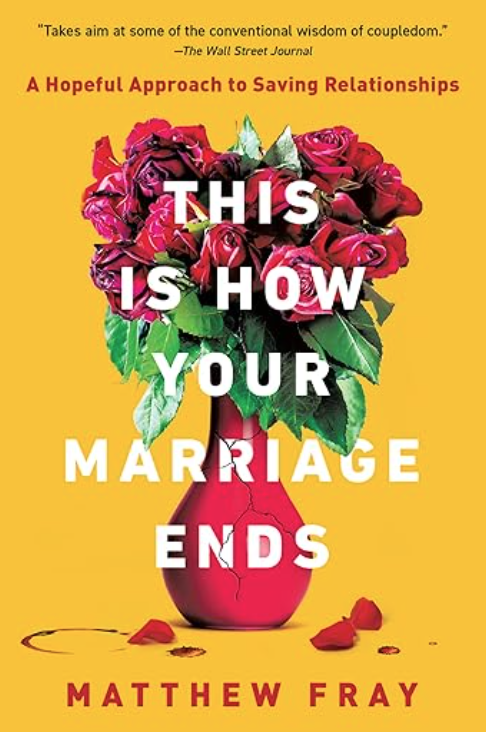
I recently read “This Is How Your Marriage Ends: A Hopeful Approach To Saving Relationships” by Matthew Fray. Below are the quotes I found most interesting. If you like them, buy the book here.
“My overarching premise is that good people who want to be married accidentally hurt one another and betray each other’s trust without either partner being aware of it as it is happening until their marriage slowly becomes toxic and/or ends.” (8)
“His wife is always overreacting, he said. It’s as if he can never predict the next thing that will upset her.” (12)
“No good deed is ever enough. No sacrifice I make proves my commitment. No amount of love nor any kindness I feel or display is ever acknowledged.” (13)
“I hadn’t changed. She had. And it didn’t seem fair that she had “roped me into marriage” under the pretense that we were great for one another and loved each other as we were, but years later, I was no longer good enough.” (13)
“I can’t live like this, they say. It’s so unfair that I’m always made out to be the bad guy and that nothing I do is ever good enough.” (16)
“Yet, no matter how hard they try to explain themselves to one another, nothing seems to get better. The hurt keeps growing slowly in intensity as frustration mounts and resentment grows.” (16)
“We enter marriage totally unaware that unpleasant preexisting conditions in our dating relationships that we calculate to be tolerable or something that might dissipate in time will often metastasize in marriage and eventually kill whatever we used to be.” (20)
“We are set up to fail in our most critical, foundational human relationships.” (21)
“In the United States alone, there are about 6,200 marriages per day. The inverse is that there re about 3,000 divorces per day.” (24)
“Holy shit. Feelings can HURT, I thought. And if feelings can hurt this much, and this is how my wife was feeling, and every time she tried to help me understand her pain I responded as if she was dumb, weak, or crazy, all while refusing to adjust any of my behaviors-doesn’t it make sense that she wanted to end our marriage? If I were in her position and were experiencing that same level of pain while not receiving any support or concern from her regarding my suffering, wouldn’t I have made the same choice that she did?” (33)
“Hundreds, maybe thousands of times, my wife tried to communicate that something was wrong. That something hurt.
But that doesn’t make sense. I’m not trying to hurt her; therefore, she shouldn’t feel hurt.
We didn’t go down in a fiery explosion. We bled out from 10,000 paper cuts.” (35)
“Spouses who frequently, if not always, remember to consider each other in your decision-making each day are the kind of people who trust one another and who trust that their marriage will go the distance.” (36)
“marriage is essentially the equivalent of everyone we invite to our wedding being on the same jumbo plane with us and bidding us farewell as we parachute onto some island that we think we understand but actually know next to nothing about.” (37)
“Imagine being in culinary school and whipping together a shitty omelet with runny eggs, rotting vegetables, doused in rancid vinegar, and then protesting your cooking instructor hating the food you made on the basis that you’re a well-liked person who supports local charities.
That must have been how I sounded to my wife.” (41)
“She felt unloved, she said. Uhhh. But I literally love you more than anyone. Can’t you tell by the fact that I married you and give everything I have to you and exchanged my previous fun, single life to spend the rest of my life with you? Imagine being this ungrateful and tone-deaf. Dudes are out there hitting their wives, sleeping with their co-workers, committing crimes, staying out all night drinking, etc., and I’m not a good husband?!
I don’t do all of these horrible things that bad men do-that bad husbands do! Why is she always complaining about the negative things I do without ever acknowledging any of the positives?” (42)
“While I explained how I was so smart and righteous to do whatever I had done, my wife was hearing me more or less promise that, in all similar future scenarios, her pain-her feelings of being loved, respected, cared for-would not matter as much to me as whatever super-smart and logical calculation I had made.
My wife, over and over again, heard me promise to hurt her again in the future. I thought I was intelligently sharing a different way to think about it so that my wife could adjust her silly feelings so she wouldn’t be inconvenienced by them.
I don’t need to change because I’m a good person who didn’t do anything wrong. SHE needs to change because it isn’t fair that she’s making her emotions MY responsibility!” (48-49)
“Good people telling the truth as they see it. Do you see the problem? THAT is how marriages get destroyed.” (49)
“There is only one reason I will ever stop leaving that glass by the sink, and it’s a lesson I learned much too late: because I love and respect my partner, and it really matters to them.” (54)
“I needed to understand what was important to her and what was not important to her. And then demonstrate respect for things on her This Is Important to Me list.” (55)
“me loving my wife in my brain and feeling love for my wife in my chest wasn’t nearly as important as conveying that idea through acts of love.” (55)
“We don’t think it’s fair that our partner’s preferences should always win out over ours.” (56)
“I’m grateful for another opportunity to demonstrate to my wife that she comes first and that I can be counted on to be there for her and that she needn’t look elsewhere for happiness and fulfillment.” (58)
“She hated it and asked me not to. I treated her as if she were wrong or crazy for always needing her preferences to win over mine.” (59)
“Maslow called this craving for the approval of others the Lower form of Esteem. Leveraging others’ opinions as evidence that we are good enough. Checks out.
He called it the Lower form of Esteem because we can never legitimately feel respected and accepted until we decide to respect and accept ourselves. Self-respect, Maslow said, is the Higher form of Esteem.” (67)
“Poor self-esteem can result in us interpreting our partner’s actions in the most negative terms possible because we subconsciously question whether we’re worthy of their love. This condition results in feelings of anxiety and the expectation of rejection, the result of which is us interpreting neutral or benign actions as rejecting or “mean.”” (67)
“Some people, for many reasons, live entire lives without feeling loved, without respecting themselves, and never really feeling safe or comfortable in their own skin.” (68)
“And the simple truth is this: When we are obstacles to our partners’ pursuit of their own needs, or when we neglect to fulfill any needs that fall to us as their partners, we are complicit in their decisions to pursue those needs elsewhere.” (68)
“This is the result of unmet needs further down the pyramid. Expensive gifts, flirty texts, and earnest efforts to contribute more around the house do not feel like thoughtful acts of love and intimacy when they are coming from the same person who triggers feelings of mistrust and a lack of safety.” (70)
“I figured I don’t cheat, I don’t physically abuse, I don’t gamble away our living-expense money, I’m not an addict, and I’m not a threat to abandon her or our children. I’m trustworthy!
But that is not the equation for Trust. The equation is: Safety + Belonging + Mattering = TRUST” (71)
“For the rest of the conversation, neither person is talking about the same thing.” (74)
“In a conversation with my wife about the dish by the sink, I would think, “What kind of insane person would want to have a horrible fight and ruin our night and make our marriage out to be a train wreck over something as insignificant as laundry or a dirty dish? I am never this irrational! If she thinks laundry and dishes are more important than our marriage, her priorities are warped, and she must not love me.
And my wife, much like Tara’s partner, would think, “I cannot trust this man. I can’t count on him. He does NOT respect me. He never apologizes for hurting me because he doesn’t think it’s a big deal. He always tells me how what I think and feel is wrong or dumb. I have all these feelings and I know I’m not crazy, but he NEVER acknowledges them as important or worth his attention. He thinks proving’ his point and winning our arguments are more important than my feelings. He doesn’t care. He must not love me.” (74-75)
“Our parents never told us otherwise, probably because they didn’t want us to know how many times they almost divorced or wanted to have sex with someone else.” (76)
“My wife communicated pain and frustration over the frequent reminders she encountered that told her over and over and over again just how little she was considered when I made decisions.” (77)
“Feelings matter whether or not we want them to. This was an unpopular idea with the twentysomething version of me.
How I feel today is not necessarily how I will feel tomorrow. Sometimes I feel angry about someone or something, but after a good night’s sleep that often goes away. Sometimes I feel like being alone but other times I want to be with people. Sometimes I feel like listening to rap and other times I feel like listening to guitar rock. Because feelings are ever-changing, they can’t be what I use to guide my decisions. I’m going to be bigger and better and stronger than that!
But then we wake up as adults and, sooner or later, must face the
truth—our feelings matter. They do.” (81)
“Most of our relationship problems are not logical problems. They are emotional ones.” (82)
“The more common version of thi story involves one of us trying to convince our partner that they’re overreacting – that whatever transpired SHOULDN’T be a big deal to them. That if they realize how insignificant the incident/comment/interaction/conversation was, or how silly the fight is, then they can stop feeling bad about it. No one’s upset anymore! Problem solved!
That’s what I did. I tried to make my wife feel better by explaining my feelings, believing I guess that she might adopt my version of events, thereby relieving her of the inconvenient pain, anger, or sadness she was feeling.” (87-88)
“I spent years defending myself against my wife’s grievances by imploring her to grant me more patience and forgiveness on account of me loving her and having her best interests at heart.
And so instead of validating her pain and seeking to understand it more fully, I’d pivot the conversation to how unfairly she was treating me. It’s because I was really bad at husband-ing.
But imagine if she KNEW that I wasn’t hurting her intentionally?
The way she knew her infant son wasn’t trying to sabotage a peaceful night of sleep when he woke up crying.”
“If you value your relationship with someone, it will be helpful to come to terms with this truth. When we love people, we must honor THEIR experiences-THEIR reality-to connect with them on an emotionally healthy level.” (107)
“let’s pretend we generally feel comfortable in 65 degrees but know that our partner feels cold in the same air temperature.
This is about acknowledging your partner’s experience in 65 degrees with thoughtful action rather than invalidating it with a sales pitch about how she or he is wrong to feel uncomfortable since it’s an obviously comfortable temperature given your individual feelings about it.” (114)
“Could it be that what our loved ones actually crave is to be considered in our decision-making? To be worthy, in our minds and hearts, of always being important enough to include in our calculations-no matter how deceptively minor or inconsequential we might believe these calculations to be?” (115)
“My marriage fights mostly consisted of me invalidating my wifes complaints under the premise that I considered them petty or unwor-thy. I treated her arguments as illogical. And because, in my mind, her arguments lacked logic and reason, I categorized them as wrong.
I was right. She was wrong. And since I believed that, she was the real rabble-rouser in the marriage and nothing was ever my fault.” (116)
“When we’re in it-fighting with our spouses and feeling betrayed because they don’t seem to be loving us as they promised to on our wedding day—we sometimes feel like they’re deliberately causing us harm.
And that hurts more than the thing they’re doing. That feeling that they would WANT to hurt us. That’s what hurts the most.” (118)
“Until your partner demonstrates beyond doubt that they can articulate accurately your point of view, you can safely conclude that THEY DON’T KNOW HOW YOU REALLY FEEL. The significance of that can’t be overstated.” (119)
“Everyone has a different list of things that can hurt them. Our pains are not universal, just as our level of comfort in 65-degree air is going to vary from person to person.
When we don’t know our spouses—when we’re not experts about who they are, what harms them, and what brings them pleasure or joy-then we are a constant threat to hurt them regardless of how much love we feel for them and regardless of our intentions.” (121)
“A marriage destined to fail and one that will last fifty-plus years will look and sound the same to other couples at the party or dinner table.” (125)
“Two common occurrences are responsible for destroying trust in our relationships:
- An event or situation in which one or both partners feel hurt by the other, and
- The conversation we have about that hurtful event or situation.
The event is one thing, but the conversation is usually where shit hits the fan. And after that happens enough times, people often want to divorce because of how badly they hurt.” (126)
“Constantly and most of the time unconsciously, we invalidate the lived experiences of the people we love. With great con-viction, we tell them to their faces that their thoughts and beliefs are wrong. We tell them that their feelings are wrong. And we tell them that their treatment of us is wrong-that it’s unfair.” (127)
“Underneath all the specifics is a simple and difficult truth: I didn’t remember to actively love my spouse.” (134)
“When I judged my wife’s thoughts-her opinion or interpretation about something that happened-to be “correct,” I was loving and supportive.
When I judged her thoughts to be Less Than somehow, I contradicted her. Invalidation. I didn’t mean it this way, but my wife must have heard “No, you dumb, silly person! Your brain isn’t working correctly! Here’s the smart-person way to think about this.” (138)
“I don’t believe it’s morally reprehensible to disagree with someone, which they may experience as invalidation. I don’t think it’s “evil,” or even “bad.”
What I do think is that it erodes trust. Every time. And after enough trust erosion, marriage breaks. Any meaningful relationship will break.” (139)
“I needed to learn how to care that whomever I’m speaking with is suffering in some way and how to respond to them in a way they would experience as understanding and supportive. I needed to learn how to care about that rather than running the situation through my personal litmus tests. SHOULD this person feel that way? SHOULD they believe this? Isn’t that weak or silly or unhealthy or wrong?” (140)
“We need to replace this habit of judgment with something else. Curiosity. Empathy. Encouragement. Anything but judgment.” (141)
“Screw being right. It’s bullshit. I mean, knock yourself out if winning these little knowledge battles with others gives your life meaning and completeness, but once I saw this toxic pattern I seemed forever stuck in, I committed to trying to abandon this habit of wanting to be right.” (144)
“it’s up to me to have the awareness and discipline to choose to show up in that way, even when I believe someone else might be mistaken or that they are feeling emotions that don’t quite make sense to me as they’re happening.” (147)
“But when I think about my behavior-and others’ behavior-not as some genetic fatal flaw I’m stuck with but as a habit I can practice changing to something positive and healthy, I find my sense of direction. A North Star.” (148)
“And this is one of the most important realizations I’ve ever had: So long as I process everything my wife is doing and saying through the filter of MY thoughts and MY feelings, then I’m always going to have reason to defend myself.” (151)
“I never really had a chance to restore or maintain trust with my wife because I NEVER set aside my own thoughts and feelings to try to experience the moment as she was. I never considered HER as the protagonist in the story. I never wondered What if I’m the villain here?” (152)
“You’re deciding whether another person’s mental and emotional experiences are valid, and I hope you’ll consider the inherent disrespect and self-absorption involved in that-determining that everything we think and feel is superior and more important than others’ thoughts and feelings.” (154)
“instead of judging someone else’s experience to be wrong and trying to convince them of my mental and emotional superiority, I will try to understand all of the ways in which it makes perfect sense for them to feel as they do.” (156)
“I can care that someone who matters to me is experiencing something they perceive to be bad or painful or terrifying, and I can choose to express some empathy and remorse that they feel bad somehow, and then I can do the work of learning WHY a particular event or a particular statement triggered the negative emotion.” (157)
“I can always choose the quality of the relationship over my individual thoughts and feelings. And doing so is the difference between having relationships with trust and emotional intimacy and relationships without.” (158)
“If my wife has a high-pressure business presentation coming up next Friday, is fighting a cold, and is grieving the loss of her grandmother with whom she had a really close relationship, then maybe the most effective way to communicate my love and support for my spouse is to make sure the kids, family pets, and-ESPECIALLY-me are not taxing her mental and emotional energy beyond their limits.” (159)
“I can talk with her. I can let her know that I see how much she’s carrying-that I’m tuned in, connected, aware-and that I have her back.” (159)
“Attacking a well-intentioned person’s character—or NOT taking care to word things in ways that communicate to someone else that we don’t believe them to be bad people hurting us on purpose—is a sure-fire way to generate a defensive response.
And defensive responses invalidate. And invalidation always erodes trust. And trust erosion always leads to shitty relationships. And shitty relationships beget divorce and sad kids and future shitty relationships.” (161)
“How to Compose a Successful Critical Commentary
- You should attempt to re-express your target’s position so clearly, vividly, and fairly that your target says, “Thanks, I wish I’d thought of putting it that way.”
- You should list any points of agreement (especially if they are not matters of general or widespread agreement.
- You should mention anything you have learned from your target.
- Only then are you permitted to say so much as a word of rebuttal or criticism.” (164)
“One of the tools she or my brother-in-law use when they feel their temperatures rising during an argument is to leverage their mutual love of music and endearing immaturity to signal a peace treaty to the other in the middle of the conversation.” (165)
“And since a body in motion continues to move at a constant velocity unless acted upon by an external force, two people doing nothing AREN’T sitting still. They’re drifting apart at a constant velocity until someone does something about it.
We are always either moving toward each other or away from each other.” (169)
“I don’t like the word “blame” I don’t believe relationship conflict is the result of people doing bad things. I believe relationship conflict is the result of people failing to understand and accurately calculate for how their partner will experience something they say or do (or fail to say or do).” (175)
“”But Matt! What about the kids?! Shouldn’t they always come first?!” Nope. They shouldn’t. And, as a father who loves his son more than anything else on this planet, I struggle writing those words. It twists my insides a little. That’s usually how I know something is true-when it feels uncomfortable and inconvenient.
Prioritizing anyone or anything over your wife or husband is the most surefire way I know to destroy your family.” (176)
“When we teach our children that they are the most important things in life and that if they want our attention they will always get it and that if they want or need something we always drop everything we’re doing so that it is magically done for them and that the marriage between Mom and Dad isn’t the top priority, what happens?
Bad news: You end up getting someone like me. (Sorry, Mom.)
You raise kids who grow up believing they’re uniquely special even though they’re not. You raise kids who lack self-sufficiency as well as self-awareness and who grow up expecting their partners to do things for them that their parents used to, but then also get mad at their partners anytime they feel as if they are being treated like a kid.” (177)
“When we don’t prioritize the relationship between Mom and Dad, we inadvertently raise kids who have no idea what a loving, high-functioning, healthy, mutually respectful marriage looks like.” (177)
“I was happy. I felt good. People liked me. I had friends. My life was amazing. And I gave up virtually all of it and promised you forever, and all you do is treat me like a failure every day.” (184)
“We’ve created billions of very decent human beings who unknowingly walk around every day trying their God’s-honest best but are accidentally napalming their homes and closest relationships.” (188)
“2. Husbands Who Are Good Men. All good men who are married fall into one of two camps.
GOOD HUSBANDS. A good husband performs the duties of marriage with skill and competence. His success is usually most apparent to his wife, who feels loved and secure most days of her life and who loves and respects him in ways she’s only ever felt for her children and her very closest family members. He is often appreciated by his in-laws, admired by his friends and neighbors, secretly or not-so-secretly wanted by women who covet the things he provides his wife and family in their own lives, and has very little conflict-related drama or life stresses at home with his wife and family.
BAD HUSBANDS. A bad husband is shitty at marriage. No matter how GOOD of a human being he is, he sucks at the complexities of human relationships. (Note: This puts him in the 95 percent of everyone who at times struggles with the complexities of human relationships. This does not make him stupid or incompetent or unfit necessarily for anything good men are suited for. It just makes him bad at marriage. Throughout human history, good men have been bad at many things, like singing and dancing or constructing high-rise buildings or playing the piano or carving ice sculptures or solving advanced mathematics.)
- Good Men Who Are Shitty Husbands. All good men who are bad husbands fall into one of two camps.
MEN WHO DON’T KNOW THEY ARE BAD HUSBANDS. Either these men don’t know they’re bad husbands because they don’t know what shitty husband-ing is and/or no one has ever taught him that he’s one OR anytime someone (usually his wife) says that he is, he doesn’t actually believe it. (Note: I believe, of all married men in existence, the VAST majority-I’m talking 85-ish percent-fall into this category.)
MEN WHO KNOW THEY ARE BAD HUSBANDS BUT WANT TO BE GOOD. This is a very bad spot to be in because, to arrive here, one usually has to have a miserable, failing marriage wreaking so much emotional havoc, stress, and anxiety in our home lives that we FINALLY decide to ask ourselves the right question: What can I do to help fix this?” (196)
“REALIZATION #1
Wow. Our problems are so common that generic, made-up stories in a self-help book totally NAIL my marriage. These exact same marriage problems are affecting almost everybody.
REALIZATION #2
If these relationship problems are this common, that means my wife and I aren’t somehow fatally flawed. We’re not NOT soul mates or freaks unfit for marriage. These problems are practically universal and we don’t have to feel ashamed for having them.
REALIZATION #3
If nearly all marriages suffer these common problems, then that means it’s foolish to get divorced with the intention of replacing your spouse with someone else. Because these same problems will ALSO exist with that other person. If my wife and I love each other, our son, and both generally prefer marriage to being single, the most logical course is to work hard on this marriage rather than trying to start new relationships as middle-aged, divorced, single parents only to inevitably have to work hard on THAT relationship, but with the added suck of all the family and friends breakage and losing so much time with our children.” (198)
“Is it really fair to ask me to adjust everything I do, think, feel, and say simply because it hurts my wife’s incorrect feelings when all she has to do is realize her mistake and simply STOP feeling bad about silly things?
After writing about marriage and divorce for several years, I’ve come to believe that the above sentiment is among the top marriage killers in the world. It’s an invisible, quiet belief that triggers the Invalidation Triple Threat response pattern, regardless of gender.” (204)
“I loved my wife. But I didn’t RESPECT her individual experiences as being equally valid to mine.” (205)
“A healthy sexual relationship pis a pillar on which lasting marriages are built.” (216)
“I was dishonest with my wife about sex-related things in our mar-riage. I was, in general, uncomfortable discussing sex audibly in conver-sation. But I was mostly afraid of disclosing everything that I thought and felt and feared and fantasized and wanted or didn’t want.” (245)
“I only know what I thought and felt, but what adulthood has taught me is that when you think and feel something, you tend to discover that millions of other people think and feel those things too.” (247)
“COMPATIBILITY IN DATING AND MARRIAGE ISN’T HOW ALIKE WE ARE
COM•PAT•I•BIL-I•TY-noun-1. a state in which two things are able to exist or occur together without problem or conflict 2. a feeling of sympathy and friendship; like-mindedness.” (268)
“I often ask the people I coach to take the personality test an additional time but, that second time, answering the questions as they believe their partner would.
I love the insights and conversations that naturally occur when we discover the gaps between what we believe about someone else (or ourselves) and what’s actually real. The majority of conflict that exists between two romantic partners lies in that gap between what we think we know and the truth.” (272)
“Ted Hudson, a researcher at the University of Texas, conducted a longitudinal study on romantic compatibility in couples who had been married for several years.
“My research shows that there is no difference in the objective compatibility between those couples who are unhappy and those who are happy,” Hudson wrote.
Couples who feel content and positivity within their relationships said that compatibility wasn’t an issue for them. The happy couples in Hudson’s study said it was their own willful behavior that made the relationship successful—not personality compatibility.
When the unhappy couples in the study were asked about compatibility, they all said that compatibility was extremely important to having a successful marriage. And in the midst of their failing marriages, they didn’t believe they were compatible with their partners.
When the unhappy couples said, “We’re incompatible,” what they actually meant was “We don’t get along very well,” Hudson wrote.” (274)
“She wants to talk about it. It makes her feel better.
He doesn’t want to talk about it. It makes him feel worse.
Are they incompatible?
Or.
Does being compatible really mean that she fundamentally understands how stressful and difficult conversations that may be cathartic for her can feel difficult and damaging for him, and then approaches conversations with him with that in mind?
And does being compatible really mean that he fundamentally understands that listening to what she has to say, even if it’s inconvenient or a little bit frustrating for him, will strengthen the intimate bond between them, so he’s going to make whatever concessions are necessary to achieve that?” (275)
“Love them for who they are, not for what they do for you.” (276)
“Why is she trying to make me responsible for her emotions? I’d wonder. This is absolute bullshit.” (279)
“People with poor boundaries typically come in two flavors: those who take too much responsibility for the emotions/actions of others, and those who expect others to take too much responsibility for their own emotions/actions,” Mark Manson writes.” (285)
Liked the quotes? Buy the full book here.