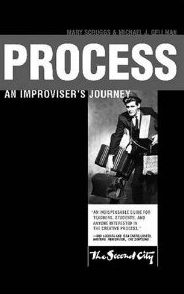
I recently finished reading “Process: An Improviser’s Journey” by Mary Scruggs and Michael Gellman. Here’s the quotes I found useful.
“You can save yourself from this slow, painful death by getting your focus off of yourself.” (xxii)
“I got that feeling of panic again, and I knew from experience that the best way to handle that feeling is to just start doing something.” (24)
“Stay in the moment. Don’t try to think up clever bits. Don’t feel responsible for creating the final product.” (41)
“When I do manage to exist in the present moment and the present moment only, I feel like I’ve brushed up against something eternal. I’ve touched the divine.” (42)
“What you do in normal life is not theater. Theater is compressed time and space, artificial dialogue, and heightened situations. It is our job as good actors to help the audience believe it’s real and natural. And I think it helps if we believe in the given circumstances ourselves. The more we commit to the character and the play, improvised or scripted, the better we are able to get to that place of the believable.” (64)
“When you follow the dialogue rules, you almost have to explore and heighten relationship.” (66)
“If there is no physical manifestation of your reaction to your discovery, does it exist for your audience?” (70)
“The fact that you can write is an asset – a tremendous asset. That’s why you’re so good at the dialogue rules. Just don’t get ahead of yourself when you’re improvising. React to what you see, taste, hear, touch, and smell – not to the story in your head.” (72)
“Having two points of concentration actually seemed to help me stay in the moment.” (74)
“We worry that we aren’t going to have an honest discovery, so we make up stories. Or if we actually manage to have a real discovery, we worry that our reaction to that discovery isn’t going to be enough.” (75)
“Dialogue comes after the reaction. The ashes after the fire. Don’t try to manufacture.” (86)
“To avoid getting into fights, only make ‘I’ statements. For example, ‘I think,’ ‘I am,’ ‘I want,’ ‘I feel.’ (100)
“You are not responsible for the product. Only the process. Improvise moment to moment to moment, and the play will take care of itself.” (103)
“Acting is acting is acting, and if people believe we are who we say we are, it is considered to be good acting.” (140)
“Since the money we are gambling is mostly the business men’s, the least we can do is to act as if we were reliable and responsible characters: not artists but craftsmen, highly paid craftsmen who can be guaranteed to turn out goods of standard quality.” (xix)
“‘Creativity’ will always look after itself if you are prolific in production, which means starting off by turning out masses of work that is relatively unoriginal, derivative and imitative. When productivity has become second nature, you will find you have acquired a freedom in which your particular and personal individuality emerges of its own accord.” (xxiii)
“His response to our work was so incredibly un-lazy and passionate, and there was always a kind of warning bell that I heard whenever I was with him. To me it rang: ‘I am the writer and director of films you are still watching thirty years after I made them. The determination and commitment I have shown is something you will need if you are to in the world I have left behind.’” (xxiv)
“Film is not just something up there on the screen – it’s a happening in your head.” (xxxv)
“The value of any ‘rule’ is not apparent until you have studied the exception to it.” (xxxvii)
“Cinema is not so much non-verbal as pre-verbal.” (3)
“Hitchcock is suggesting that a good film should be ninety per cent understandable even if dubbed into a language no one sitting in the auditorium understands.” (4)
“Exposition in film is much more interesting after the dramatic event as a comment (or perhaps explanation) on it.” (6)
“If the only purpose of dialogue is to provide expository information to the characters in the scene but to the audience, it is boring.” (22)
“The comic figure is a caricature who cannot feel too much pain and whose emotions are simplified to the point of absurdity.” (34)
“Screenplays are not written, they are REWRITTEN and REWRITTEN and REWRITTEN.” (40)
“Use coincidence to get characters into trouble, not out of trouble.” (41)
“If you’ve got a Beginning, but you don’t yet have an end, then you’re mistaken. You don’t have the right Beginning.” (42)
“Character progression: When you’ve thought out what kind of character your protagonist will be at the end, start him or her as the opposite kind of person at the beginning.” (42)
“Anything that can be cut should be, because when everything non-essential is eliminated, what remains is greatly strengthened.” (46)
“Imagine yourself in the role of this antagonist. Begin to write an interior monologue in the first person, an account of the story as seen through the eyes of this antagonist.” (52)
“Choice of a story’s point of view very often determines the theme.”
“Every screenplay that finally became a film was rewritten a minimum of five and a maximum of seven times.” (58)
“Don’t wait to get it right, just get it written.” (58)
“A character is a personification of a point of view.” (58)
“A weakness in the third act is not just a weakness of the end of the screenplay, it is a fundamental weakness of the whole work.” (60)
“One of the writer’s jobs is to be the connection between two other personalities: the director speaking the film ‘language’ and the performer discovering the role.” (66)
“I urge you to avoid introducing technical jargon that is meant to demonstrate your acquaintance with problems of production for these things are not your business. While the impulse of a good director will be to scratch it all out, it also clearly indicates to the producer that you are a bumbling amateur.” (72)
“Professional screenplay shave a quality in common with good journalism: they use the minimum number of words to communicate the maximum information. A good screenplay must be not only easy to read, it should be easy to read fast.” (73)
“I find it useful to think of the audience as the enemy, to try to tell the story while always remembering that the audience has somewhere better to go and something better to do.” (77)
“A story can quickly become monotonous if tension is constant.” (80)
“They say that the most thoroughly deranged people are those who act in an utterly logical way, except that this logic is based on one insane premise.” (115)
“A line that reads quite implausibly on the printed page can be quite convincing and effective when spoken in a throwaway or incidental fashion by the actor.” (121)
“Dramatic economy, which includes the ability of the writer to cut what at one point he might have considered to be his best work ever, is one of the most important skills a writer can have, learned only through much experience, combined with a ruthless attitude and an utter lack of sentimentality. It takes effort, lots of effort. It means rewriting and rewriting and rewriting – a constant process of distillation.” (125)
“When a writing dilemma appears insoluble, it is not a bad tactic to push it deliberately out of your consciousness while you go off on other business, or indeed play.” (162)
“The first step in all dramatic writing is visual.” (165)
“It is the task of the writer and director to find some way of making character-action believable.” (166)
“The actor must decide what the character is saying to himself at all times, as if he were writing a continuous inner soliloquy that expresses his character’s thoughts, responses and attitudes. An actor who has mastered a role is able to speak this soliloquy out loud. He is, at all times, able to answer the question ‘What is this character really trying to say with his line?’ (even if his character is not). In this way, subtext can develop during rehearsal, quite unconsciously, as a way of controlling the inflections of words, the timing of gestures, and the length of silences.” (182)
“If you avoid eye contact by looking only during those brief instants when you have a real need to see seomthing, then your mind is constantly at work. Thus to scrutinize an object with extreme concentration, you must keep the focus of your attention in constant motion.” (184)
“Try the fixed look at your partner again but now keep the look moving from the mouth to the yes, the left eye to the right, the eyebrows to the chin. This will, on film at least, appear as a fixed concentration of your attention.” (184)
“A screen actor’s performance is likely to be much more useful to the director and the editor if his looks are no sustained but are rather a series of sharply defined flicks of the eye to check for information.” (185)
“The character who is ‘almost angry but a bit pitying’ will achieve this effect with more vitality if he shows an impulse to anger, quickly checked by a contradictory moment of pity, then by another flash of annoyance. If the girl who is resentful but intrigued alternates between moments of resentment and moments of interest, it is much clearer for the audience.” (187)
“This is perhaps the primary function of the director: to provide his actors with the same kind of support and stimulus the stage actor gets during a live performance.” (189)
“This is the reason why, in the vast majority of cases, the director who demonstrates to the actor by acting the role himself, by reading the line of dialogue for the actor to mimic or by performing the gesture so that the actor can copy it, has already failed.” (190)
“One of the most helpful things the director can do is invite the actor to improvise scenes that do not appear in the script but that in narrative terms have taken place just before the scene that is being presently explored.” (191)
“Questions are often more helpful to the actor than any answers the director might be able to offer (a good example being something like, ‘What happened to your character after the last scene and before this one?’). (191)
“A director contributes not by instructing the actor but by inspiring him.” (191)
“Every entrance is an exit from a previous situation and every exit is an entrance to somewhere else. Indeed, if this is not the case you should ask yourself whether or not the scene is necessary.” (193)
“You should know your story so completely that there is no question any actor can ask you about a character (including aspects of off-screen life and back-story) for which you cannot instantly improvise a convincing answer.” (193)
“The way to make a cut seem smooth is to make the jump of the mind’s eye one that the audience wants to make.” (199)
“The motivation for every cut should always be built into the preceding angle.” (199)
“It might not be too much to say that what a film director really directs is his audience’s attention.” (200)
“Making something eye-catching is not always a matter of making it bigger. Rather, it is about being that little bit different form everything else.” (201)
“We see the start of every action, then cut away and almost immediately reintroduce the action at a more advanced stage. It will appear to the audience as though it is all one uninterrupted process.” (211)
“A scene that involves very complicated and expensive logistics, crowds, special effects and elaborate production design can very profitably be planned in very precise detail beforehand. But if you are working on a scene with a lot of dialogue and the possibility of complex movements of actors during a sustained scene, it can be a mistake to plan the camera set-ups in advance in any rigid way.” (218)
“If one character is seen in close-up and the other in medium shot, our feelings of sympathy and/or identification are with the figure seen at the closer distance.” (225)
“IF one character is on screen for longer than another, and especially if edits are timed to capture the thoughts of that character, then the scene will often appear to be from his or her point of view.” (225)
“When cutting from a long-shot to a closer angle, it is generally a good idea to change the angle.” (249)
“When the edit is equivalent of a visual enlargement of the preceding picture, the problem is likely to be that we do not really see anything we haven’t already seen.” (249)
“If suspense is aimed for, the spectator must first be shown what to wait for. If a shock is intended, the pre-warning must be, so to speak, negative: the spectator must be deliberately led away from the significant event before it can come to him as a surprise.” (254)
“When editing, don’t try to preserve every aspect of both performances.” (256)
“Once the audience understands what is about to happen, when the impulse to act is clear, it’s time to make your cut, so the audience is able to see the consequences of that action.” (256)
“It makes good sense to begin by shooting the master-shot of a scene, even if it is not the first shot in continuity.” (260)
“When shooting a scene, always ask yourself, ‘If I was allowed only one close-up, where would it be and which character would it feature?’” (260)
“The experienced director will line up the closer angle with the actors in position and then instruct them to step out of the frame and move into position only after the camera is rolling.” (260)
“Theory will not usually help you to do work that is good, though it may be of some help to identify your mistakes, and thus can sometimes be useful for corrective purposes.” (289)
“It is not childish to live with uncertainty, to devote oneself to a craft rather than a career, to an idea rather than an institution. It’s courageous and requires a courage of the order that the institutionally co-opted are ill equipped to perceive. They are so unequipped to perceive it that they can only call it childish, and so excuse their exploitation of you.” (18)
“Part of the requirement of a life in the theatre is to stay out of school.” (18)
“The audience will teach you how to act and the audience will teach you how to write and to direct. The classroom will teach you how to obey, and obedience in the theatre will get you nowhere. It’s a soothing falsity.” (19)
“If you want to be in the theatre, go into the theatre. If you want to have made a valiant effort to go into the theatre before you go into real estate or law school or marry wealth, then perhaps you should stay in school.” (19)
“The study of acting consists in the main of getting out of one’s own way, and in learning to deal with uncertainty and being comfortable being uncomfortable.” (20)
“The actor has his own trials to undergo, and they are right in front of him. They don’t have to be super added; they exist. His challenge is not to recapitulate, to pretend to the difficulties of the written character; it is to open the mouth, stand straight, and say the words bravely – adding nothing, denying nothing, and without the intent to manipulate anyone: himself, his fellows, the audience.” (22)
“Find your mark, look the other fellow in the eye, and tell the truth.” –James Cagney (25)
“It is the audience that goes to the theatre to exercise its emotion – not the actor, the audience. And when they go, having paid to be moved, they exercise their right to their money’s worth.” (25)
“The actor creates excuses not to act and attributes her reluctance to everything in the world except the actual cause.” (29)
“Nobody cares how hard you worked. Nor should they.” (32)
“Any worthwhile goal is difficult to accomplish. To say of it “I’ll try” is to excuse oneself in advance.” (34)
“Those with “something to fall back on” invariably fall back on it. They intended to all along. That is why they provided themselves with it.” (34)
“Where in the wide history of the world do we find art created by the excessively wealthy, powerful, or educated?” (35)
“One could also say, “I see nothing else worth my time,” which is, I think, a rather strengthening attitude.” (35)
“It is the writer’s job to make the play interesting. It is the actor’s job to make the performance truthful.” (41)
“To serve in the real theatre, one needs to be able to please the audience and the audience only.” (42)
“The opinion of teachers and peers is skewed, and too much time spent earning their good opinion unfits one for a life upon the stage.” (42)
“You will not please either yourself or others in every aspect of every outing.” (48)
“They come to the show to be pleased, and they will be pleased by the honest, the straightforward, the unusual, the intuitive – all those things, in short, which dismay both the teacher and the casting agent.” (50)
“You have an enormously greater chance of eventually presenting yourself to, and eventually appealing to, an audience by striking out on your own, by making your own plays and films, than by submitting to the industrial model of the school and the studio.” (51)
“The audience perceives only what the actor wants to do to the other actor.” (56)
“Here, again, is your job: learn the lines, find a simple objective like that indicated by the author, speak the lines clearly in an attempt to achieve that objective.” (57)
“It is not necessary to believe anything in order to act.” (57)
“You have to learn the lines, look at the script simply to find a simple action for each scene, and then go out there and do your best to accomplish that action, and while you do, simply open your mouth and let the words come out however they will.” (62)
“For to you, to the actor, it is not the words which carry the meaning – it is the actions.” (62)
“What matters is what you mean. What comes from the heart goes to the heart. The rest is Funny Voices.” (63)
“Two things should happen in the rehearsal process: 1. The play should be blocked 2. The actors should become acquainted with the actions they are going to perform.” (72)
“An action is the attempt to accomplish something.” (72)
“Each character in the play wants something. It is the actor’s job to reduce that something to its lowest common denominator and then act upon it.” (74)
“The correct unit of study is not the play; it is the scene.” (75)
“The boxer has to fight one round at a time; the fight will unfold as it is going to. The boxer takes a simple plan into the ring, and then has to deal with the moment. So do you. The correct unit of application is the scene.” (76)
“The greatest performances are seldom noticed. Why? Because they do not draw attention to themselves, and do not seek to – like any real heroism, they are simple and unassuming, and seem to be a natural and inevitable outgrowth of the actor.” (79)
“If we devote ourselves to the punchline, all else becomes clear. The punchline is the action.” (83)
“You don’t have to become more interesting, more sensitive, more talented, more observant – to act better. You do have to become more active.” (84)
“Nobody with a happy childhood ever went into show business.” (87)
“Your concentration is always like water. It will always seek its own level – it will always flow to the most interesting thing around.” (94)
“The more you are concerned with yourself, the less you are worthy of note.” (95)
“The more a persons’ concentration is outward, the more naturally interesting that person becomes.” (95)
“It’s not your responsibility to do things in an interesting manner – to become interesting. You are interesting. It’s your responsibility to become outward-directed.” (95)
“Why not direct yourself toward the actions of the play? If they are concrete, provocative, and fun, it will be no task at all to do them; and to do them is more interesting than to concentrate on them.” (95)
“No one wants to pay god money and irreplaceable time to watch you be responsible. They want to watch you be exciting.” (97)
“Luck, if there is such a thing, is either going to favor everyone equally or going to exhibit a preference for the prepared.” (99)
“Leave the concerns of the street on the street. And when you leave the theatre, leave that performance behind you. It’s over – if there is something you want to do differently next time, do it.” (102)
“If you decide to be an actor, stick to your decision. The folks you meet in supposed positions of authority – critics, teachers, casting directors – will, in the main, be your intellectual and moral inferiors. They will lack your imagination, which is why they became bureaucrats rather than artists; and they will lack your fortitude, have elected institutional support over a life of self-reliance. They spend their lives learning lessons very different from the ones you learn, and many or most of them will envy you and this envy will express itself as contempt. It’s a cheap trick of unhappy people, and if you understand it for what it is, you need not adopt or be overly saddened by their view of you. It is the view of the folks on the veranda talking about the lazy slaves.” (110)
“You don’t have to portray the hero or the villain. That’s been done for you by the script.” (114)
“Most of us have learned something from a teacher. But I doubt if anyone ever learned anything from an Educator.” (122)
“Once you hit your goal, you’re going to want to go somewhere else.” –Bob Dassie (6)
“It is harder to mark progress without a leader.” (6)
“In an improv scene, you can have the game of one-upsmanship between the two characters which employs the skill set of listening, character and environment.” (12)
“Look at what characters commit to most emotionally. That is where the drive is for the characters and thus is the drive for the scene.” (12)
“Just as players can sabotage themselves by going for the joke, directors can sabotage themselves by striving for the unique.” (13)
“When we forcefully strive to be unique, we are no longer fulfilling our purpose, which his to guide the group. Just as going for the joke at the expense of the scene is selfish, so is trying to make yourself look like a brilliant guru at the expense of real guidance. Your focus should always be on the group you are leading, rather than the specifics of what you are leading them through.” (13)
“Improvisation, for all its technique and complexities, can still be broken down into these two acts: making a choice and committing to that choice.” (16)
“Those who try to create their own definition of what the work truly is will find that they are still derivative of what came before, except now they have made it more complicated.” (17)
“Instead of spotlighting a player’s weakness, give them a challenge to focus on that will force them into other choices.” (22)
“Sometimes I will simply ask the troupe I am directing, “Which scene did you have the most fun doing? Which scene do you think I had the most fun watching?” (35)
“Allow yourself to be wrong and adapt every once in a while. It is a stronger place to build from than from a place of vagueness so as to appeal to everyone with whom you are working.” (42)
“All things, regardless of how subtle or bland, are choices, and that when we commit to them they become strong choices.” (63)
“What makes a choice strong and realistic is commitment.” (69)
“There is no killjoy as big as obligation when it comes to performing. (75)
“Keeping the concept to a single arc that can be defined in one sentence is a good way to guarantee simplicity and fun.” (85)
“You most definitely start your process by being selfish. In fact, you should embrace it. It is nice to say that the performance is for the audience, but it is not true, unless you are on a gig at a pediatric cancer ward or doing a show for the elderly or the homeless. You are first and foremost performing for yourself. It drives you. It speaks to you. It feeds you. Show appreciate for the audience at all times – they are paying you the honor of coming to see your show above everything else they could be doing – but do not create the show for them. Don’t blame them when the show doesn’t work and don’t create the show for them.” (86)
“Whatever the case may be, it will be easier to make a show more palatable to others once you have your own stakes in it figured out.” (86)
“There is a tendency to add new rules to safeguard against failure, but it is more effective to scale back the parameters that are already in place.” (88)
“While you do not have control over what the audience will like, you do have control over how strong your product is and that is a much more productive focus for you to have.” (89)
“If we focus too much on the other person’s actions, rather than developing our reactions, we stifle the flow.” (111)
“Sometimes people just need to be heard and know that they are heard so that they can feel valued.” (119)
“Not casting an extremely talented person because they are going to be high maintenance to deal with, is THE BEST reason to not cast someone.” –Joe Bill (120)
“What we learn to do in the beginning is what we need to do in the end.” (5)
“All the characters that we play are really subsets of ourselves. It’s ourselves in slightly different moods – ourselves carrying a little more emotional freight.” (9)
“Your job is to take that suggestion and discover a theme for the piece.” (17)
“You will find your relationship in the first three lines of your scene. Pay close attention ot those lines – it’s always there.” (19)
“When the players forget the focus of the scene and begin new relationship in every beat, the Harold tends to peter out at the end.” (19)
Del’s General Principles for the Harold 1. You are all supporting actors 2. Always check your impulses 3. Never enter a scene unless you are needed! 4. Save your fellow actor, don’t worry about the piece. 5. Your prime responsibility is to support. 6. Work at the top of your brains at all times. 7. Never underestimate or condescend to your audience. 8. No jokes (unless it is tipped in front that it is a joke). 9. Trust… trust your fellow actors to support you: a) Trust them to come through if you lay something heavy on them. b) Trust yourself. 10. Avoid judging what is going down except in terms of whether it needs help (either by entering or cutting), what can best follow, or how you can support imaginatively if your support is called for. 11. Listen!
“The only real mistake is to ignore the mistakes in their work.” (31)
“Watch the news, familiarize yourself with the classics, find your voice, and form an opinion. If you don’t have anything to say, what is there to be funny about?” (40)
“Confidence brings about calmness. With that comes the ability to think and take the time to come up with the best response possible, rather than quick silly joke.” (41)
“The worst thing that might happen if you look stupid is that people might laugh, and, since we are doing comedy, that’s not a bad thing.” (46)
“Being nervous is great! How often do we get nervous on a daily basis? Being slightly nervous means you care, and you’re alive, and you’re taking some kind of risk. Hooray for being nervous! A friend told me to substitute the word ‘excitement’ for ‘nervous.’ That was you acknowledge the physical feelings without putting a negative spin on things. So to answer your question, sometimes I still get so excited about ‘Weekend Update’ that I want to throw up.” –Amy Poehler (46)
“The audience comes to enjoy a show and escape their own lives for a couple of hours. They don’t want to see you argue and be reminded of how miserable they sometimes are in their everyday existence.” (50)
“People don’t pay good money to watch us judge ourselves.” (65)
“When you indicate that something is funny, it really isn’t.” (67)
“The more you wait to add to the group, the more the jump rope turns into a large steel cable.” (69)
“The people who loved the work were the ones who were noticed.” (81)
“Del used to say that the people who come here with tunnel vision to be stars usually end up in community theater somewhere.” (81)
“Just be devoted to the work, take the time to get good, and the rest will take care of itself.” (81)
“All of you must remember that you will never have done it all. Do not stop creating. The excitement is in the work.” (82)