
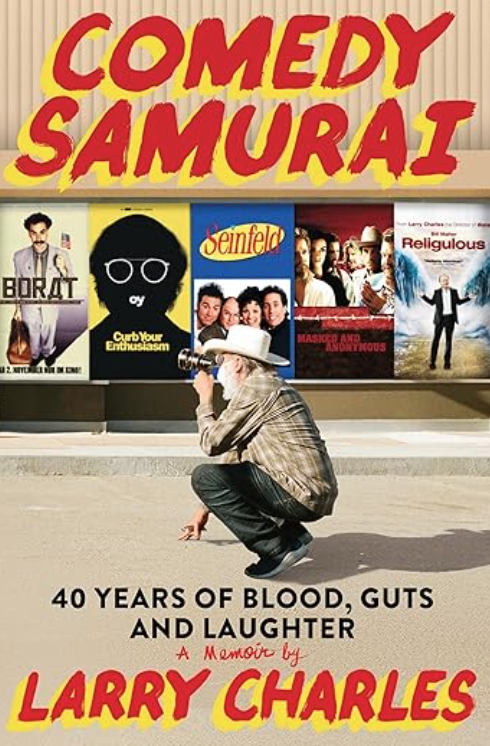
I recently read Comedy Samurai: 40 Years of Blood, Guts, and Laughter by Larry Charles. Below are the quotes I found most interesting. If you enjoy them, buy the book here.
“I have found after years of doing this that writers enter these first meetings h the personas they want to project—cool, reserved, aggressive,
—but after a few weeks of grinding under pressurized deadlines, masks are discarded and you are who you are. And that’s a relief. Because to interact as a staff and produce the best-quality work, important that people be authentic. Even and maybe especially writers.” (10)
“I realized that people had LA all wrong. The first mistake was comparing it to New York. New York with its skyline and classic iconic architecture was renaissance art. You could look at it and know immediately why it was beautiful. LA was modern art. Jagged and jarring, risking ugliness and formlessness, but if you looked at it long enough and deeply enough, the beauty emerged.” (38)
“I was still trying to figure out what I’d done wrong when the answer was nothing. Life just works that way sometimes. Some people are lucky, and some people, large pools of people—in fact, entire regions of the earth—are fucked.” (41)
“Of course it’s absurd. It’s ridiculous. Its meaninglessness is what’s meaningful. It’s everything, it’s nothing. Embrace the absurdity.” (49)
“Failure is a crucial component of success. There is no success without failure. I’ve worked with some of the greats, and their failures are legion. Publicly humiliating failures. But they were not deterred. But rejection is crippling for some of equal talent and vision and destroys their ability to move on.” (84)
“I walked through the stage, answering a nonstop barrage of questions. That’s what being a show runner is. Answering questions. Solving problems. Making creative decisions. And you hope that you’re right enough of the time to make the show a hit.” (92)
“First, I had to learn to deal with writers as the boss, as a leader. On Seinfeld, there was no writers’ room, which was a staple of sitcoms of the ’80s, ’90s, and beyond, and eventually movies as well. Gangs of writers all pitching ideas desperately, because their jobs depended on it, that rarely meshed. For me, it diluted the singular voice of the show, any show, and reduced it to a corporate echo of what the show should be. This became standard operating procedure everywhere but notably not at Seinfeld. The writers’ room was an early low-tech version of AL.” (93)
“Gordon Hunt, who had such a varied résumé, was a consummate actor’s director. Gordon was a listener. The actors always felt heard.
And he was always willing to explore ideas and thoughts. My epiphany from him was, if you want actors to take chances and make leaps, you must make them feel secure, and each reaches that point a different way.” (95)
“He was a hiatus baby. Get pregnant before the season starts. Give brith when the season ended.” (98)
“One of the key lessons I learned from Curb was to let go of con-trol. Magic can’t happen if you try to control it. You want to guide it, harness it somewhat, but be allowed to unleash the magic and let it flourish. If that happens in front of the camera, you establish that one-of-a-kind, one-time, lightning-in-a-bottle intimacy with the audience. And the audience responds.” (113)
“But Bob was convinced this was the title, and so it was. And I was a believer. Bob was conjuring spirits from another realm. He was pure instinct. No second-guessing. Fearless as an artist. And he taught me to take that final step and be the same. Trust your instincts. That’s all you have. Everything else is bullshit and illusion.” (123)
“But it’s about non-attachment. We can’t change the past. We can only truthfully and honestly report it. Witness to our life.” (142)
“I had failed before. And learned to embrace failure as part of the success equation. And knew that failure, like success, came in many unexpected forms. Not that failure didn’t hurt and leave lingering wounds, but if you choose this path, you have no choice. There’s a price you pay for everything.” (143)
“I needed an agent to negotiate with my own agent.” (144)
“But I was into the show. This was often the problem. I loved Curb. And Entourage. Thought they were great shows. I wanted to contribute to great things, and it made me vulnerable to the unscrupulous behavior of the Hollywood manipulators.” (145)
“Although I thought the show (Entourage) was great and distinctive, that’s all I usually have any control or influence over. The rest-the commercial success or viability of one project or another-always comes as some sort of surprise.” (148)
“The most enlightened people we met on our journey by far, and perhaps most ironically, were the Vatican priests. Why? They were well educated. In fact, they were PhDs. They understand the difference between the value of myth as representative and metaphorical for truth versus reality. They had no illusions about God, Jesus, religion. But they had to continue selling the message to the masses. Somebody had to make payments on the house.” (207)
“Science wasn’t even invented until five hundred years after religion, so of course, religion couldn’t ever reconcile scientific evidence with faith. Religion is not, nor was it meant to be, nor could it ever be, science. That simple timeline explained so many misconceptions.” (208)
“Ray Suarez writes about the Jefferson Bible, a version of the Bible that Jefferson himself wrote, which omits any reference to miracles or the supernatural. How many religious patriotic Americans realize that?” (210)
“Control, to a large degree, is an illusion. Luck occurs in that nonrational realm between complete control and complete letting go.” (256)
“More often in life, there are no heroes or villains. Only flawed humans. And reality.” (276)
“That is the nature of power. Undoing what is already done.” (283)
“Sacha had developed the habit at previews of the previous movies of marking each laugh with a grade based purely on audience reaction, and those gags with lower grades would be dropped. It seemed quite clear to me that he had lost his instinct and was no longer confident to stay ahead of the audience and was satisfied with them telling him what to do.” (285)
“The audience was now telling Sacha what was funny, and that could be lethal.” (285)
“The more reliance on the audience to guide the performers, the weaker and weaker the product.” (285)
“I believe what an audience responds to is a compelling character, good or bad.” (286)
“Structural questions regarding jokes and laughs can be broken down into micro-structure and macro-structure. An example of macro-structure is: Is the premise that this whole scene rests on even funny? And if not, why not? The micro might be, the payoff might be perfect, but the setup is wrong and is stopping the joke from reaching its maximum laugh potential. And what if an audience is laughing so hard from the previous “joke,” they laugh over the joke in question? How do you accurately grade that?” (287)
“Larry David never worried about what the audience thought. And he never worried about jokes. In fact, he was anti-joke and pro-structure. If the character and the situation were well set up, then you didn’t need jokes to make the scene funny.” (287)
“The audience doesn’t want to tell us what’s funny. It’s relying on us to tell them. That is the responsibility of a comedy.” (288)
“Of course, I heard complaints from the writers. It was a natural outgrowth of making creative contributions without the sufficient power or leverage to enforce them. I’d never met a writer who didn’t complain. Including myself.” (288)
“Risking bad taste is an important component of great comedy. Good taste was a target of satire and derision in great comedy.” (290)
“I realized that Sacha didn’t really understand why the Naked Fight worked. It worked because we knew and cared about the characters of Borat and Azamat and were invested in their relationship, so that the Naked Fight arose organically out of the situation and characters, as extreme and radical as it was.” (304)
“Failure is essential to creative growth. Even though I didn’t want to have to live through it again. But there I was.” (308)
“there is no separation between the laughter and tears, the joy and sadness.” (383)
“We all think that the time that we live in is the only time, the most important time, the last time, instead of, oh well, another time. One of an infinite number that exist in multiple realms. It seems like it will go on forever, but the only constant is, it won’t. Not in the way we imagine it.” (383)
“I don’t think I realized until I wrote the book, until I read the book, how much I was the agent of my own misfortune. I had lost my temper, been impatient and uncool, betrayed those closest to me, wasn’t honest especially with myself. Acted impulsively, selfishly, thoughtlessly, with everyone and everything in my life as well. Why was I rushing past everything? What was I rushing for? What was I rushing to? Death? What was the rush? Did my hfear hasten my journey? And what did I miss along the way?” (383)
“I could’ve been more generous with the joy and love I doled out.” (383)
“Rare was the time I was with my children, girlfriends, wives, friends, work, and allowed myself to feel the love and luck of my life. The joy of the moment. Instead I only felt pressure.” (384)
“Are we simply randomly thrown into the brief, brutal earthly existence, long enough to suffer but too short to understand? Funny, right?” (386)
Enjoyed the quotes? Buy Larry Charle’s Comedy Samurai book here.