“Every generation of humans believed it had all the answers it needed, except for a few mysteries they assumed would be solved at any moment. And they all believed their ancestors were simplistic and deluded. What are the odds that you are the first generation of humans who will understand reality?” (21)
“Four billion people say they believe in God, but few genuinely believe. If people believed in God, they would live every minute of their lives in support of that belief. Rich people would give their wealth to the needy. Everyone would be frantic to determine which religion was the true one.” (27)
“It is not belief to say God exists and then continue sinning and hoarding your wealth while innocent people die of starvation. When belief does not control your most important decisions, it is not belief in the underlying reality, it is belief in the the usefulness of believing.” (29)
“People claim to believe in God, but most don’t literally believe. They only act as though tye believe because there are earthly benefits in doing so.” (29)
“The best any human can do is to pick a delusion that helps him get through the day.” (29)
“It is beyond the human brain to understand the world and its environment, so the brain compensates by creating simplified illusions that act as a replacement for understanding. When the illusions work well and the human who subscribes to the illusion survives, those illusions are passed to new generations.” (34)
“I can conceive of only one challenge for an omnipotent being – the challenge of destroying himself.” (42)
“Are you saying we’re evolving into God?” “I’m saying we’re the building blocks of God, in the early stages of reassembling.” “I think I’d know it if we were part of an omnipotent being,” I said. “Would you? Your skin cells are not aware that they are part of a human being. Skin cells are not equipped for that knowledge. They are equipped to do what they do and nothing more. Likewise, if we humans – and all the plants and animals and dirt and rocks – were components of God, would we have the capacity to know it?” (53)
“Luck conforms to normal probability curves. Most people will have average luck and some people will experience extra good luck or extra bad luck. A handful will have good luck so extraordinary that it will be indistinguishable from magic.” (76)
“We like to believe that other people have the same level of urges as we do, despite all evidence to the contrary. We convince ourselves that people differ only in their degree of morality or willpower, or a combination of the two. But urges are real, and they differ wildly for every individual. Morality and willpower are illusions. For any human being, the highest urge always wins and willpower never enters into it. Willpower is a delusion.” (94)
“Women believe that men are, in a sense, defection versions of women. Men believe that women are defective versions of men. Both genders are trapped in a delusion that their personal viewpoints are universal. That viewpoint – that each gender is a defective version of the other – is the root of all misunderstandings.” (110)
“Women define themselves by their relationships and men define themselves by whom they are helping. Women believe value is created by sacrifice. If you are willing to give up your favorite activities to be with her, she will trust you.” (110)
“Men believe value is created by accomplishment, and they have objectives for the women in their lives. If a woman meets the objectives, he assumes she loves him.” (111)
“The best you can hope for in a relationship is to find someone whose flaws are the sort you don’t mind. It is futile to look for someone who has no flaws, or someone who is capable of significant change; that sort of person only exists in our imaginations.” (112)
“A woman needs to be told that you would sacrifice anything for her. A man needs to be told he is being useful. When the man or woman strays from that formula, the other loses trust. When trust is lost, communication falls apart.” (112)
“You should lie about your talents and accomplishments, describing your victories in dismissive terms as if they were the result of luck. And you should exaggerate your flaws.” (113)
“Your problem is that you view conversation as a way to exchange information… conversation is more than the sum of the words. It is also a way of signaling the importance of another person by showing your willingness to give that person your rarest resource: time. It is a way of conveying respect. Conversation reminds us that we are part of a great whole, connected in some way that transcend duty or bloodline or commerce. Conversation can be many things, but it can never be useless.” (113-114)
“Don’t judge people by their mistakes; rather, judge them by how they respond to their mistakes.” (114)
“People who do affirmations will have the sensation that they are causing the environment to conform to their will. This is an immensely enjoyable feeling because the illusion of control is one of the best illusions you can have.” (119)
“Not all leaders are irrational,” I argued. “The most effective ones are. You don’t often see math geniuses or logic professors become great leaders. Logic is a detriment to leadership.” (127)
“In America the share of national income going to the top .01% (some 16,000 families) has risen from just over 1% in 1980 to almost 5% now – an even bigger slice than the top .01% got in the Gilded Age.” (xii)
“Today, women in the United States, on average, have the lowest life expectancy of women in any of the advanced countries.” (xiii)
“Non-Hispanic white women with a college degree have a life expectancy that is some ten years greater than the life expectation of black or white women without a high school diploma.” (xiii)
“There was no reason to believe that giving more money to America’s wealthy would lead to more investment in the United States: money goes to where returns are highest, and with America’s downturn, returns often look higher for investments in the emerging markets. And even when there is investment in the United States, it’s not necessarily investment related to job creation: much of the investment is in machines designed to replace labor, to destroy jobs.” (xvi)
“The top 400 income earners in the United States paid an average tax rate of just 19.9 percent in 2009. Overall, the richest 1 percent of Americans pay effective tax rates in the low twenties, lower than those of Americans with more moderate incomes.” (xxvii)
“Some of the growth in inequality can be attributed to globalization and the replacement of semiskilled jobs with new technologies and outsourced labor.” (xxvii)
“Societies with more economic inequality tend to have more political inequality, especially when it reaches the outsize levels.” (xxviii)
“The chances of an American citizen making this way from the bottom to the top are less than those of citizens in other advanced industrial countries.” (xlv)
“For years there was a deal between the top and the rest of our society that went something like this: we will provide you jobs and prosperity, and you will let us walk away with the bonuses. You all get a share, ven if we get a bigger share. But now that tacit agreement between the rich and the rest, which was always fragile, has come apart.” (xlvii)
“The political system is more akin to “one dollar one vote” than to “one person one vote.” Rather than correcting the market’s failures, the political system was reinforcing them.” (1)
“Government policies have been central to the creation of inequality in the United States.” (7)
“In the mid-2000s, before the onset of the Great Recession, people in the bottom 80 percent were spending around 110 percent of their income.” (16)
“Some U.S. states spend as much on their prisons as they do on their universities.” (19)
“Money that is spent on “security” – protecting lives and property – doesn’t add to well-being; it simply prevents things from getting worse.” (19)
“Even as a myth, the belief that everyone had a fair chance had it uses: it motivated people to work hard. It seemed we were all in the same boat.” (25)
“Our hypothesis is that market forces are real, but that they are shaped by political processes.” (66)
“Imagine what the world would be like if there was free mobility of labor, but no mobility of capital. Countries would compete to attract workers. They would promise good schools and a good environment, as well as low taxes on workers. This could be financed by high taxes on capital.” (77)
“More than $3.2 billion was spent on lobbying in 2011 alone.” (119)
“Credit card companies would extract more money from transaction fees than the grocery store would profit from the sale of its goods.” (120)
“When inequality is as large as it is in the United States, it becomes less noticeable – perhaps because people with different incomes and wealth don’t even mix.” (185)
“If an individual believes what he has is a result just of his own efforts, he is less willing to share that wealth with others who he thinks chose to exert less effort. If an individual sees his success as a result largely of good luck, he is more willing to share that good fortune.” (199)
“In the great bailout of the Great Recession, one corporation alone, AIG, got more than $180 billion – more than was spent on welfare to the poor from 1990 to 2006.” (225)
“If debts can’t be discharged, or can’t be discharged easily, lenders have less of an incentive to be careful in lending – and more of an incentive to engage in predatory lending.” (242)
“Promotion is not how things are made great – only how they’re heard about.” (19)
“To be great, one must make great work, and making great work is incredibly hard. It must be our primary focus. We must set out, from the beginning, with complete and total commitment to the idea that our best chance of success starts during the creative process.” (19)
“Art is the kind of marathon where you cross the finish line and instead of getting a medal placed around your neck, the volunteers roughly grab you by the shoulders and walk you over to the starting line of another marathon.” (28)
“But Hamilton’s “topical writing has endured” works like The Federalist Papers and George Washington’s farewell address – “because he plumbed the timeless principles behind contemporary events.” (30)
“Seinfeld has transcended the era it was produced in primarily because, like many classics, it focused on what was timeless about timely events.” (31)
“Jeff Bezos reminds his employees, “Focus on the things that don’t change.”” (31)
“You can’t make something that lasts if it’s based on things, on individual parts that themselves won’t last, or if it’s driven by an amateur’s impatience. The creative process will require not only time and work, but also the long view.” (31)
“Peter Thiel writes, “If you focus on near-term growth above everything else, you miss the most important question you should be asking: Will this business still be around a decade from now?” (33)
“Creative people naturally produce false positives. Ideas that they think are good but aren’t. Ideas that other people have already had. Mediocre ideas that contain buried within them the seeds of much better ideas. The key is to catch them early. And the only way to do that is by doing the work at least partly in front of an audience. A book should be an article before it’s a book, and a dinner conversation before it’s an article. See how things go before going all in.” (42)
“Creation is often a solitary experience. Yet work made entirely in isolation is usually doomed to remain lonely.” (43)
“You don’t have to be a genius to make genius – you just have to have small moments of brilliance and edit out the boring stuff.” (43)
“Classics are built by thousands of small acts. And thinking about them in that way allows you to make progress.” (44)
“It’s about finding the germ of a good ideas and then making it a great product through feedback and hardwork.” (44)
“Many creators want to be for everyone… and as a result end up being for no one.” (45)
“Identify a proxy from the outset, someone who represents your ideal audience, who you then think about constantly throughout the creative process.” (46)
“You want what you’re making to do something for people, to help them do something – and have that be why they will talk about it and tell other people about it.” (49)
“The more clearly it expresses some essential part of the human experience, the better chance the products that address it will be important and perennial as well.” (49)
“The creator of any project should try to answer some variant of these questions: What does this teach? What does this solve? How am I entertaining? What am I giving? What are we offering? What are we sharing?” (51)
“An essential part of making perennial, lasting work is making sure that you’re pursuing the best of your ideas and that they are ideas that only you can have (otherwise, you’re dealing with a commodity and not a classic.” (52)
“The Grateful Dead weren’t trying to be the best at anything, they were trying to be the only ones doing what they were doing. Srinivas Rao put it well: “Only is better than best,” (53)
“Far too many people set out to produce something that, if they were really honest with themselves, is only marginally better or different from what already exists. Instead of being bold, brash, or brave, they are derivative, complementary, imitative, banal, or trivial. The problem with this is not only that it’s boring, but that it subjects them to endless amounts of competition.” (53)
“The higher and more exciting standard for every project should force you to ask questions like this: What sacred cows am I slaying? What dominant institution am I displacing? What groups am I disrupting? What people am I pissing off?” (54)
“Brashness, newness, boldness – these attitudes are not at all at odds with perennial sales. In fact, it’s an essential part of the equation. Stuff that’s boring now is probably going to be boring in twenty years. Stuff that looks, sounds, read, and performs like everything else in its field today has very little chance of standing out tomorrow.” (54)
“People want things that are really passionate. Often the best version is not for everybody. The best art divides the audience. If you put out a record and half the people who hear it absolutely love it and half the people who hear it absolutely hate it, you’ve done well. Because it is pushing that boundary.” (55)
“Cyril Connolly said that literature is writing meant to be read twice – everything else is mere journalism.” (57)
“One agent I work with put it to me, “Spend three times longer revising your manuscript than you think you need.” (58)
“Robert McKee said, “I don’t think anyone can actually set out consciously to produce a masterpiece. I think what we do is to tell the best story we can, the best way we can, and produce it in the best way possible, and then see how the world reacts to it.” (59)
“The more nervous and scared you are – the more you feel compelled to go back and improve and tweak because you’re just not ready – the better it bodes for the project.” (59)
“Nobody wants the hassle of cultivating a diamond in the rough. If you want to be successful, you’d better be cut, polished, set, and sized to fit. What does that mean? At a very basic level, if you’re not amazing in every facet, you’re replaceable. To publishers, studios, investors, and customers alike.” (68)
“Remember Neil Gaiman’s advice: When people tell you something’s wrong or doesn’t work for them, they are almost always right. When they tell you exactly what they think is wrong and how to fix it, they are almost always wrong.” (73)
“Seth Godin explained, “Everything that has a clear path to commercial success is in a genre.”” (80)
“This is why creators must know which variable(s) the project will hing eon. They must know which conventions of the genre they are observing and which ones they are taking a risk on by tweaking or subverting. They must understand – even if it is some vague gut notion – what they are making and what they are aiming for. If they do, the rest can be lined up against it.” (81)
“You must be able to explicitly say who you are building your thing for. You must know what you are aiming for – you’ll miss otherwise. You need to know this so you can make the decisions that go into properly positioning the projects for them. You need to know this so you can edit and refine the work until it’s so utterly awesome that your target group cannot resist buying it. Marketing then becomes a matter of finding where those people are and figuring out the best way to reach them.” (86)
“The key to this is to service the core audience first and do so in a way that does not alienate the others – only then can you emanate outwardly from the center.” (87)
“Robert Greene wanted a diversity of examples in his work so that every reader would feel included.” (89)
“You must create room for the audience to inhabit and relate to the work. You must avoid the trap of making this about you – because, remember, you won’t be the one buying it.” (89)
“Today, in order to even have a chance at people’s attention, your project has to seem as good as or better than all the others. Three critical variables determine whether that will happen: the Positioning, the Packaging and the Pitch. Positioning is what your project is and who it is for. Packaging is what it looks like and what it’s called. The Pitch is the sell – how the project is described and what it offers to the audience.” (90)
“Work that is going to sell and sell must appear as good as, or better than, the best stuff out there. Because that’s who you’re competing with: not the other stuff being released right now, but everything that came before you. A new TV show is competing with on-demand episodes of Breaking Bad and Seinfeld and The Wire. A new book is competing with Sophocles and John Grisham.” (91)
“Harvey Weinstein wrote to Errol Morris with this admonition: Speak in short one-sentence answers and don’t go in with all the legalese. Talk about the movie as a movie and the effect it will have on the audience from an emotional point of view. If you continue to be boring, I will hire an actor in New York to pretend that he’s Errol Morris… Keep it short and keep selling it because that’s what is going to work for you, your career and the film.” (96)
“You’re going to need to explain to reporters, prospective buyers or investors, publishers, and your own fans: Who this is for Who this is not for Why it is special What it will do for them Why anyone should care.” (97)
“You must be willing to be a big enough jerk – ahem, enough of a perfectionist – to say: “No, we’re not moving on from here until we get this right.”” (98)
“Nothing else will matter – the quality of your product, the strength of your marketing – if the premise and the pitch of the product are wrong.” (98)
“I am making a ____ that does ___ for ___ because ____.” (98)
“If your goal is to make a masterpiece, a perennial seller for a specific audience, it follows that you can’t also hope that it is a trendy, of-the-moment side hustle.” (100)
“We can’t prioritize the gatekeepers (the media) over the goalkeepers (the audience). To do so is foolishly shortsighted.” (103)
“Jeff Goins makes the distinction between starving artists and thriving artists. One adopts all the tropes and cliches of the bohemians and supposed purity. The other is resilient, ambitious, open-minded, and audience-driven.” (104)
“Winston Churchill said, “To begin with, your project is a toy and an amusement. Then it becomes a mistress, then it becomes a master, then it becomes a tyrant. The last phase is that just as you are about to be reconciled to your servitude, you kill the monster and fling it to the public.” (105)
“Marketing is anything that gets or keeps customers.” (110)
“It is the job as the marketer of my work to make people care, and that’s not going to be possible if I start with any illusions or entitlements.” (115)
“A recent study found that when you visit the Facebook News Feed, more than 1,500 pieces of content are vying for your attention. There is, in other words, a 1-in-1,500 chance of even seeing a desired customer.” (116)
“No one has the steam or the resources to market something for more than a short period of time, so if a product is going to sell forever, it must have a strong word of mouth.” (119)
“Our marketing efforts, then, should be catalysts for word of mouth.” (119)
“Hey, as many of you know, I have been working on ___ for a long time. It’s a ___ that does ___ for ___. I could really use your help. If you’re in the media or have an audience or you have any ideas or connections or assets that might be valuable when I launch this thing, I would be eternally grateful. Just tell me who you are, what you’re willing to offer, what it might be good for, and how to be in touch.” (126)
“A smart business friend once described the art of marketing to me as a matter of “finding your addicts.” (128)
“Price is marketing.” (140)
“A critical part of attracting influencers is to look for the people who aren’t besieged by requests.” (146)
“We announced he was accepting Bitcoin payments for the book… both of them ended up getting media attention, mostly from outlets that don’t otherwise cover rap music or books.” (160)
“Tell me what to do!” the student says. Epictetus corrects him, “It would be better to say, ‘Make my mind adaptable to any circumstances.’” (170)
“If you have to choose between spending money to pay for a publicist or buying your own products and giving them away to the right early adopters, you should go with the latter every time.” (170)
“Where other bands relied on radio, on being on MTV, on being timely or on trend, Iron Maiden focused on one thing and one thing only: building a cross-generational global army of loyal fans who buy every single thing they put out.” (177)
“Casey Neistat says, “Platform is not a stepping stone. It is the finish line.”” (183)
“Marcus Aurelius once admonished himself to be a “boxer, not a fencer.” A fencer, he said, has to bend down to pick up his weapon. A boxer’s weapon is a part of him – “all he has to do is clench his fist.” In developing a platform, we eschew the promotional apparatus that must be rebuilt and picked up anew with each and every launch. Instead, we choose to bind ourselves to an audience, to become one with that audience, and to become one with our weapon.” (184)
“Focus on “pre-VIPs” – The people who aren’t well known but should be and will be.” (193)
“More great work is the best way to market yourself.” (205)
“Creating more work is one of the most effective marketing techniques of all.” (205)
“It turns out that with each new album, the sales of a band’s previous album will increase. As the researchers wrote, “Various patterns in the data suggest the source of the spillover is information: a new release causes some uninformed consumers to discover the artist and purchase the artist’s past albums.” (206)
“There is a difference between something that services your audience and something that expands it.” (210)
“Colonel Parker, the infamous manager of Elvis Presley, came up with the idea to sell “I Hate Elvis” memorabilia, so that Elvis could profit from his haters too.” (211)
“Some questions to ask yourself: What are new areas that my expertise or audience would be valuable in? Is it possible to cut out the middleman like a label or a VC and invest in myself? Can I help other artists or creatives achieve what I have achieved? What are other people in my field afraid to do? What do they look down on? (These are almost always great opportunities.) What can I do to make sure that I am not dependant on a single income stream? If I took a break from creating, what would I do instead? What are parts of the experience ro community surrounding my work that I can improve or grow?” (214)
“Luck is polarizing. The successful like to pretend it does not exist. The unsuccessful or the jaded pretend that it is everything. Both explanations are wrong.” (220)
“As Nassim Taleb puts it, “Hard work will get you a professorship or a BMW. You need both work and luck for a Booker, a Nobel or a private jet.” (220)
“The more you do, the harder you work, the luckier you seem to get.” (221)
“We do what we do because there is nothing more rewarding than the artistic and creative process – even if those rewards aren’t always financial, even if they don’t accrue as quickly as we might have originally hoped.” (224)
“Bill Walsh explained that his goal was to “establish a near-permanent ‘base camp’ near the summit, consistently close to the top, within striking distance.” The actual probability of winning in a given year depended on a lot of external factors – injuries, schedule, drive, weather – just as it does for any mountain climber, for any author, for any filmmaker or entrepreneur or creative. We do know with certainty, however, that without the right preparation, there is zero chance of successfully making a run to the summit.” (226)
“Steve Martin once explained that there were three levels of “good” when it came to a movie: “One is when it comes out. Is it a hit? Then after five years. Where is it? Is it gone? Then again after ten to fifteen years if it’s still around. Are people still watching it? Does it have an afterlife?” (229)
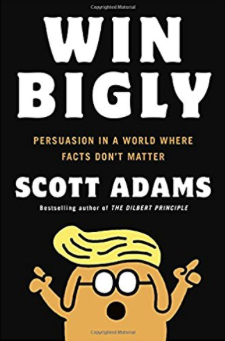
I recently read “Win Bigly: Persuasion In A World Where Facts Don’t Matter” by Scott Adams. Below are the quotes I found most interesting. If you like the quotes, click here to buy the book.
“We all think we are the enlightened ones. And we assume the people who disagree with us just need better facts, and perhaps better brains, in order to agree with us. That filter on life makes most of us happy – because we see ourselves as the smart ones.” (3)
“The method goes like this: Make a claim that is directionally accurate but has a big exaggeration or factual error in it. Wait for people to notice the exaggeration or error and spend endless hours talking about how wrong it is. When you dedicate focus and energy to an idea, you remember it. And the things that have the most mental impact on you will irrationally seem as though tye are high in priority, even if they are not. That’s persuasion.” (20)
“The things that you think about the most will irrationally rise in importance in your mind.” (22)
“Consider a small 2012 study by researcher Daniel Oppenheimer that found students had better recall when a font was harder to read.” (25)
“A good general rule is that people are more influenced by visual persuasion, emotion, repetition, and simplicity than they are by details and facts.” (25)
“Humans think they are rational, and they think they understand their reality. But they are wrong on both counts.” (35)
“The main theme of this book is that humans are not rational. We bounce from one illusion to another, all the while thinking we are seeing something we call reality. The truth ist hat facts and reason don’t have much influence on our decisions, except for trivial things, such as putting gas in your car when you are running low. On all the important stuff, we are emotional creatures who make decisions first and rationalize them after the fact.” (37)
“On mushrooms… your perceptions are independent from the underlying reality. This awareness never leaves you. Once you understand your experience of life as an interpretation of reality, you can’t go back to your old way of thinking.” (43)
“The most common trigger for cognitive dissonance is when a person’s self-image doesn’t fit their observations. For example, if you believe you are a smart and well-informed person, and then You do something that’s clearly dumb, it sends you into a state of cognitive dissonance. And once you are in that uncomfortable state of mind, your brain automatically generates an illusion to solve the discomfort. In this situation, your brain would tell you the new information was inaccurate. The alternative is to believe that you are dumb, and that violates your self-image. You don’t like to change your self-image unless it is in the direction of improvement.” (49)
“It is easy to fit completely different explanations to the observed facts. Don’t trust any interpretation of reality that isn’t able to predict.” (54)
“People are more influenced by the direction of things than the current state of things.” (68)
“The reality one learns while practicing hypnosis is that we make our decisions first – for irrational reasons – and we rationalize them later as having something to do with facts and reason.” (71)
“If you want the audience to embrace your content, leave out any detail that is both unimportant and would give people a reason to think, That’s not me. Design into your content enough blank spaces so people can fill them in with whatever makes them happiest.” (78)
“Our brains interpret high energy as competence and leadership (even when it isn’t).” (92)
“Our visual sense is the most persuasive of our fives senses, so using a real person whom we recognize, and can imagine, is a great technique.” (95)
“Below I rank for you the broad forms of persuasion by their relative power… Big fear Identity Smaller fear Aspirations Habit Analogies Rason Hypocrisy Word-thinking” (99)
“When you attack a person’s belief, the person under attack is more likely to harden his belief than to abandon it, even if your argument is airtight.” (106)
“Fear can be deeply persuasive. But not all fear-related persuasion is equal. To maximize your fear persuasion, follow these guidelines. A big fear is more persuasive than a small one. A personal fear is more persuasive than a generic national problem. A fear that you think about most often is stronger than one you rarely think about. A fear with a visual component is scarier than one without. A fear you have experienced firsthand (such as a crime) is scarier than a statistic.” (114)
“It is easier to persuade people when they expect to be persuaded. If your persuasion skills are viewed as credible, people will persuade themselves that you can persuade them, and that makes everything easier.Credibility, of any sort, is persuasive.” (116)
“If you want to persuade use visual language and visual imagery. The difference in effectiveness is enormous.” (137)
“Participate in activities at which you excel compared with others. People’s impression of you as talented and capable compared with the average participant will spill over to the rest of your personal brand.” (147)
“In business, always present your ideas in the context of alternatives that are clearly worse. Don’t just sell your proposed solution; slime all the other options with badness.” (147)
“Always remember that people make decisions in the context of alternatives. If you aren’t framing the alternatives as bad, you are not persuading at all.” (147)
“When you associate any two ideas or images, people’s emotional reaction to them will start to merge over time.” (153)
“Humans put more importance on the first part of a sentence than the second part.” (159)
“Simplicity makes your ideas easy to understand, easy to remember, and easy to spread. You can be persuasive only when you are also memorable.” (201)
“Revolution is a term that people use only when you’re successful. Before that, you’re just a quirky person who does things differently.” (10)
“If you think revolution needs to feel like war, you’ll overlook the importance of simply serving people better. When you’re onto something great, it won’t feel like revolution. It’ll feel like uncommon sense.” (10)
“Success comes from persistently improving and inventing, not from persistently doing what’s not working.” (11)
“The way to grow your business is to focus entirely on your existing customers. Just thrill them, and they’ll tell everyone.” (17)
“Watch out when anyone (including you) says he wants to do something big, but can’t until he raises money. It usually means the person is more in love with the idea of being big-big-big than with actually doing something useful. For an idea to get big-big-big, it has to be useful. And being useful doesn’t need funding.” (18)
“Never forget that there are thousands of businesses, like Jim’s Fish Bait Shop in a shack on a beach somewhere, that are doing just fine without corporate formalities.” (23)
“As your business grows, don’t let the leeches sucker you into all that stuff they pretend you need. They’ll play on your fears, saying that you need this stuff to protect yourself against lawsuits. They’ll scare you with horrible worst-case scenarios. But those are just sales tactics. You don’t need any of it.” (23)
“When you build your business on serving thousands of customers, no dozens, you don’t have to worry about any one customer leaving or making special demands.” (25)
“Have the confidence to know that when your target 1 percent hears you excluding the other 99 percent, the people in that 1 percent will come to you because you’ve shown how much you value them.” (27)
“No business goes as planned, so make ten radically different plans.” (30)
“Never forget why you’re really doing what you’re doing. Are you helping people? Are they happy? Are you happy? Are you profitable? Isn’t that enough?” (35)
“Your company should be willing to die for your customers. That’s the Tao of business. Care about your customers more than about yourself, and you’ll do well.” (39)
“It’s another Tao of business: Set up your business like you don’t need the money, and it’ll likely come your way.” (40)
“Even if you want to be big someday, remember that you never need to act like a big boring company.” (51)
“In the end, it’s about what you want to be, not what you want to have. To have something (a finished recording, a business, or millions of dollars) is the means, not the end. To be something (a good singer, a skilled entrepreneur, or just plain happy) is the real point. When you sign up to run a marathon, you don’t want a taxi to take you to the finish line.” (59)
“Being self-employed feels like freedom until you realize that if you take time off, your business crumbles. To be a true business owner, make it so that you could leave for a year, and when you came back, your business would be doing better than when you left.” (71)
“Kurt Vonnegut and Joseph Heller were at a party at a billionaire’s extravagant estate. Kurt said, “Wow! Look at this place! This guy has everything!” Joseph said, “Yes, but I have something he’ll never have… Enough.”” (81)