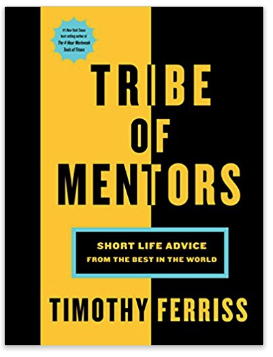
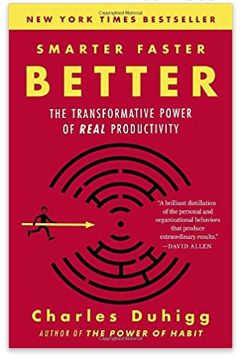
“Smarter Faster Better” Quotes

I recently read “Smarter Faster Better: The Secrets of Being Productive in Life and Business” by Charles Duhigg. Below are the quotes I found most interesting. If you like them, buy the book here.

“Motivation is triggered by making choice that demonstrate to ourselves that we are in control. The specific choice we make matters less than the assertion of control. It’s this feeling of self-determination that gets us going.” (20)

“We should reward initiative, congratulate people for self-motivation, celebrate when an infant wants to feed herself. We should applaud a child who shows defiant, self-righteous stubbornness and reward a student who finds a way to get things done by working around the rules.” (36)

“When we start a new task, or confront an unpleasant chore, we should take a moment to ask ourselves “why…” Once we start asking why, those small tasks become pieces of a larger constellation of meaningful projects, goals, and values.” (36)

“Project Oxygen found that a good manager 1) is a good coach; 2) empowers and does not micromanage; 3) expresses interest and concern in subordinates’ success and well-being 4) is results oriented; 5) listens and shares information; 6) helps with career development; 7) has a clear vision and strategy; 8) has key technical skills.” (43)

“They were all behaviors that created a sense of togetherness while also encouraging people to take a chance. We call it ‘psychological safety…’ a shared belief, held by members of a team, that the group is a safe place for taking risks. It is a sense of confidence that the team will not embarrass, reject, or punish someone for speaking up.” (50)

“The right norms could raise the collective intelligence of mediocre thinkers. The wrong norms could hobble a group made up of people who, on their own, were all exceptionally bright.” (60)

“All the members of the good teams spoke in roughly the same proportion… conversations didn’t need to be equal every minute, but in aggregate, they had to balance out.” (60)

“The good teams tested as having “high average social sensitivity” – a fancy way of saying that the groups were skilled at intuiting how members felt based on their tone of voice, how people held themselves, and the expressions on their faces.” (61)

“For psychological safety to emerge among a group, teammates don’t have to be friends. They do, however, need to be socially sensitive and ensure everyone feels heard.” (64)

“Teams need to believe that their work is important.
Teams need to feel their work is personally meaningful.
Teams need clear goals and defined roles.
Team members need to know they can depend on one another.
But, most important, teams need psychological safety.” (66)

“People who know how to manage their attention and who habitually build robust mental models tend to earn more money and get better grades.” (92)

“If you want to make yourself more sensitive to the small details in your work, cultivate a habit of imagining, as specifically as possible, what you expect to see and do when you get to your desk.” (92)

“Narrate your life, as you are living it, and you’ll encode those experiences deeper in your brain.” (92)

“Mental models help us by providing a scaffold for the torrent of information that constantly surrounds us. Models help us choose where to direct our attention, so we can make decisions, rather than just react.” (101)

“Employees work smarter and better when they believe they have more decision making authority and when they believe their colleagues are committed to their success. A sense of control can fuel motivation, but for that drive to produce insights and innovations, people need to know their suggestions won’t be ignored, that their mistakes won’t be held against them. And they need to know that everyone else has their back.” (165)

“At the intermediate level, you want to know as many rules as possible. Intermediate players crave certainty. But elite players can use that craving against them, because it makes intermediate players more predictable.” (173)

“The future isn’t one thing. Rather, it is a multitude of possibilities that often contradict one another until one of them comes true. And those futures can be combined in order for someone to predict which one is more likely to occur.” (179)

“We can always find the right story when we start asking ourselves what feels true,” Del Vecho told me. “The thing that holds us back is when we forget to use our lives, what’s inside our heads, as raw material” (223)

“Creativity can’t be reduced to a formula. At its core, it needs novelty, surprise, and other elements that cannot be planned in advance to seem fresh and new. There is no checklist that, if followed, delivers innovation on demand.
But the creative process is different. We can create the conditions that help creativity to flourish. We know, for example, that innovation becomes more likely when old ideas are mixed in new ways. We know the odds of success go up when brokers – people with fresh, different perspectives, who have seen ideas in a variety of settings – draw on the diversity within their heads. We know that, sometimes, a little disturbance can help jolt us out of the ruts that even the most creative thinkers fall into, as long as those shake-ups are the right size.” (235)

“If you want to become a broker and increase the productivity of your own creative process, there are three things that can help: First, be sensitive to your own experiences. Pay attention to how things make you think and feel. That’s how we distinguish cliches from true insights…
Second, recognize that the panic and stress you feel as you try to create isn’t a sign that everything is falling apart. Rather, it’s the condition that helps make us flexible enough to seize something new. Creative desperation can be critical; anxiety is what often pushes us to see old ideas in new ways. The path out of that turmoil is to look at what you know, to reinspect conventions you’ve seen work and try to apply them to fresh problems. The creative pain should be embraced.
Finally, remember that the relief accompanying a creative breakthrough, while sweet, can also blind us to seeing alternatives. It is critical to maintain some distance from what we create. Without self-criticism, without tension, one idea can quickly crowd out competitors. But we can regain that critical distance by forcing ourselves to critique what we’ve already done, by making ourselves look at it from a completely different perspective, by changing the power dynamics in the room or giving new authority to someone who didn’t have it before. Disturbances are essential, and we retain clear eyes by embracing destruction and upheaval, as long as we’re sensitive to making the disturbance the right size.” (236)

“When Alter conducts experiments, he sometimes gives people instructions in a hard-to-read font because, as they struggle to make out the words, they read the text more carefully. “The initial difficulty in processing the text leads you to think more deeply about what you’re reading, so you spend more time and energy making sense of it.” (247)

“Researchers found that hand writers scored twice as well as the typists in remembering what a lecturer said.” (265)

“Productivity doesn’t mean that every action is efficient. It doesn’t mean that waste never occurs. In fact, as Disney learned, sometimes you have to foster tension to encourage creativity. Sometimes a misstep is the most important footfall along the path to success.” (285)

Liked the quotes? Buy the book here.

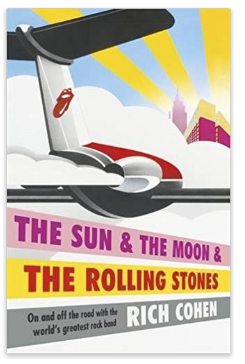
“The Sun & The Moon & The Rolling Stones” Quotes

I recently read “The Sun & The Moon & The Rolling Stones” by Rich Cohen. Below are the quotes I found most interesting. If you like the quotes, buy the book.

“An artist needs a belief. It does not matter whether that belief is Rastafarianism or Communism. It’s the structure of belief that matters – it gives their work coherence, shape. It’s there even when you don’t know it.” (21)

“There’s a moment when your real life starts, when you realize that what came before was prelude. Old friends and mentors – you shed them like baby teeth and you’re free.” (43)

“No more than a handful of people turned out. Gomelsky puts the number at three. When Brian asked, “What should we do?” Giorgio said, “What do you mean? Play!” You don’t punish the people who showed up for the sins of those who stayed home.” (62)

“There’s tremendous power in being first. In birth order, in the mysterious circle of fame. Being first means being free to invent and go it alone. Being in any place but first means riding the wake. It means being defined in comparison. It means being the next Beatles, the anti-Beatles, the new Beatles, or the shitty Beatles.” (66)

“When I was a boy, my father… told me that life is 99 percent marketing. “You’re better off with a great salesman and a mediocre product, than with a masterpiece and a moron to sell it.”” (78)

“Every now and then, a nation experiences a caesura, a pause between eras. To those who recognize such things, it’s an opportunity. Because a death is a birth and an exit is an entrance. Because you can only weep for so long. Because after tears you need laughter. As America emerged from its nightmare, Americans wanted something untainted with tragedy, fresh and new. It’s no coincidence that the Beatles landed in the United States less than three months after the Kennedy assassination.” (85)

“The Beatles had changed the rules; a band had to write songs. Bob Dylan made it even more important. It was about authenticity. A singer singing his own words is an artist; a singer covering someone else’s words is an actor.” (105)

“American rock stars aspire to immortality. They want to be James Dean and die beautifully. British rock stars aspire to aristocracy. They want to acquire titles and houses with names.” (155)

“In art, you have a choice, though you probably won’t realize it at the time. Posterity or right now.” (173)

“Forget the fact that open G had been around for years – if Richards stole the sound from Ry Cooder, why don’t Ry Cooder songs sound anything like the Stones? Why aren’t they nearly as evocative, menacing? IT gets at a deep unfairness: all the skill in the world does not add up to genius. Ry Cooder is a technically better player than Keith Richards, was goofing with open G first, and was after some of the same effects, but he did not have that same artistic soul.” (191)

“Mick’s showbiz, a pop version of the classic Hollywood diva, for whom the show must always go on, for whom obscurity is even more terrifying than death. It’s a special kind of charisma that generates tremendous light but little heat. People crave that light but get no sustenance from it. It destroys them. Life with Mick is life astride a black hole. Time accelerates. Two years ages you immeasurably. Yet none of it touches him. Because no one else matters. He’s the ego that became the world. He stands before the millions but the millions don’t exist. At the center of the universe, Mick Jagger dances alone.” (200)

“As you get older you’ll notice that no matter what direction you walk, you’re walking away.” (200

“Art is not linear; it’s circular. An artist does not improve, nor progress. He simply rides the wheel, waiting for the clouds to break and the sun to appear.” (230)

“Hemingway said: When they attack, they attack precisely what is strong, unique. What critics really want is a slightly different version of what they already love. If you give them something new, they will hate you. At first. But great work invents its own genre.” (277)

“The moment you build a shrine, you’re saying the past is more important than the present.” (307)

Liked the quotes? Buy the book here.

“Unstoppable: My Life So Far” Quotes

I recently read “Unstoppable: My Life So Far” by Maria Sharapova (and Rich Cohen – which is the reason I started reading the book). Below are the quotes I found most interesting. If you like them, buy the book here.

“By toughness, Yudkin meant persistence, the quality that makes you lock in and focus when asked to do the same thing a million times. If you ask most kids to do something, they will do it once or twice, then get restless, shut down, and walk away. To be great at anything, Yudkin believed, you had to be able to endure a tremendous amount of boredom. That is, you had to be tough.” (17)

“You have a good day, it’s a good day. You put together a string of good days, you have a good career.” (46)

“If you don’t have a mother to cry to, you don’t cry. You just hang in there, knowing that eventually things will change – that the pain will subside, that the screw will turn.” (47)

“That’s what people do not understand about tennis. You do not have to be the best player in the world to win. You only have to be better, on that day, than the person across from you.” (50)

“What made my career possible? IT was not all those times he embraced challenges and said yes. Way too much credit is given to the art or act of saying yes. It was all those times he said no that made the difference. Up to this point, yes – beyond this point, no.” (68)

“At the moment of temptation – by which I mean the appearance of an easier path – he always said no. ANd he did not despair about it. Because he’s determined, and because he believed.” (68)

“Anyone can be composed and cool while winning, when everything is going according to plan. But how do you deal with a losing streak? That’s the big question – that’s what separates the professionals from the cautionary tales.” (117)

“Without those parents, you would not have the Williams sisters or Andre Agassi or me. The tennis parent is the will of the player before the player has formed a will of her own.” (127)

“Having a two-year-old around when you play a big match is great because the two-year-old is interested but does not really care, and that not caring, that happy not caring, reminds you that, in the end, all of this is nothing. There are champions now; in ten years, there will be different champions. It’s fleeting, so have fun – that’s what you get from a two-year old.” (158)

“As hard as I practice, I have learned that doing nothing is just as important as doing everything.” (161)

“I know what losing does to you. I’d learned its lessons on tennis courts all over the world. It knocks you down but also builds you up. It teaches you humility and gives you strength. It makes you aware of your flaws, which you then must do your best to correct. In this way, it can actually make you better. You become a survivor. You learn that losing is not the end of the world.” (195)

“Winning fucks you up. First of all, it brings all kinds of rewards, which, if seen from the proper perspective, reveal themselves for what they really are: distractions, traps, snares. Money, fame, opportunity. Each laurel and offer and ad and pitch takes you further from the game. It can turn your head. It can ruin you, which is why there are many great players who won just a single Grand Slam, then seemed to wander away.” (195)

“It’s the first big test of a long career – yes, you can win, but can you win again? That’s an even tougher task. The history books are littered with names of athletes who got that single big win but never got a second Grand Slam. One-hit wonders. Not because they were not great, or won by luck. But because they never figured out how to adjust after everyone else has made their adjustments.” (202)

“What sets the great players apart from the good players? The good players win when everything is working. The great players win even when nothing is working even when the game is ugly; that is, when they are not great. Because no one can be great every day. Can you get it done on the ugly days, when you feel like garbage and the tank is empty?” (247)

“I’ve worked harder with Sven than I’ve ever worked in my life. That’s how it has to be when you get a little older. You need to go twice as hard to look half as natural. You need to double your effort to get the same result. In other words, practice is everything.” (268)

“There is no perfect justice, not in this world. You can’t control what people say about you and what they think about you. You can’t plan for bad luck. You can only work your hardest and do your best and tell the truth. In the end,it’s the effort that matters. The rest is beyond your control.” (288)

Liked the quotes? Buy the book here.
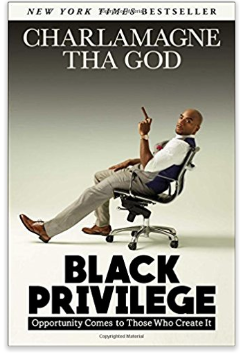
“Black Privilege” Quotes

I recently read “Black Privilege: Opportunity Comes to Those Who Create It” by Charlamagne Tha God. Below are the quotes I found most interesting. If you like them, buy the book.

“Opportunity truly does come to those who create it.” (xx)

“When you stop complaining about where you are physically and start focusing on where you are mentally, that’s when you will start to transcend your circumstances.” (1)

“When I’m stuck, I reconnect with my core. That means getting on a plane to Charleston and then heading straight to Moncks Corner. I will literally drive to my mom’s house and go sleep in my old bedroom.” (30)

“When I can reconnect with the dreams my younger self used to have, whatever little drama or doubt that was getting me down quickly becomes irrelevant.” (30)

“During the cultural revolution in China, wearing glasses often got people killed because they were a symbol of elitism>” (40)

“Fuck your dream (If it’s not really yours.)” (98)

“It’s critical that you be able to tell the difference between someone telling you “Fuck you dreams” in order to get you on the right path or simply telling you “Fuck your dreams” because they’ve already given up on their own.” (105)

“You can talk about all the magazines and blogs you’ve read, or discuss what rappers are dissing each other, but ultimately sharing your own life is what will take you to the next level. Honesty and intimacy is what forges a real connection with the audience.” (132)

“Very few things will center you and recharge your spirit like caring for your child.” (136)

“I don’t keep any personal items in my office. Because you just never know.” (When they might fire you) (141)

“When someone offers to help you, tell them exactly what you want. Don’t beat around the bush. If you’re not crystal clear about what your ask is, chances are you won’t get anything.” (148)

“You can never – even if the situation blows up in your face – hurt yourself by helping others.” (151)

“Success is a process: there are no cheat codes, no life hacks, no shortcuts, and no half steps. Opportunity always comes before money, but sadly a lot of us don’t recognize it unless there’s a paycheck attached. Don’t make that mistake.” (153)

“When you’re just starting out, put yourself in the position to be a part of the process, and THEN get that money.” (153)

“If you want to see a person’s true character, watch how they treat people who seemingly can’t help them.” (153)

“Too often we’re given bad advice on what it takes to get from where we are to where we want to be. We’re taught that the only accurate sign that we’re moving toward success is making money. We get caught up sweating the results instead of embracing the process. Even though embracing the process is the only way you’re ever going to get what you want out of life.” (157)

“Tommy Buns was telling them to slow down and focus on the work in front of them, no matter how small the job might seem, instead of immediately looking forward to the big scores. If they couldn’t even put the weed in the bag first, how were they going to go out and become major players/” (157)

“You’re supposed to be busting your ass for “nothing” when you’re in your twenties. And sometimes even your thirties. That doesn’t mean you’re being exploited. It means you’re building up the skills, connections , and reputation to eventually build a platform on your own.” (160)

“If hard work is the best quality an intern can display, ambition is definitely one of the worst. That doesn’t mean you can’t be ambitious… but I guarantee their employers weren’t too aware of that ambition when they were interning. They all knew how to keep that ambition in check until the time was right” (163)

“In order to be a great intern, you must have blinders on and stay focused on the work that’s in front of you, instead of the work you want to be doing down the road. This is because the program directors, managers, producers, and supervisors don’t care about your dreams. They’re focused on their own. So don’t waste their time making noise about what you want or what your master plan is.” (163)

“Your only value to them is the work you put in. If you’ve handled your internship correctly, when it’s time to move on, your superior should come to you and say, “So, what are you trying to do with your career?” And when you tell them, it should be their first time hearing your plans.” (164)

“I’d rather take less money now if it helps set me up to get more in the long run. I’m focused on creating opportunity for myself, not wring every last penny out of a deal.” (166)

“I asked Paul, “Tell me how people who’ve achieved fame manage to fall off?” “Their attitudes and managers,” he replied. “Bad attitude speaks for itself, But you know, you get these managers that speak for you and they take a bunch of your money and they create drama where there is no need for it,” he told me. “The most dangerous thing they do is gas up the talent. They make you feel like you’re bigger than the company, which you never are. I don’t care how famous you are, or how much press you get, you’re never bigger than the company. And if a manager makes you feel like you are, they’re doing you a great disservice.”” (171)

“Measure your success by the opportunities you’re presented with and the opportunities you’re creating for others. Not the amount of zeroes in your paycheck. When that’s your sole measurement, you’re going to come up short in the end.” (172)

“Being active on social media can amplify the work you’re already doing, but it is not work unto itself.” (174)

“He just had that combination of charisma and work ethic that made him stand out despite his surroundings.” (178)

“Too many radio jocks and writers don’t share their true opinions because they’re more concerned with making friends in the industry than being advocates for their audiences.” (216)

“Opening up was the turning point. Instead of dissing me, they began to root for me. They wanted to walk my journey with me.” (219)

“It’s insane to expect to be further along in life if you’re still acting and thinking the same way that you always have.” (243)

“There are a lot of people whose main talent is their ability to coach.” (262)

Liked the quotes? Buy the book.

“Win Your Case” Quotes

I recently read “Win Your Case: How To Present, Persuade, and Prevail – Every Place, Every Time” by Gerry Spence. Below are the quotes I found most interesting. If you like them, buy the book.

“Our ability to feel has been supplanted by that tyrant called the intellect. We think. We do not feel. From the time we were children our left brain has become so completely dominant and our native feelings so rejected that we can no longer call upon them to reveal the truth, for the truth is most often a feeling.” (25)

“Logic and reason often become but tools used by those in power to deliver their load of injustice to the people.” (29)

“I tell lawyers that none of us is celver enough to choose the right words, the right vocal intonation, the right rhythms in our speech, the right facial expression, the right hand and body movements, and to choose them simultaneously, word after word, sentence after sentence, unless we are telling the truth as we perceive it, yes, as we feel it.” (31)

“That truth includes the revelation of our feelings. Yes, we care. Yes, we’re afraid. We may be inexperienced. We’re taking risks – risks that we may be rejected, even cast out. But we are open and honest about who we are and what we feel. In the end, our candor and caring cast a dazzling, if humble light on our presentation that leaves all of our shortcomings in forgotten shadows.” (32)

“Owning our feelings. When we stand before a jury or any other decision maker without owning our feelings we hide the most important part of us.” (32)

“Often we don’t have to identify our feelings for the jury – to say, “I feel angry,” or “I feel afraid,” or “I feel lonely” or sad, or confused, or lost. But when we are in touch with our feelings they’ll show through.” (32)

“To move others we must first be moved. To persuade others, we must first be credible. To be credible we must tell the truth, and the truth always beings with our feelings.” (32)

“Spontaneity is the key that unlocks the doors of the listener, because that which is spontaneous is honest and is heard as honest.” (35)

“When we’re tied to our notes, or worse, when we’re frozen in the words of a memorized script, the sounds, the language, the whole dramatic movement is lost.” (35)

“These risks of doing something in the moment are the risks we should take.” (39)

“We are being trained not to hear anything but what the voice of Big Brother (the corporate overlord) wants us to hear. We are being trained not to tune in to ourselves but to tune ourselves out and tune in the programs that Madison Avenue prepares for us, so that we, the New Indians, as it were, will voluntarily give up whatever we have in exchange for the trinkets and beads and booze that the corporate overlord wishes to sell us from the company store. In short, we have become deaf mutes of a kind.” (41)

“Never intentionally set out to frighten an opponent. If we can hold our opponent’s fear to a minimum it will be that much easier to defeat him.” (51)

“But if we turn on the dogs, turn on the fear, concentrate on it and feel it, we’re taken into a different world. Something happens to the dogs when we face the dogs. They being to slink away. Embracing fear we leave fear powerless. Fear becomes afraid of us.” (52)

“The only appropriate method to deal with fear is to own it.” (52)

“Once I understood that simple shift in paradigm from one who gives his permission to be defeated to one who withholds it, everything about me began to change – my voice, my posture, my self-esteem, my confidence, even my walk. One is either prey, victim, sufferer, wounded, loser, and casualty, and is devoured, or one is unconquerable.” (56)

“Changing one’s vision of the self gives birth to a new person. The question is no longer why am I being defeated/ No question is asked. The indomitable self radiates from the person and beams out in a sort of invisible halo of power. It is more than charisma. It is awesome to behold, like a roaring river. It need not take on the thunder of the orator. It is often quiet and easy, but the power is there – a sense that to conquer the person one would have to kill him with an ax.
Things change in the presence of such a person. Doors open. Respect is given as automatically as a smile returns a smile. Possessing such power, the person can be humble, and gentle, and loving, because refusing to give permission to be defeated, a simple, transforming state of mind, no longer requires the false accouterments of power – bravado, arrogance, and conceit. This power which is achieved by retaining what has belonged to us all along – our refusal to give our permission to be defeated – is complete and perfect in itself.” (57)

“It makes little difference how we deal with fear in the courtroom or any other room. Once it is dredged up from the murky, roiling depths and spread out in the sunshine it changes. It becomes something that can be dealt with because we have given ourselves permission to face it, and magically it loses its power. Once we understand that to be afraid is not synonymous with being a coward we can put its power to work for us. It will explode into action, into spontaneity, into emotional muscle, and into the caring and commitment we gather to win.” (59)

“If we understand that anger is most often the product of injury, then don’t we also understand that anger is a secondary emotion – that the hurt, the pain came first, after which anger rushed in to take its place? Indeed, the anger will not diminish until we have relieved ourselves of the hurt.” (61)

“If we understand that anger has been seeded by hurt, is it not more useful to deal with the hurt than with the anger? Our hurt is not threatening to the person who hurt us. But our anger is. Anger begets anger.” (61)

“But if I say to you, “That hurt me,” the response of the other is more likely to be, “I didn’t mean to hurt you, or I wish I hadn’t,” and the war may come to an end.” (61)

“We do not like angry people. But in the same way, we do not trust people who should be angry and who are not.” (63)

“When I walk into the courtroom I see the judge for who he is – an ordinary man with extraordinary power.” (70)

“Every courtroom I enter belongs to me. The judge and the opposing lawyers, indeed, the hostile witnesses, are my guests.” (72)

“The best way to tell the story is always from the inside out. It’s hard to tell our story until we know it – that is, until we’ve felt it – heard it with our third ear, seen it with the eyes of our client, until we have been gripped by it in deep places, and have finally lived it.” (94)

“Why do we need a theme for our case? It usually contains the essence of our story – the quintessential statement that continues to emerge from out of the chaos of words, that redirects us to the cause when the arguments lead to other places and fuzz our focus. The theme speaks of the underlying morality of the case – what is right or what is wrong. It is the final argument in a single phrase.” (95)

“Without a powerful theme we will win no wars, win no cases, sell no products, and advance no causes.” (96)

“The stories that each of us have experienced, although with differing details, are the same in their substance. For every story we hear we inhabit part of that story as our own.” (100)

“Before you can expect people to reveal their feelings, their biases and prejudices, we must first be willing to reveal our own – openly and honestly.” (116)

“Research reveals that something like eighty-five percent of jurors make up their minds in the case by the end of the opening statement.” (128)

“In the courtroom the contest is often simply over the credibility of the lawyers.” (129)

“Often we use the first person in telling the story. A certain power rises up out of a first-person narrative that cannot be duplicated in third-person story telling. And it is easy to move in and out of the first person.” (132)

“We think in pictures – not abstractions.” (146)

“If we know the story inside and out, if we’ve written and rewritten it, outlined it, and, with heroic tenacity, outlined it again, magically we will become spontaneous. We do not deliver a memorized statement. We do not read from notes. We simply have a loaded mind computer with a narrative that includes an outline, a beginning, a middle, and an end, and – trusting the wonders of the mind to now tell the story in an exciting and compelling way – we will give a winning opening statement.” (147)

Liked the quotes? Buy the book here.
Verified by ExactMetrics