Interview with John Vorhaus

Today I’m honored to interview John Vorhaus about his latest book, “How To Write Good” as well as some other topics. John Vorhaus is the author of the classic comedy writing textbook, The Comic Toolbox: How To Be Funny Even If You’re Not. Of all his novels, Lucy in the Sky is his favorite. When not writing novels and non-fiction, he travels the world, teaching and training writers – 29 countries on five continents at last count.

What are the biggest differences between your new book “How To Write Good” and older, “how to write” guides like Steven Pressfield’s The War of Art, etc?

jv expedition cropped

Mine has many fewer words, some of them invented. Seriously, I’m not sure that the differences are as important as the similarities. A wise teacher once told me, “The ocean is blue and it’s also wet,” by which she meant that you can learn something from everyone, even if it’s on a topic you know very well. I would expect that people reading How to Write Good (HTWG) will find some of the concepts resonant of other writing books they’ve read. However, since writers, like all artists, constantly need to “keep revelation alive,” it’s useful to have a steady stream of blew, wet, salty, deep, turbulent, fish-filled, mysterious oceans.

This is your second ebook (also see The Little Book of the Sitcom), will you ever publish a physical book again?

Yes. The third Radar Hoverlander novel, The Texas Twist, is due out from Prospect Park Books in June, in both ebook and dead tree format. Also, like LBOS, HTWG is available in print format for those who desire it.

While your book felt targeted at how to write a novel, I could see the applicability for all other sorts of writing. Was this intentional?

Yes. It’s hard to write a book on writing that covers all possible writing ground. Having written extensively about TV and film scriptwriting, and being now a working novelist, I thought I would put the emphasis on short-form and long-form prose; however, I take pains to point out that the tools I offer can be used by writers of everything from limericks to philosophy tomes. Indeed, I would hope that creators in whole other genres (artists, musicians, filmmakers) could get something out of my whimsical approach to creativity.

You talk about focusing on the process and ignoring the payoffs as one way to avoid paralysis. In your early career, how long were you focused on process until you started to see some payoff?

I would say I still am. I mean, I got a payoff, of a sort, the first time I went onstage as a singer/songwriter at an open mic night. Well, I got praise and a few bucks in a tip jar. Is that a payoff? I wrote three or four sitcom spec scripts before I started drawing work from that field. I wrote two and a half novels before I sold one. But throughout – from that day to this – I focus solely on “the words on the page.” It’s the only part of the process I can truly control, and if I let my mind wander to the parts I can’t control, well, despair sets in and nothing gets done.

But the point I would make to, especially, young writers is, “You have no idea how much time you have and how much real work you’ll get done.” Life is long. Your body of work will sustain you.

What’s your next book going to be about?

The Texas Twist revisits world-class con artist Radar Hoverlander and his band of merry scamsters as the work some rich veins of available cash in Texas and the Midwest. Everything goes great until an űber-con artist gets them in his sights…

From our previous interview, you mentioned “I can afford to sell small amounts of many products” this reminds me of the 1,000 true fans rule. What are your thoughts on that? Do you think the number of true fans necessary to sustain a career differ significantly based on the specific career (book author vs stand up performer vs musician, etc)?

I have no idea how to comment intelligently on that question. My business model has always been, “Go off in all directions at once. You’re sure to arrive somewhere.” With that in mind, I really don’t think about 1,000 true fans or any other arbitrary number. I just keep writing and keep trying to make people aware of my work. The rest, I trust, will take care of itself. I consider myself a pretty good promoter, but I’m crap at analytics. I couldn’t tell you definitively how many copies of anything I’ve sold. I just don’t care. I want a large enough audience to sustain my efforts, but I have no idea how to grow that audience beyond “keep on keepin’ on.”

What’s the biggest difference in comedy writing between today and when you started? What’s the biggest difference in writing in general (doesn’t have to be comedy)?

Technology. When I was coming up, the tools for making my own comic videos or films were prohibitively expensive, and the tools for distributing them were nonexistent. Now, thanks to cheap video cameras and editing software, plus the internet, anyone who wants to create can create. It’s much easier these days to “throw it out the window and see if it lands.” At the same time, the explosion of creative output has driven the perceived value of content way down. With millions of writers (not just comic writers) willing to give their content away for free, it gets harder and harder to make the argument that content should be paid for, and paid for at a premium.

Another big difference for “writing in general” is how much easier it is to do research now. I’ve written novels about cities I’ve never lived in, or even visited, but feel that I’m conveying an authentic sense of space, just because I have so much access to information about places I’ve never been.

Anything else readers should know?

People who find their way into my body of work are surprised to discover how eclectic it is. I’ve written comic novels and serious ones; how-to books on writing and creativity; and more than two million words on poker. I would just invite your readers to brows my Amazon author page. They’re bound to find something they like. Oh, and blah-blah-blah twitter @TrueFactBarFact.

Also, I mentioned earlier that my business model is “go off in all directions at once.” Actually I have another one that I like better: “Walk down the beach, pick up everything you find, turn it into a party hat.” That’s kind of what I was getting at in HTWG: The most important part of the writing process is to have fun with it so you’ll be motivated to keep after it. This world of ours contains so many blessed party hats that there’s really no reason for anyone to exist in any state other than pure bliss. I hope that HTWG will help writers, especially new writers, discover how easy and fun it is to have an effective, growing, thriving, active practice of writing.


Other Comedy Tips:

[wp_list_bookmarks category=”2″ & categorize=”0″ & title_before=” ” & category_before=” ” & category_after=” ” & title_li=”0″]
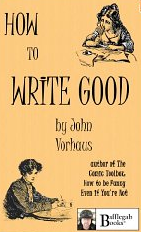
“How To Write Good” Quotes

I recently read “How To Write Good” an e-book by John Vorhaus. The quotes I found most interesting are below. As always, if you liked the quotes, please buy the full book here.

Screen Shot 2013-02-24 at 1.59.37 PM“90 percent of everything everyone thinks is pretty much the same stuff, so the trick of reading other people’s minds is really just getting better at reading your own.” (KL 70-72)

“Choice is made. Don’t second guess. Move on.” (KL 80-81)

“To me, in this context, better is largely just faster. I consider myself a “better” writer when my process is more efficient, when I’m getting more writing done.” (KL 86-87)

“Whimsy says that any choice is a good choice. Whimsy explores ideas just for fun. Whimsy doesn’t care about broken bits of writing or storytelling. Or grammar. Or syntax. Or complete sentences. Whimsy plans to fix everything later. Whimsy, out of sheer whimsy, thinks of as many ways as it can to express whimsy. Whimsy knows there’s more than one path through story. Whimsy says what the fruck. (And whimsy makes fruck a word.)  Whimsy knows the secret of how to write good.” (KL 89-92)

“It’s so great to be a writer who doesn’t fear to be a fool.” (KL 105)

“All real writers are addicted to writing. ” (KL 136)

“The first goal of every writing project, for this completist writer at any rate, is to get the first draft done, and that won’t happen in the presence of fear.” (KL 142-143)

“Judge a sentence by this test only: Does it get you to the next one? If yes, keep writing. If no, fix what needs to be fixed and move on. But the thing is, again, move on. Get that first draft finished. Major revisions – real fixes – will come later, and that’s part of your active practice, too.” (KL 175-177)

“Keep giving them you until you is what they want.” (KL 181-182)

“The more comfortable you become with making those arbitrary choices – the ones that make you cringe and think, Jeez, they’ll never buy this! – the sooner those arbitrary choices become your voice.” (KL 184-185)

“Trust your choices – not that they’re good ones, necessarily, but that they’re yours.” (KL 219)

“As a writer you want to make choices that are easy and fun for you. You don’t want to make choices based on how you think your work will be received or what traffic some mythical market will bear.” (KL 219-221)

“When I find myself shining too long or too much, what I do is I take the win. I bask in the moment momentarily, then tell myself to get over myself and get back to work.” (KL 491-493)

“What happens when things go as planned? Nothing. The story stalls because emotions remain unchanged.” (KL 530)

“Once you see pivots as the substrate of story, and once you understand your story as merely a long string of emotional states changed by new information, you’ll find that you get less and less lost, and your stories have more and more drive.” (KL 532-533)

“Drive a story from action to emotion, emotion to action, action to emotion, and start getting good at that.” (KL 573)

“At the right time in the development process you would dress up Jack’s room, describe the furniture, the people you see, fill it up with detail. That time, though, is not now. Now it’s just action, emotion, action, emotion, action, emotion, until you get the hang of it.” (KL 575-577)

“Don’t be afraid to write stuff that some people hate; if people don’t get worked up one way or another, you’re never going to have any kind of career.” (KL 593)

“Your writing’s not good, your writing’s not bad, it’s just the writing you’re doing now.” (KL 604-605)

“Feel good about writing bad. It’s easy to do if you remember that your writing always serves the twin goals of advancing the current work and advancing your craft.” (KL 608-609)

“Never get down on yourself for a day of bad writing. Every day, every hour, every minute you spend writing, even the worst, builds craft.” (KL 610-611)

“None of it’s wasted. None of it. I’ve had bunches of broken stories that lay fallow until I got good enough to fix them.” (KL 662-663)

“Writer’s block takes place at the specific intersection of too much fear and not enough information.” (KL 698)

“If you say ouch, my feelings every time someone gives you bad news about your work, A) you’ll drive those people away and, 2) your work will cease to evolve.” (KL 813-814)

“Inappropriately large goals kill will and crush productivity. Appropriately sized goals offer the immediate reward of a job, well, done.” (KL 860-861)

“You’re a writer; it’s your job to tell people what to think.” (KL 897)

“A theme is a truth we believe in and want to promote, expressed as a call to action.” (KL 940)

“For 99 percent of the writing process, the best thing to do with the audience is ignore it, because contemplation of the audience takes you off the page.” (KL 951-952)

“A story is an arc of change from denial to acceptance of the theme.” (KL 969-970)

“It’s easy as Mad Libs if you think about it. The theme of the story is [insert theme]. The hero is [insert name]. The story is [name learns to theme].” (KL 984-985)

“Rock bands figured it out long before writers. Just because they were on their own label didn’t mean they sucked. It meant they’d found a way around a clumsy, cumbersome distribution system that no longer met their needs.” (KL 1020-1021)

“More often than not, rules are made by rule-makers for the benefit of rule-makers. If those rules don’t benefit us, we don’t have to follow ‘em.” (KL 1023-1024)

If you liked the quotes, please buy the book here.

“The Fish That Ate The Whale” Quotes

I recently read “The Fish That Ate The Whale: The Life and Times of America’s Banana King” by Rich Cohen. Below are the quotes I found most interesting. As always, if you liked the quotes, please buy the book here.

The Fish That Ate The Whale“It’s what people mean when they speak of American exceptionalism: unlike the Europeans, we do not yet know you can’t be both powerful and righteous.” (xii)

“He believed in staying close to the action – in the fields with the workers, in the dives with the banana cowboys. You drink with a man, you learn what he knows. (“There is no problem you can’t solve if you understand your business from A to Z,” he said later.)” (12)

“The ability to attract followers would prove crucial. Though he said little, he was recognized as a leader. His team was better, stronger, tighter.” (28)

“The independents who survived this wave – a tidal wave that remade everything that came before – were allowed to survive by United Fruit. They were left to stand as proof of healthy competition. In other words, even its rivals existed so U.F. could prosper.” (47)

“It’s just the sort of person he was,” explained Brogan, who worked for Zemurray in South America. “He was one of those guys, part of him is always figuring. You listen to a man like that. He knows something that can’t be taught.” (52)

“One definition of evil is to fail to recognize the humanity in the other: to see a person as an object or tool, something to be put to use. The spirit of colonialism infected the trade from the start.” (65)

“There are times when certain cards sit unclaimed in the common pile, when certain properties become available that will never be available again. A good businessman feels these moments like a fall in the barometric pressure. A great businessman is dumb enough to act on them even when he cannot afford to.” (65)

“He believed in the transcendent power of physical labor – that a man can free his soul only by exhausting his body.” (71)

“Unlike most of his competitors, he understood every part of the business, from the executive suite where the stock was manipulated to the ripening room where the green fruit turned yellow. He was contemptuous of banana men who spent their lives in the North, far from the plantations. Those schmucks, what do they know? They’re there, we’re here!” (71)

“Go all in, or get out. Sam was young and wanted to bet everything: great fortunes come from big plays.” (74)

“What was Sam thinking, piling debt on debt, risk on risk? By buying out Hubbard, he was taking it all on his own shoulders. But what did it matter? If he failed by himself, he would lose the exact same amount as if he failed with a partner: everything.” (74)

“He had refused to play a bit part in life and went adventuring instead.” (81)

“Lee Christmas said, “Because I want the buzzards to eat me, and fly over you afterward, and scatter white shit all over your God-damned black faces.” (82)

“Every great victory carries the seed of ultimate defeat.” (96)

“When a man becomes my age in the United States,” Christmas told Molony, “he’s only good for fertilizer.”” (98)

“Zemurray never forgot the less. It does not matter hwo many bananas you ship: when you lose your reputation, you lose everything.” (101)

“There was not a job he could not do, nor a task he could not accomplish. (He considered it a secret of his success.)” (103)

“Speaking of Nicaragua, Zemurray notoriously said, “A mule costs more than a deputy.” (105)

“The executives who ran United Fruit had taken over from the founders and were less interested in risking than in preserving. Zemurray was the founder, forever on the attack, at work, in progress, growing by trial and error, ready to gamble it all.” (107)

“A corporation ages like a person. As the years go by and the founders die off, making way for the bureaucrats of the second and third generations, the ecstatic, risk-taking, just-for-the-hell-of-it spirit that built the company gives way to a comfortable middle age. Where the firm had been forward looking and creative, it becomes self-conscious in the way of a man, pestering itself with dozens of questions before it can act. How will it look? What will they say? If the business is wealthy and strong, the executives who come to power in these later generations will be characterized by the worst of self-confidence: they think the money will always be there because it always has been.” (109)

“Victor Cutter’s work was done by way of character building, a luxury of the middle class. Zemurray’s work was done in order to survive.” (110)

“Wars are not won by running your mouth.” (113)

“He formed his philosophy: get up first, work harder, get your hands int he dart and the blood in your eyes.” (118)

“He had since become a man of means. Whereas the young Sam was reckless and immune – from nowhere, with nothing – there were all sorts of ways the middle-aged Sam could be hurt. Success limited his options and made him vulnerable.” (118)

“Show me a happy man and I will show you a man who is getting nothing accomplished in this world.” (120)

“In some ways, the world was better back then. It did not matter if you were kind or as mean as a snake – you were supposed to give, so you gave. That’s all.” (128)

“He’d clearly been affected by the folk wisdom, what his father told his mother over the dinner table in Russia: that giving with display is not giving, but trading. I give you money, you give me prestige.” (128)

“The greatness of Zemurray lies in the fact that he never lost faith in his ability to salvage a situation. Bad things happened to him as bad things happen to everyone, but unlike so many he was never tempted by failure. He never felt powerless or trapped. He was, as I said, an optimist. He stood in constant defiance.” (139)

“When he was forbidden to build a bridge, he built a bridge but called it something else. For every move, there is a countermove. For every disaster, there is a recovery. He never lost faith in his own agency.” (139)

“The best tycoons are like magicians; they know when to share information and when to withhold.” (141)

“In a time of crisis, the mere evidence of activity can be enough to get things moving.” (148)

“When offered the freedom of America, which is not only freedom here and now, but also freedom from the past, freedom to choose what to remember, he grabbed it.” (162)

“No matter his wealth or power, the Hebrew would always be a stranger in a strange land, vulnerable to the slightest shift in the popular mood.” (163)

“Where did the interest of United Fruit end and the interest of the United States begin? It was impossible to tell. That was the point of all Sam’s hires: If I can perfectly align the interests of my company with the interests of top officials in the U.S. government – not the interests of the country, but the interests of the people in charge of the country – then the United States will secure my needs.” (186)

“Bernays had pioneered a trick he would use throughout his career. If you want to advance a private interest, turn it into a public cause.” (188)

“Castillo Armas had an interesting biography, always a helpful distraction for the media. (If you don’t want them to find the truth, give them a better story.)” (198)

“When you ask why the Jews, of all the people of the ancient world, have persisted into modern times, you can come up with various reasons: maybe it’s the power of the tradition, maybe it’s the will of God, or maybe it’s just that Jews had no choice, were locked in ghettos, confined to towns and professions where they had to marry other Jews. Even when the walls came down in Europe, Jews were hemmed in by prejudice and fear. But in America, where we’re all mutts, Jews were offered real freedom: not only to worship and travel and work, but from history. Jews could be Jews in America, or they could stop being Jews, which, for many, turned out to be the ultimate emancipation.” (226)

“A corporation is a product of a particular place and a particular time. U.S. Steel was Pennsylvania in the 1890s. Microsoft was Seattle in the 1980s. It’s where and when their sense of the world was fixed. The company brain is hardwired. Which is why a corporation, though conceivably immortal, tends to have a life span, tends to age and die. Unless remade by a new generation of pioneers – in which case it’s a different company – most corporations do not outlive the era of their first success. When the ideas and assumptions prevalent at the time of their founding go out of fashion, the company fades.” (229)

“United Fruit struggled under the weight of its own history, its own image. Once considered among the most enlightened corporations in America, it came to be seen as one of the worst.” (236)

“In the end, I decided that his career is the history of the nation, the promise and the betrayal of that promise, experienced in the span of a single life. It starts a hundred years ago, when America was a rising power, and ends the day before yesterday, with the confidence of the people sapped. It might look bad but, as Zemurray understood, as long as you’re breathing, the end remains to be written.” (242)

Did you like the quotes? Then buy the whole book here.

“Learned Optimism” Quotes

I recently finished reading Learned Optimism: How to Change Your Mind and Your Life by Martin Seligman. Below are the quotes I found most interesting. As always, if you like the quotes, please buy the book here.

Learned Optimism Cover“Women, in fact, being more emotionally labile, are both happier and sadder than men. The skills fo becoming happy turn out to be almost entirely different from the skills of not being sad, not being anxious, or not being angry.” (iv)

“”Happiness” is a scientifically unwieldy notion, but there are three different forms of it you can pursue. For the “Pleasant Life,” you aim to have as much positive emotion as possible and learn the skills to amplify positive emotion. For the “Engaged Life,” you identify your highest strengths and talents and recraft your life to use them as much as you can in work, love, friendship, parenting, and leisure. For the “Meaningful Life,” you use your highest strengths and talents to belong to and serve something you believe is larger than the self.” (iv)

“In a society in which individualism is becoming rampant, people more and more believe that they are the center of the world. Such a belief system makes individual failure almost inconsolable.” (vi)

“The defining characteristic of pessimists is that they tend to believe bad events will last a long time, will undermine everything they do, and are their own fault. The optimists, who are confronted with the same hard knocks of this world, think about misfortune in the opposite way. They tend to believe defeat is just a temporary setback, that its causes are confined to this one case. The optimists believe defeat is not their fault: Circumstances, bad luck, or other people brought it about. Such people are unfazed by defeat. Confronted by a bad situation, they perceive it as a challenge and try harder.” (5)

“Twenty-five years of study has convinced me that if we habitually believe, as does the pessimist, that misfortune is our fault, is enduring, and will undermine everything we do, more of it will befall us than if we believe otherwise. I am also convinced that if we are in the grip of this view, we will get depressed easily, we will accomplish less than our potential, and we will even get physically sick more often. Pessimistic prophecies are self-fulfilling.” (7)

“Habits of thinking need not be forever. One of the most significant findings in psychology in the last twenty years is that individuals can choose the way they think.” (8)

“When failure occurs, it is because either talent or desire is missing. But failure also can occur when talent and desire are present in abundance but optimism is missing.” (13)

“Changing the destructive things you say to yourself when you experience the setbacks that life deals all of us is the central skill of optimism.” (15)

“People who give up easily believe the causes of the bad events that happen to them are permanent: The bad events will persist, will always be there to affect their lives. People who resist helplessness believe the causes of bad events are temporary.” (44)

“If you think about bad things in always’s and never’s and abiding traits, you have a permanent, pessimistic style. If you think in sometimes’s and lately’s, if you use qualifiers and blame bad events on transient conditions, you have an optimistic style.” (44)

“People who believe good events have permanent causes are more optimistic than people who believe they have temporary causes.” (45)

“People who believe good events have permanent causes try even harder after they succeed. People who see temporary reasons for good events may give up even when they succeed, believing success was a fluke.” (46)

“It comes down to this: People who make universal explanations for their failures give up on everything when a failure strikes in one area. People who make specific explanations may become helpless in that one part of their lives yet march stalwartly on in the others.” (46)

“People who blame themselves when they fail have low self-esteem as a consequence. They think they are worthless, talentless, and unlovable. People who blame external events do not lose self-esteem when bad events strike. On the whole, they like themselves better than people who blame themselves do.” (49)

“Maybe what looks like a symptom of depression – negative thinking – is the disease. Depression, he argued courageously, is neither bad brain chemistry nor anger turned inward. It is a disorder of conscious thought.” (73)

“Depression results from lifelong habits of conscious thought. If we change these habits of thought, we will cure depression. Let’s make a direct assault on conscious thought, we said, using everything we know to change the way our patients think about bad events.” (75)

“Working wives are less depressed, on average, than wives who do not work outside the home.” (85)

“People who believe themselves stupid, rather than uneducated, don’t take action to improve their minds.” (87)

“The belief in self-improvement is a prophecy just as self-fulfilling as the old belief that character could not be changed.” (88)

“The difference between Sophie and someone who takes antidepressant drugs is that she learned a set of skills to use whenever she is faced with failure or defeat – skills she always carries with her. Her victory over depression is hers alone, not something she must credit to doctors and the latest medication.” (91)

“My profession spends most of its time (and almost all of its money) trying to make the troubled less troubled. Helping troubled people is a worthy goal, but somehow psychology almost never gets around to the complementary goal of making the lives of well people even better.” (96)

“Success requires persistence, the ability to not give up in the face of failure. I believe that optimistic explanatory style is the key to persistence.” (101)

“The explanatory-style theory of success says that in order to choose people for success in a challenging job, you need to select for three characteristics: 1. aptitude 2. motivation 3. optimism All three determine success.” (101)

“Depressed people – most of whom turn out to be pessimists – accurately judge how much control they have. Nondepressed people – optimists, for the most part – believe they have much more control over things than they actually do, particularly when they are helpless and have no control at all.” (109)

“Typically we are more depressed when we wake up, and as the day goes on we become more optimistic.” (113)

“On the whole, prepubescent children are extremely optimistic, with a capacity for hope and an immunity to hopelessness they will never again possess after puberty.” (125)

“One particular component of depression, hopelessness, is the most accurate predictor of suicide.” (126)

“He had isolated three protective factors. If any single one of the three was present, depression would not occur, even in the face of severe loss and privation. The first protective factor was an intimate relationship with a spouse or a lover. Such women could fight depression off well. The second was a job outside the home. The third was not having three or more children under the age of fourteen at home to take care of.” (134)

“In addition to invulnerability factors, Brown had isolated two major risk factors for depression: recent loss (husband dying, son emigrating) and, more important, death of their own mothers before the women had reached their teens.” (134)

“First – and most important – the children of divorce do badly, by and large. Tested twice a year, these children are much more depressed than the children from intact families. We had hoped the difference would diminish over time, but it doesn’t. Three years later, the children of divorce are still much more depressed than the other children.” (145)

“A team’s explanatory style for bad events strongly predicts how they do against the point spread after a loss in the next season. The optimistic teams cover the spread more often than the pessimistic teams do.” (163)

“Helplessness [in rats] produced more rapid growth of tumors.” (170)

“They found that the immune system turned down during grieving.” (177)

“All this evidence makes it clear that your psychological state can change your immune response. Bereavement, depression, and pessimism all can lower your immune system’s activity.” (178)

“We found that explanatory style for good events was completely changeable across fifty years. The same person could, for example, at one point in life regard good events as due to blind fate and at another time as due to his own skill. But we found that explanatory style for bad events was highly stable across a period of more than fifty years.” (178)

“Before age forty-five optimism has no effect on health. Until that age the men remained in the same state of health as at age twenty-five. But at age forty-five the male body starts its decline. How fast and how severely it does so is well predicted by pessimism twenty-five years earlier.” (181)

“The presidential candidates who were much more optimistic than their opponents won in landslides.” (190)

“We found that merely repeating positive statements to yourself does not raise mood or achievement very much, if it all. It is how you cope with negative statements that has an effect.” (221)

“To dispute your own beliefs, scan for all possible contributing causes. Focus on the changeable (not enough time spent studying), the specific (this particular exam was uncharacteristically hard) and the nonpersonal (the professor graded unfairly) causes.” (222)

“Schedule a specific time for thinking things over. It might be a half hour this evening or any other time that fits into your day. When you find yourself ruminating, you can say to yourself, “Stop! I’ll tackle that at seven thirty this evening.” The tormenting process of worrisome thoughts going round and round, coming back again and again, has a purpose. to make sure we don’t forget or neglect an issue we should deal with. But if we set aside a specific time for thinking the issue over, we undercut the very reason for brooding now, so the brooding is no longer psychologically necessary.” (277)

As always, if you liked the quotes, please buy the book here.

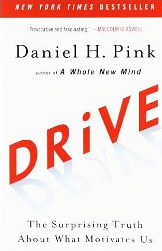
“Drive” Quotes

I recently finished reading Drive: The Surprising Truth About What Motivates Us by Daniel H. Pink. I consider this a comedy book since motivation and self-direction are so crucial to comedy. Below are the quotes I found most interesting. As always, if you like the quotes, please buy the whole book here.

Drive Cover“When money is used as an external reward for some activity, the subjects lose intrinsic interest for the activity,” Deci wrote. Rewards can deliver a short-term boost – just as a jolt of caffeine can keep you cranking for a few more hours. But the effect wears off – and, worse, can reduce a person’s longer-term motivation to continue the project.” (8)

“Societies also have operating systems. The laws, social customs, and economic arrangements that we encounter each day sit atop a lawyer of instructions, protocols, and suppositions about how the world works. And much of our societal operating system consists of a set of assumptions about human behavior.” (16)

“Routine, not-so-interesting jobs require direction; nonroutine, more interesting work depends on self-direction.” (30)

“The best use of money as a motivator is to pay people enough to take the issue of money off the table.” (33)

“When children didn’t expect a reward, receiving one had little impact on their intrinsic motivation. Only contingent rewards – if you do this, then you’ll get that – had the negative effect.” (36)

“When institutions – families, schools, businesses, and athletic teams, for example – focus on the short-term and opt for controlling people’s behavior,” they do considerable long-term damage.” (37)

“Try to encourage a kid to learn math by paying her for each workbook page she completes – and she’ll almost certainly become more diligent in the short term and lose interest in math in the long term.” (37)

“In eight of the nine tasks we examined across the three experiments, higher incentives led to worse performance.” (39)

“Another study of artists over a longer period shows that the concern for outside rewards might actually hinder eventual success.” (43)

“Those artists who pursued their painting and sculpture more for the pleasure of the activity itself than for extrinsic rewards have produced art that has been socially recognized as superior.” (44)

“Extrinsic rewards can be effective for algorithmic tasks – those that depend on following an existing formula to its logical conclusion.” (44)

“Several researchers have found that companies that spend the most time offering guidance on quarterly earnings deliver significantly lower long-term growth rates than companies that offer guidance less frequently.” (56)

“In environments where extrinsic rewards are most salient, many people work only to the point that triggers the reward – and no further. So if the students get a prize for reading three books, many won’t pick up a fourth, let alone embark on a lifetime of reading.” (56)

“For routine tasks, which aren’t very interesting and don’t demand much creative thinking, rewards can provide a small motivational booster shot without the harmful side effects.” (60)

“The best way to avoid the seven deadly flaws of extrinsic motivators is to avoid them altogether or to downplay them significantly and instead emphasize the elements of deeper motivation – autonomy, mastery, and purpose.” (62)

“Your best approach is to have already establish the conditions of a genuinely motivating environment. The baseline rewards must be sufficient. That is, the team’s basic compensation must be adequate and fair – particularly compared with people doing similar work for similar organizations. Your nonprofit must be a congenial place to work. And the people on your team must have autonomy, they must have ample opportunity to pursue mastery, and their daily duties must relate to a larger purpose. If these elements are in place, the best strategy is to provide as sense of urgency and significance – and then get out of the talent’s way.” (64)

“Any extrinsic reward should be unexpected and offered only after the task is complete.” (64)

“Holding out a prize at the beginning of a project – and offering it as a contingency – will inevitably focus people’s attention on obtaining the reward rather than on attacking the problem. But introducing the subject of rewards after the job is done is less risky.” (64)

“The more feedback focuses on specifics (“great use of color”) – and the more the praise is about effort and strategy rather than about achieving a particular outcome – the more effective it can be.” (66)

“SDT begins with a notion of universal human needs. It argues that we have three innate psychological needs – competence, autonomy, and relatedness. When those needs are satisfied, we’re motivated, productive, and happy. When they’re thwarted, our motivation, productivity, and happiness plummet.” (70)

“For Type X’s, the main motivator is external rewards; any deeper satisfaction is welcome, but secondary. For Type I’s, the main motivator is the freedom, challenge, and purpose of the undertaking itself; any other gains are welcome, but mainly as a bonus.” (76)

“Type I’s almost always outperform Type X’s in the long run. Intrinsically motivated people usually achieve more than their reward-seeking counterparts. Alas, that’s not always true in the short term. An intense focus on extrinsic rewards can indeed deliver fast results. The trouble is, this approach is difficult to sustain. And it doesn’t assist in mastery – which is the source of achievement over the long haul. The most successful people, the evidence shows, often aren’t directly pursuing conventional notions of success. They’re working hard and persisting through difficulties because of their internal desire to control their lives, learn about their world, and accomplish something that endures.” (77)

“Type I behavior does not disdain money or recognition. Both Type X’s and Type I’s care about money. If an employee’s compensation doesn’t hit the baseline that I described – if her organization doesn’t pay her an adequate amount, or if her pay isn’t equitable compared to others doing similar work – that person’s motivation will crater, regardless of whether she leans toward X or toward I.” (77)

“One reason fair and adequate pay is so essential is that it takes people’s focus off money, which allows them to concentrate on the work itself.” (77)

“Management didn’t emanate from nature. It wasn’t handed to us from God. It’s something that somebody invented. It is, as the strategy guru Gary Hamel has observed, a technology – and an 1850s technology at that. Now look around your office or home. How many nineteenth-century technologies are you still using?” (86)

“Have you ever seen a six-month-old or a three-year-old who’s not curious and self-directed? I haven’t. That’s how we are out of the box. If, at age fourteen or forty-three, we’re passive and inert, that’s not because it’s our nature. It’s because something flipped our default setting.” (87)

“The businesses that offered autonomy grew at four times the rate of the control-oriented firms and had one-third the turnover.”

“This era doesn’t call for better management. It calls for a renaissance of self-direction.” (90)

“We’ve always taken the position that money is only something you can lose on,” Cannon-Brookes told me. “If you don’t pay enough, you can lose people. But beyond that, money is not a motivator. What matters are these other features.” (91)

“At the makers of the GORE-TEX fabric and another example of Motivation 3.0 in action, anybody who wants to rise in the ranks and lead a team must assemble people willing to work with her.” (103)

“You need not see what someone is doing
to know if it is his vocation,

you have only to watch his eyes:
a cook mixing a sauce, a surgeon

making a primary incision,
a clerk completing a bill of lading,

wear the same rapt expression, forgetting
themselves in a function.

How beautiful it is,
that eye-on-the-object look.

-W.H. Auden” (107)

“In flow, goals are clear. You have to reach the top of the mountain, hit the ball across the net, or mold the clay just right. Feedback is immediate.” (113)

“In flow, people lived so deeply in the moment, and felt so utterly in control, that their sense of time, place, and even self melted away.” (113)

“With a learning goal, students don’t have to feel that they’re already good at something in order to hang in and keep trying. After all, their goal is to learn, not to prove they’re smart.” (120)

“The two self-theories take very different views of effort. To incremental theorists, exertion is positive. Since incremental theorists believe that ability is malleable, they see working harder as a way to get better. By contrast, says Dweck, “the entity theory… is a system that requires a diet of easy successes.” In this schema, if you have to work hard, it means you’re not very good. People therefore choose easy targets that, when hit, affirm their existing abilities but do little to expand them.” (120)

“Try to pick a profession in which you enjoy even the most mundane, tedious parts. Then you will always be happy. – Will Shortz” (122)

“Mastery hurts. Sometimes – many times – it’s not much fun.” (122)

“Being a professional,” Julius Erving once said, “is doing the things you love to do, on the days you don’t feel like doing them.” (123)

“This is the nature of mastery: Mastery is an asymptote. You can approach it. You can home in on it. You can get really, really, really close to it. But like Cezanne, you can never touch it. Mastery is impossible to realize fully. Great athletes often say that they can – that they must – become better. They say it when they’re amateurs. They say it after their best outing or at the end of their finest season. They’re pursuing mastery. That’s well-known. What’s less well-known is that they understand that they’ll never get it. It will always hover beyond their grasp.” (125)

“The joy is in the pursuit more than the realization. In the end, mastery attracts precisely because mastery eludes.” (125)

“Forty-eight hours without flow plunged people into a state eerily similar to a serious psychiatric disorder.” (127)

“The single greatest motivator is “making progress in one’s work.” The days that people make progress are the days they feel most motivated and engaged.” (127)

“Business leaders, Gary Hamel says, “must find ways to infuse mundane business activities with deeper, soul-stirring ideals, such as honor, truth, love, justice, and beauty.” Humanize what people say and you may well humanize what they do.” (137)

“It’s often difficult to do something exceptionally well if we don’t know the reasons we’re doing it in the first place.” (138)

“There are certain things that if you value and if you attain them, you’re worse off as aresult of it, not better off.” (142)

“If people chase profit goals, reach those goals, and still don’t feel any better about their lives, one response is to increase the size and scope of the goals – to seek more money or greater outside validation. And that can “drive them down a road of further unhappiness thinking it’s the road to happiness,” Ryan said.” (143)

“One way to orient your life toward greater purpose is to think about your sentence.” (155)

“You spend a lot more time grinding through tough tasks than you do basking in applause.” (155)

“At the end of each day, ask yourself whether you were better today than you were yesterday. Did you do more? Did you do it well?” (155)

“Reminding yourself that you don’t need to be a master by day three is the best way of ensuring you will be one by day three thousand.” (156)

“Clay Shirky argues that when we design systems that assume bad faith from the participants, and whose main purpose is to guard against nasty behavior, we often foster the very behavior we’re trying to deter. People will push and push the limits of formal rules, search of every available loophole, and look for ways to game the system when defenders aren’t watching. By contrast, a web of rules that assumes good faith – as most autonomy-centered policies do – can actually encourage good behavior.” (173)

“If you think people in your organization are predisposed to rip you off, maybe the solution isn’t to build a tighter, more punitive set of rules. Maybe the answer is to hire new people.” (173)

“Paying great people a little more than the market demands, Akerlof and Yellen found, could attract better talent, reduce turnover, and boost productivity and morale. Higher wages could actually reduce a company’s costs.” (180)

If you liked the quotes, please buy the whole book here.

Verified by ExactMetrics