3m05s Good to start laughing on “didn’t make it” makes it less harsh
3m15s Great improvised bit
3m57s Nice call back to improvised stuff
5m26s Good job “reacting” to the one audible “hmm”
7m48s Not a bad line to put in, “now that we’re all friends, let’s do some therapy”
10m07s More emphasis on “real”
10m56s Stepped on the laugh a little, but I was trying to finish before all the checks get dropped
Overall: Great set. My material hit really strong and I improvised and played with the crowd. The birthday stuff at the end was a little too heavy/sad at times, I should play with way to make it funnier and less sad.
3m58s I did four straight minutes before going into material, I feel that’s a new record for me
4m44s Look up higher and don’t tilt head down while doing the confused face
5m34s Could’ve made fun of the guys lack of answer after his friend gave a good answer instead
6m20s Could’ve asked more info about the late people
7m10s Could’ve made up some stuff about what he was texting
10m19s Give it another half beat after “they’re not all drunks”
11m44s Go into the need therapy in a funnier way, or keep asking her about the most messed up cases
13m24s Don’t say “that one’s for me” 3 times in one set
14m22s Try to rephrase “then I turns into, oh I wanna be independent, but together”
Doing time between comics
httpv://youtu.be/kW93yBpxMKA
0m20s Pause between each of her words as it’s supposed to be a little kid
0m52s Sell the “oh it’s okay” stronger
1m34s Say “I can’t get married either” first or something, it’s weird where I went into the joke
3m24s Don’t stumble on the words, but at least I acknowledged it
5m23s Hit “emergency” more sarcastically
Overall: Great job with the crowd work up front and not forcing material. The response to material was up and down but I did a good job as host getting to know the audience, being friendly, high energy and interacting with them.
Today I’m honored to be interviewing Neil Berliner. Neil Berliner has written lines performed on many major roasts for Comedy Central, The Howard Stern Show, and the Friars Club, including William Shatner, Matt Lauer, Flavor Flav, Artie Lange, Pat Cooper, Andy Dick, and Mario Batali. His material has been featured in many national venues including The New York Times, The View, The Howard Stern Show, The Joy Behar Show, Page 6 and Rush & Molloy. Neil currently writes monologues and desk bits for the syndicated late-night talk show, The John Kerwin Show in L.A., founded and writes the weekly “Monoblogue” 1-liner column for “Stage Time Magazine”, and will be presenting his joke writing workshop, Anatomy of a 1 Liner at The World Series of Comedy in Las Vegas in September, 2012
1. You write for other performers. What kind of technological changes have occurred in the process from when you started out in comedy to now?
Oh, it’s awesome My jokes get stolen much more quickly now. Just in time to still be fresh for one particular network late-night talk show. Thanks for asking. No, but, that aside, the methods of getting the jokes to people quickly, like by texting, has been helpful. Comics hate getting new jokes over the fax machine in the green room while the other comedians are hangin’.
2. Are you able to find more clients due to the web?
The web has undoubtedly helped me to get more clients. The exposure of my jokes on Facebook, in particular, has afforded me some incredibly high-up connections and clients. Key people who would not otherwise be seeing my material are definitely seeing it now, and some are acting on it. Well, if you call vomiting “acting”. No, really. And I find Facebook to be much more beneficial than Twitter. People are obsessed with the number of Twitter followers they have, but 99.9% of those followers can’t do much of anything for you. The difference, in my opinion, is that the bar for being followed by someone influential on Twitter seems much higher than the bar for that very same person to friend you on Facebook. I interact and have definitely benefitted from influential comedy people on Facebook, but practically never on Twitter.
3. Is it easier to work for international clients with Skype?
Well, I don’t have any international clients, but that’s not a bad idea, like, maybe to trick foreign comics into buying my Montreal Expos jokes. Thanks.
4. Some comedians who get help with their jokes don’t want that fact well known. Has the internet made this harder to hide?
The internet per se doesn’t have anything to do with making this harder to hide. What makes it very hard to hide is having a big mouth, just like it’s always been.
5. How do you protect your client’s privacy?
The real issue is how does the need to be professional win out over the desire to get creative recognition. Well, one factor is that I’ve become more confident in my ability to write jokes over the past few years, so I don’t need to keep convincing myself of that any more. I’ve also accepted the fact that I’m not the star of these projects, but still get satisfaction in knowing that there would be no star at all if the material was no good. So I no longer feel the need for people to know that I’ve written a particular line. Also, when people whom you respect use your stuff, and even tell their comic friends about you, and then they even use your material, it gives you even more confidence. Like for instance, last week, I was down in Florida for a big show, and afterwards we were all hanging out and a very well known comic who’d never met before just nonchalantly asked me if I could write a better punch line for a joke she’d done that night. She’d heard about me from one of the other comedians on the bill. So, in general, confidence-builders have taught me to keep quiet. This issue of using writers and how to deal with it can actually be a double-edged sword for comedians. To some people, having a writer is actually a status symbol, first because most comedians can’t afford to use one, (or think they can’t), so it could be perceived as “having arrived”. Also, if it’s a roast or award show, or for instance, or for a Conan or Leno, writing all the material can seen as being “below” that person. And so that leads to guys proclaiming that, “I have the best writers”. In other words, “not only am I funnier than you, but I can also select better writing talent than you can, and have that talent join my team, rather than yours.”
6. Tell me about your Stage Time magazine column.
Well, I founded and I’ve been writing a 1-liner monologue joke column I call “Monoblogue” for a few years. I saw a need and the editor went for it. I mean, it’s a comedy magazine for standup comedians that didn’t have any jokes. Leighann Lord has a column in there too called “The Urban Erma” (after Erma Bombeck), but her stuff is well thought-out and with sophisticated vocabulary, not like the throwaway one-off shit that I write. But I think the general teaching point is to find a need that hasn’t been met. The Stage Time experience actually reminds of when I used to read a journal aimed at pharmaceutical representatives. It showed them all sorts of ways to convince doctors to prescribe their products. But the only thing the journal didn’t have was a column by a doctor. So I pitched it, saying it needs a feature from the customer’s point of view. They agreed, and I wrote their “Doctor’s World” column for a few years. (Neil is also an M.D.).
7. Do you see all magazines becoming online only?
Of course, as soon as a sufficient number of people who insist on holding paper in their bony, veiny, liver-spotted hands finally die.
8. You’re a writer for The John Kerwin Show. How did that come about?
We’re broadcast on a network called JLTV and we’re seen nationally on Directv, Comcast; and many of the other big carriers. And to prove my point from before, John “liked” some of my jokes on Facebook, so I decided to message him, and flat out told him that I should be writing for his show. A few months later, former Johnny Carson writer Tony DeSena left the show, so John hired me. I write it with Marv Silbermintz, a 17- year Leno/Tonight Show writer, and Ken Burmeister, a really funny New York City comedian/writer/actor from the Mike Bochetti camp, whom I brought on board. I’m very proud of this show; you could hand any of our monologues to Letterman or Fallon or any of them, and I guarantee you that you wouldn’t feel any drop off. And we’re just four guys with probably 1/000 the budget of the big network shows. Leno’s actually very aware of us and has been quite encouraging. We also draw very well known guests. The tenacity of John Kerwin should be an encouraging example to anyone trying to make it in this business. He’s a total professional and well-focused on our goal. We’re actually filming our hundredth show later this month.
9. Is the goal to get picked up by a bigger network?
Yes, that’s being very actively addressed.
10. Where do you see the future of online comedy videos?
I think the cream eventually rises to the top, regardless of medium. It does make the skill set needed to succeed much more complicated and diversified, though. It’s not enough to just be funny any more. You have to do your own promotion and become proficient at all the technology. But at least with the Internet, virtually anyone with a camera and a dream can theoretically make a video that’ll go viral. Or at least fungal.
11. How are you using the internet/social media to promote your career?
Well, besides Facebook, and to a smaller extent, Twitter, I’ve put up a website to promote my writing and punch up services: www.NeilBerlinerComedy.com I spend a few hours a day on Facebook and various news outlet sites. I’m basically thinking of writing jokes almost constantly.
12. Have you noticed the payoff yet?
Yes, I actually have a waiting list. I had to tell a few people that I couldn’t immediately take them on. One guy was kind of shocked, he asked me if it was the first time I’d “rejected” anybody!
13. How much information do you tend to share on social networks?
I don’t post stuff about my family, or bank passwords, if that’s what you mean. But I’ll put up jokes all day. Jokes on the net are publicity tools; they’re just throw-aways with a two day shelf life anyway. So what do I care if some open-mic kid uses them, if they also happen to be seen by someone who can actually help me? I know I mentioned having my jokes lifted by one of the major players, but that’s different, because it’s been ongoing and uncompensated, not to mention unappreciated.
14. What do you think of stand up comics posting their videos online?
I’d recommend short clips or even single jokes to accomplish what I just mentioned. And only your top stuff. If you’re not sure if it’s funny, then it’s not.
15. What’s your weirdest online experience involving your comedy career?
Having my old, thick, awful rug pulled off my head on a Howard Stern TV event, and then seeing it posted on the web. I know, with this state-of-the-art completely natural looking new one, you couldn’t tell at all.
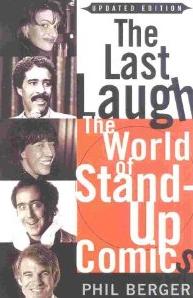
I just finished reading “The Last Laugh: The World of Stand-Up Comics” by Phil Berger. If you’re interested in comedy history from the 50’s to the 80’s this is an interesting read. Below are the quotes I found most interesting.
“The incident showed the cocksure feeling a comic had to have. Without it, he was a goner. An audience sensed fear. So comics made themselves larger than life.” (40)
“Lenny had the reputation for relying on his own wit. He was prolific, heeding what old pal Georgie Starr later prescribed as the only way for a comic: You’ve got to fuck and suck it and eat it night and day. Work on the material. Work on it. Work on it.” (79)
“Bruce took the chances. He was not afraid to fall flat on his arse with new material. There were those that saw him go gurgling down the drain one night and make thunder the next.” (86)
“Phil Leeds was a lovable little fellow who all comics loved. Never a major comic. And that’s why they all love him. Because comics love people who aren’t successful. That’s how they judge a good comic.” (98)
“Sometimes Klein would get a sly smile, as if a phrase had just occurred to him. It made whatever followed feel spontaneous.” (247)
“Confidence is experience. You cannot have true confidence on a stage in front of strangers without experience.” (392)
“Steve Martin got so big he couldn’t experiment. And he absolutely hated himself.” (401)
“For Kaufman, the idea was to provoke reaction, and nothing pleased him more than when his concepts triggered anger, confusion or even boredom, particularly when comic intentions appeared to be entangled in sticky reality.” (402)
“Kaufman saw how fantastic it was to have everybody hate him – what theater it was.” (407)
“Branch Rickey used to say, “Luck is the residue of design.”” (417)
““In a cabaret,” says Rollins, “if an audience can sense the personality underlying the comic – if they can make contact with that personality, they’ll enjoy him more. Even if the material is not that strong.” (423)
“The idea that comic success did not equate strictly to laughs was a lesson Brezner had learned from Rollins several years before.” (424)
“Jack said, “Lad, it’s not what you do on the stage that counts, it’s what’s on the stage when you’ve left.” Meaning, there are comics who make you laugh, and twenty-five minutes after, you’re left with nothing. Woody Allen didn’t give you huge laughs, but when he finished his last line, he’d taken on a persona over and above what he had done on stage.” (424)
“Robin Williams didn’t realize the potentially touching nature of the character. We convinced him at the end of his act to have the character say two or three funny things and then play the character for real. Told him not to worry if he gets laughs. Let the character talk about the foolishness of mankind. And then take the quiet moment and walk offstage. We felt that after forty-five minutes of hysteria… do this and he’d elevate himself to an energetic freethinking comic, and one who could act as well… and I tell you, when he took the quiet moment and walked offstage without a laugh, the applause was deafening. You know, sitting in the audience, you’d just seen something special. He’d touched you. He left something on stage for you.” (425)