“And Here’s the Kicker” Quotes (Part 2)

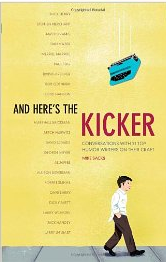
here's the kickerI recently finished a great comedy book, “And Here’s The Kicker: Conversations with 21 Top Humor Writers On Their Craft” by Mike Sacks. I got a ton of useful quotes from it, so this is part two in a rather long series of posts. I recommend buying the whole book, as there is a lot of insight inside. Since the book is interview style based, I’ve put the writer’s name above all of the quotes that are attributed to him.

DAN MAZER

“Most of the comedy writers I know are complete disasters socially. You put them in a room together, and it’s just a car crash. It’s horrible.” (56)

“They have the same type of childhood. Not necessarily unhappy childhoods so much as lonely ones.” (56)

“My mum would have been proud if I were a serial killer. She would’ve boasted that I’d murdered thirteen prostitutes and left no forensic evidence.” (57)

“I still don’t go out much. But I do think it’s vital to leave the house and meet people and explore life, to get inspiration for your work. The scourge of comedy is when it eats itself – when comedy writers watch sitcoms and think, Oh, you know, such and such a show is great. Let’s do something a bit similar to that. I think that’s wrong, really. I think the idea is to live life and take inspiration from that experience, as opposed to just getting inspiration from other artists and their work.” (57)

“At the end of my second year, I told my parents, “Look I’m not going to be a lawyer. I’m going to try and make a career in comedy.” I think my parents just ignored it and pretended it wasn’t happening, because it was just too traumatic for them. They already pictured me in a barrister’s wig and had probably already told their friends I was a lawyer.” (59)

“You find little bits here and there, and you toil away, and you do things you think are funny, and you make a nice living, and people might talk about something you wrote. But occasionally you might find a nugget. You just find this thing that is completely different and special, and you have a moment when you just know. At that point, you have to trust that instinct and really go with it.” (61)

“I think we hold a mirror up to people. We don’t edit things to make people look more stupid or ignorant. A lot of people come out of the Ali G interviews looking great.” (61)

“It’s one thing to do something funny, and that’s great, and all you can do as a comedy writer is to write funny things and hope that people find them. But the idea that so many people found this character and he became such a phenomenon is incredible to me.” (63)

“It was a genuine pop-culture phenomenon. And I think if you try to go out and create something like that, it won’t happen; it was just a weird confluence of events.” (63)

“Americans are generally more polite. That is, up until the point when they snap. And then when they snap, they snap instantly and fiercely. There’s just this moment, and then the switch flicks, and that’s it.” (64)

“That’s half the process: finding the right people to interview.” (65)

“I think some performers have one or two of those things. Some have brains. Some are funny. And some are daring. But Sacha has all three. And that’s a unique combination.” (68)

“We probably have a file of scripts and jokes that extends to about three thousand pages. We write so much material for each three-minute segment. And Sacha is brilliant at keeping it all sort of filed together in his head. He’s able to access any joke instantly and brilliantly. There are jokes from years ago that Sacha will be able to call on.” (69)

“Sacha goes to extremes with each character. If he’s playing Borat, he won’t shower the night or two before an interview. It’s an amazing devotion to detail. Even Borat’s underwear is authentic for the character. It has a Russian label on it, so that if Borat strips and somebody catches him, his underwear won’t say “Wal-Mart.” (69)

“There are two things I would say are the key to comedy. One is character. All good comedy comes from character. In my mind, jokes are one thing, but without a convincing protagonist and somebody you care about, your comedy is on a path to nowhere… Number two is to have a voice. Have an opinion. Try and say something. I don’t think it’s enough to just write trifling jokes. You should have a point of view. Have the confidence in what you think. Don’t let the executives or your own self-doubt dilute what you want to say.” (70)

MERRILL MARKOE

“If I know there is something I am supposed to be doing or saying or wearing, I feel compelled to resist – particularly with creative endeavors, like writing. If I see an obvious punch line or plotline driving toward me, I can’t help but make a sharp left turn into the unexpected. I don’t like to replicate what I’ve seen done before – I don’t like to give people what they expect. I think it’s my job to come up with a surprising angle or to add some personal twist.” (74)

“One immediate task – when we were determining how to construct a daily format – was to create segments that could be repeated.” (76)

“I had Dave’s voice all analyzed and figured out, because not only did I live with him, but I was preoccupied with creating a show that would please him. Nowadays we call that sort of thing “co-dependence.” But in those days I simply called it “being head writer.” (82)

“A friend of mine calls TV writing the “golden handcuffs.” You get hooked on the idea of making big money as a reasonable and worthy trade-off for lack of artistic control. So you stop worrying about whether you are meeting your own needs for self-expression and just focus on the size of your bank account.” (83)

“Real human beings don’t behave in big broad strokes. They behave with tiny, exacting, site-specific details. Your stupid McDonald’s employee should be different than mine.” (85)

“You need to find a way to get enough distance from yourself to effectively edit and rewrite your own work. And I do a lot of editing and rewriting. A lot.” (86)

“Don’t be overly attached to every syllable and detail of your work. Your commitment is to making the whole thing work. So you have to allow yourself to throw out sections you may love if they block the flow or seem unnecessary. Tell yourself you can save them and use them elsewhere later. Even if you never do, lie to yourself if it makes it easier.” (86)

“Take a moment to imagine how you will feel when your work is published. Anything that you think will make you uncomfortable or ill at ease… get rid of it.” (86)

“You have to allow your first draft to be really bad. Just throw a lot of things out there and get it on paper. The hardest part of the process is just getting a first full draft. The fun part, if any of it can be considered fun, is when you start to improve the piece through the editing and rewriting. That is definitely where the art is: knowing what to save, what to throw out, what to embellish.” (86)

“In the end, nothing works except sitting down to write. And then, even sadder, actually writing. “ (87)

“Robert Benchley explains, “Anyone can do any amount of work, provided it isn’t the work he is supposed to be doing at that moment.” (87)

PAUL FEIG

“Tragedy is when something bad happens to you; comedy is when something bad happens to somebody else.” (89)

“That’s the great thing about humor. You can take those experiences, and if you recount them in a funny way, and if they’re truthful and real, they will always become funnier.” (91)

“Real life experiences are rife with bad decision-making. And bad decision making is, in a lot of ways, the key to comedy.” (91)

“Movies are mostly about spectacle and huge stories… On the other hand, TV is about assembling a group of friends that you visit and hang out with every week.” (94)

“I’ve seen more comics storm off the stage and yell at people, slam their mics down, and do weirder things than you could ever imagine. There’s a real insecurity that comes with being funny. You’re on a razor’s edge. Comedy is an attempt to control things, and it just so happens that you’re trying to control people through laughter. But laughter can go off the rails at any given point.” (94)

“That’s not to say that Hollywood doesn’t care about quality but that they only want the quality when it’s going to bring in money. Nobody in Hollywood wants to do something that they’re proud of but that nobody is going to see.” (97)

“You need the show to be grounded. When it’s grounded – when the characters are living, breathing, real people – then you, as a writer, can do practically anything with them.” (98)

“The cruel side of me likes creating situations where people get buried deeper and deeper.” (100)

“You want characters to respond as they would in real life. They’re saying things quickly without thinking about them. But when you write, you can take months to finish a script. So everything the characters say has been so well thought out that it becomes almost perfect. But that’s just fake.” (100)

“You can get away with a lot by having just a simple expression.” (101)

“That’s what I liked about the show ending so suddenly: loose ends are never tied up in real life.” (101)

“If there’s any magic, it only exists to create a chemistry within a group of talented people – actors, writers, directors, producers – who are willing to work together and allow each of the others to do their best work. I personally don’t think that’s a hard mix to create again. It’s not always going to work, but I think it could work if enough talented people with a vision are willing to make it work.” (102-103)

“At the end of the day, none of us is that different. Freaks, geeks, jocks, whoever. The events we experience as human beings are fairly similar. The circumstances are different, and the surroundings and the social strata are different. But, you know, insecurity is insecurity. And loneliness is loneliness. And the basic human circumstances are all the same. If you’re telling honest stories that are done in a special way, magic can definitely be duplicated.” (103)
CLICK HERE FOR PART 3

“And Here’s The Kicker” Quotes (Part 1)

here's the kickerI recently finished a great comedy book, “And Here’s The Kicker: Conversations with 21 Top Humor Writers On Their Craft” by Mike Sacks. I got a ton of useful quotes from it, so this will be a rather long series of posts. I recommend buying the whole book, as there is a lot of insight inside. Since the book is interview style based, I’ve put the writer’s name above all of the quotes that are attributed to him.

BUCK HENRY

“I think all writers should have a voyeur nature. You have to look and listen. That’s why some writers might run out of material; they’re not looking, they’re not listening.” (6)

“If you ride in limos for too long, you tend to forget what cabs, buses, and subways are like. You lose contact. I think it’s important to stay in contact with the outside world.” (6)

“All the great filmmakers from the past knew something about real life.” (13)

“One of the characters says, “You’re not anybody in America unless you’re on TV.” That’s an American disease. And it’ sonly become truer now than it was when the movie came out.” (13)

“When you’ve been in improvisational theater, you get used to capturing the characteristics of people who are really out there in the world. And if you’re up on stage every night for a year, or two years, or three years, with the audience yelling suggestions at you like “Do Chekhov, but do it with Chinese characters,” you get used to an immediate commitment to lunatic ideas. You gain a confidence. Most of the SNL cast members came from that background.” (16)

“In one of the samurai sketches, John hit me in the forehead with a samurai sword. He put a real gash in it, and I needed a bandage. And by the end of the show, when the cast members were saying good-bye, all of them had bandages on their heads.” (17)

“Timing is when a movie comes out. Timing is what the country’s political disposition is when a movie is released. It’s what people are thinking about – what they want to see. You really can’t control that as a writer. But if you’re talented, it’ll all work out in the end. I mean, not all the talented writers will make it, of course… but for the most part, if you’re talented, I think somebody will find you.” (17)

STEPHEN MERCHANT

“In a documentary, there’s no real narrative. Usually in a documentary, a narrative I just created unofficially.” (20)

“There’s nothing wrong with a huge audience. But in reaching for that huge audience, you could possibly compromise your material or maybe try to second-guess what an audience wants. We genuinely thought that The Office was funny and that it was truthful, and maybe there would be a million and a half like-minded people who thought it was the funniest thing they’d ever seen. And if that happened, then we’d think, oh, well, we had fun and that was good. And that would be that.” (21)

“When we first showed The Office to test audiences in Britain, we received one of the lowest scores ever – the only show that beat ours was one that featured women’s lawn bowling. That’s why you can’t judge these focus groups.” (22)

“The best sitcoms are about creating an environment in which you want to return and poke around for another half-hour.” (22)

“The most important things in life are to find a job you like, to make a difference, and to find someone you love.” (25)

“Initially we started off trying to improvise, and then we typed the dialogue, but that was a very slow way of working. Ultimately, we bought a Dictaphone tape recorder. We would improvise into it and sort of refine the dialogue a little, and then we would edit it down later so that it could be typed up. It just seemed the only way to create that ebb and flow of real dialogue, where people stop and start and they don’t use proper grammar. Speech patterns are very different from what you would get if you were to just write dialogue.” (25)

“I think we kind of liked that the audience was not entirely sure how they should feel.” (29)

“We never sit down and think about what subjects we are going – or are not going – to tackle. We just do what feels right. Audiences see certain topics, and their immediate reaction is anxiety. You can’t talk about this, you can’t joke about that. Our feeling is that the more we accept people who may be different, the more we should be able to joke about our own discomfort. If I have friends who are disabled, I can make jokes about their disability, just like they can make jokes about my height or Ricky being overweight. Of course, if you’re meeting someone in the street for the first time, you don’t start making those cracks, because it’s inappropriate. But to us it’s that fascinating stew of discomfort and ignorance that becomes a great recipe for laughter. We’re not laughing at the disabled; we’re laughing at people’s discomfort with disability.” (30)

“We want our shows to be aimed at a sort of reasoning, smart, intelligent audience that can steer its way through ambiguities.” (31)

“There’s always a danger that we as comedy fans are writing comedy for other comedy fans. Whereas the average viewer – and I don’t mean this in a disparaging way – but the average viewer doesn’t sit around thinking about how jokes work. Its just not something that’s important to them. They just want the joke to be funny. So you can’t be too clever. You can’t assume reference points and sophistication that are not there.” (31)

“Sometimes you can get too up your own ass.” (31)

JUDD APATOW

“Whenever we got stuck, Garry Shandling always said, “What is the truth here? What would someone actually do?” He pushed his writers to go deeper to the core.” (33)

KEN LEVINE

“Before anything else, you have to learn how to write. And you learn writing by teaching yourself.” (34)

“One way to stand out is to write a holiday-themed script.” (35)

“Just make it “Jessica enters.” That’s all you need. Describe the action quickly, and get on with it. But you can sprinkle the scripts with inside jokes, such as: “Character orders a three-pound lobster (therefore breaking the show’s budget.) Small jokes that will reward the reader.” (35)

“When I go on staff, I want the producers and everyone else to think, Man, we cannot do the show without this guy.” (35)

HAROLD RAMIS

“An audience member told me, “When I go to the movies, I don’t want to think.” I said to myself: Why wouldn’t you want o think? What does that mean? Why not just shoot yourself in the fucking head?” (37)

“The other end of the spectrum isn’t funny: “I get so much respect.” No one will laugh at how great things are for somebody.” (38)

“I was more intrigued by the alternative comedy posture. The characters I enjoyed creating were the dropouts and the rebels. They voluntarily opted out of the mainstream. It wasn’t because they couldn’t join it. It was because it wasn’t worth doing. Or there was some serious hypocrisy going on. Or it wasn’t cool.” (38)

“I worked in a mental institution in St. Louis, which prepared me well for when I went out to Hollywood to work with actors.” (39)

“Michael Shamberg said, “Comedy works in two ways. Either you have a normal person in an extraordinary situation or an extraordinary person in a normal situation.” And A Confederacy of Dunces was about an extraordinary person in a series of extraordinary situations.” (42)

“I’m always more offended by dishonesty and hypocrisy than by an honest portrayal of the real world.” (45)

“Often, Rodney Dangerfield thought he was bombing on the set, because no one was laughing. He just didn’t know from that world. He really knew nothing about the process of filmmaking.” (47)

“It’s the editing room that saves your ass. If you took all the improv from Caddyshack and did it onstage, you’d bomb half the time. One thing I learned to do was shoot enough improv so I could actually shape it in the editing room.” (47)

“If you’re cutting away on a joke, you’re probably doing it because you can’t top that joke. If the scene is still building and is still rich, you keep going.” (47-48)

“In any genre, viewers want to feel something. They want to have an experience. There are more well-made movies than good movies. That’s sort of my new mantra. Plenty of people can shoot beautiful films. There are a lot of great edits, a lot of great designers. But where is the content? Who are the characters? Is it moving? You want the audience to feel something, and if it’s comedy, you want them to laugh hard, even if it’s at the expense of a better shot or a better edit. There are many times when the editor will say to me, “Well, that’s not a real good cut.” And I’ll say, “Yeah, but it’s funny. Let’s just do it.” (48)

“I always tell students to identify the most talented person in the room, and if it isn’t you, go stand next to him.” (48)

“It’s like that great saying, “You ride the horse in the direction it’s going.” Billy goes his own way. But he’ll go my way if he thinks it’s a good way. So my job is not to force the actor to do anything; it’s to convince them. Billy was smart enough to know a good thing when he heard it. If I said, “Try this” or “try that,” and it was really funny, he’d do it.” (49)

Q: Do you have a target audience in mind when you write?
“No, I write for everybody. Or, really, for anyone who can read and is not hopelessly fucked in the head.” (50)

“I just did what I wanted to do and what interested me. As I tell writing students, the only thing you have that is unique is yourself.” (51)

“The other approach is to skip the pitch and just write it. You don’t want to waste a lot of time waiting for an editor to evaluate the pitch. Just write it – either the editor will laugh or not.” (53)

CLICK HERE FOR PART 2

Organizing Jokes Using Microsoft Word Outline View

I’ve recently found a great new way to organize my material and I thought I’d share it. (You’ll need Microsoft Word for this, although other programs might have a similar feature.)

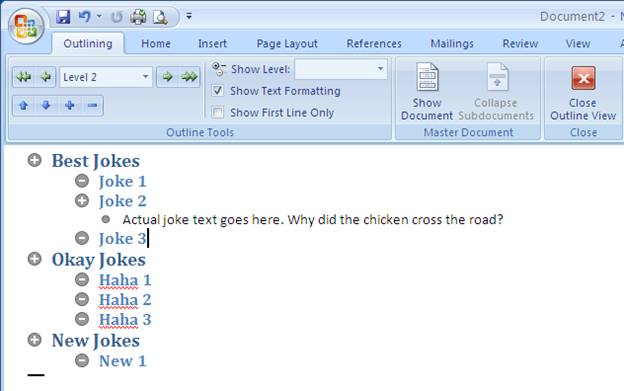
Before I give instructions, here’s what the end result might look like:

image002

Basically, when you click the little “+” button it expands into lower levels of headings and then into the actual joke text. So how do you do this from scratch?

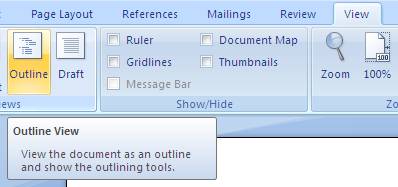
Select View – > Outline

image004

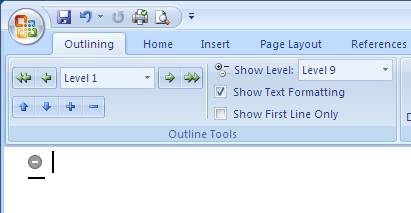
You’ll get a blank screen with one bullet point, that’s your highest level of header

image006

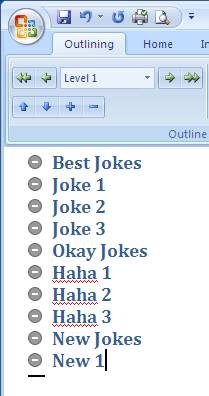
Type in some categories of jokes, then under each category type in the name

image008

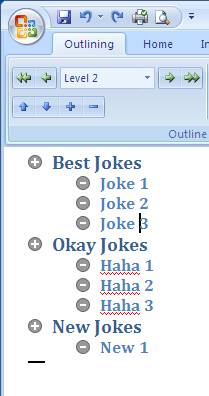
Then highlight the joke title’s (in the above case, Joke 1, Joke 2 and Joke 3) and click the green arrow that’s pointing to the right in orderto indent the jokes. Notice when your cursor is on “joke 1” the “Level 1” sign changes to “Level 2”

image010

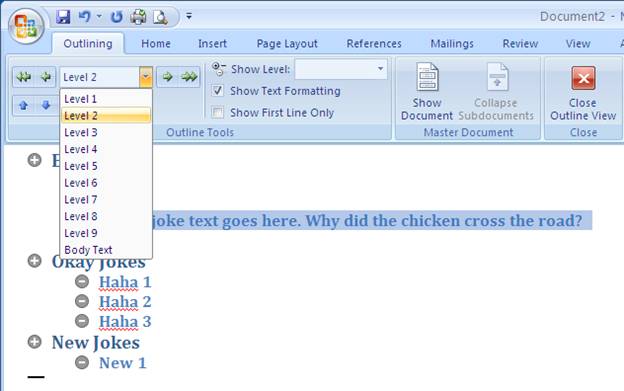
Type in joke text under each joke, then click the little drop down arrow below level 2 and select “body text”

image012

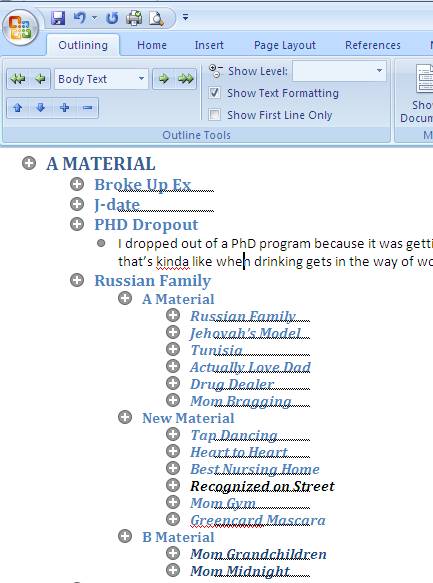
There you go, you’re now more organized with your jokes. Click the “+” and “-“ buttons to expand and collapse joke sections

image014

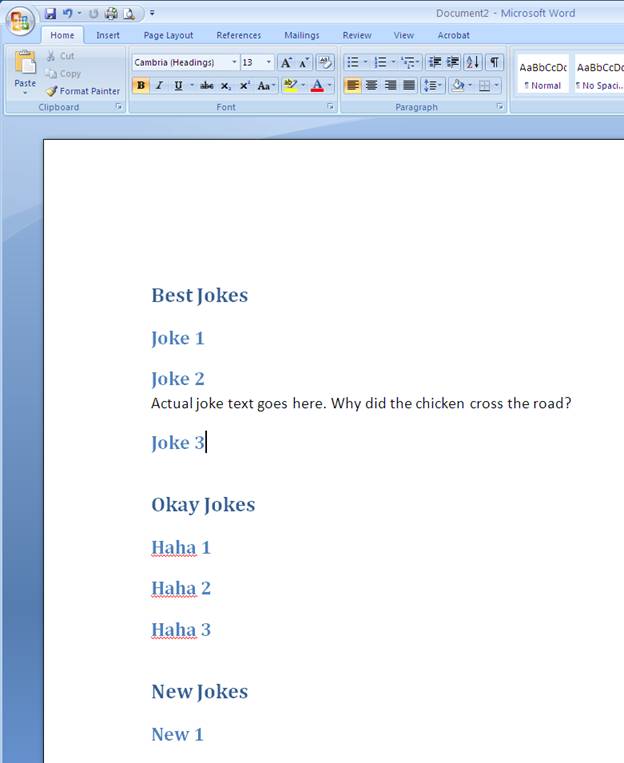
If you want to view and edit jokes normally, just click on image016

You get the following view:

image018

And yes, this is a pain to do the first time, but once you’re done, you have all your jokes nice and organized and it’s easy to add new jokes to this file, as well as to find a specific joke. Plus, you can now easily build a set list based off of your joke titles.

Wanna try stand-up comedy yourself? I teach a Comedy Class in New York City. I also do private one-on-one comedy coaching (in-person or via Zoom).

More Stand-Up Comedy Tips:

Performance Critique: May 1a

Saturday open mic

httpv://www.youtube.com/watch?v=cF0gqefuNT0

0m33s Cut this joke

1m22s Act out each picture being shown with some motion

1m37s Slow down, a lot

3m33s The first part of the Netflix joke is good, then it’s useless until the “scratched” line

Overall: I need to slow down on the vacation photos joke and the Netflix joke will be good if I get rid of the middle part.

Verified by ExactMetrics