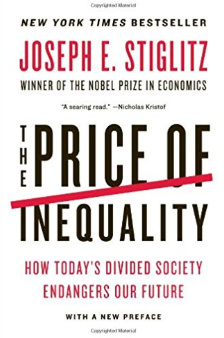
“In America the share of national income going to the top .01% (some 16,000 families) has risen from just over 1% in 1980 to almost 5% now – an even bigger slice than the top .01% got in the Gilded Age.” (xii)
“Today, women in the United States, on average, have the lowest life expectancy of women in any of the advanced countries.” (xiii)
“Non-Hispanic white women with a college degree have a life expectancy that is some ten years greater than the life expectation of black or white women without a high school diploma.” (xiii)
“There was no reason to believe that giving more money to America’s wealthy would lead to more investment in the United States: money goes to where returns are highest, and with America’s downturn, returns often look higher for investments in the emerging markets. And even when there is investment in the United States, it’s not necessarily investment related to job creation: much of the investment is in machines designed to replace labor, to destroy jobs.” (xvi)
“The top 400 income earners in the United States paid an average tax rate of just 19.9 percent in 2009. Overall, the richest 1 percent of Americans pay effective tax rates in the low twenties, lower than those of Americans with more moderate incomes.” (xxvii)
“Some of the growth in inequality can be attributed to globalization and the replacement of semiskilled jobs with new technologies and outsourced labor.” (xxvii)
“Societies with more economic inequality tend to have more political inequality, especially when it reaches the outsize levels.” (xxviii)
“The chances of an American citizen making this way from the bottom to the top are less than those of citizens in other advanced industrial countries.” (xlv)
“For years there was a deal between the top and the rest of our society that went something like this: we will provide you jobs and prosperity, and you will let us walk away with the bonuses. You all get a share, ven if we get a bigger share. But now that tacit agreement between the rich and the rest, which was always fragile, has come apart.” (xlvii)
“The political system is more akin to “one dollar one vote” than to “one person one vote.” Rather than correcting the market’s failures, the political system was reinforcing them.” (1)
“Government policies have been central to the creation of inequality in the United States.” (7)
“In the mid-2000s, before the onset of the Great Recession, people in the bottom 80 percent were spending around 110 percent of their income.” (16)
“Some U.S. states spend as much on their prisons as they do on their universities.” (19)
“Money that is spent on “security” – protecting lives and property – doesn’t add to well-being; it simply prevents things from getting worse.” (19)
“Even as a myth, the belief that everyone had a fair chance had it uses: it motivated people to work hard. It seemed we were all in the same boat.” (25)
“Our hypothesis is that market forces are real, but that they are shaped by political processes.” (66)
“Imagine what the world would be like if there was free mobility of labor, but no mobility of capital. Countries would compete to attract workers. They would promise good schools and a good environment, as well as low taxes on workers. This could be financed by high taxes on capital.” (77)
“More than $3.2 billion was spent on lobbying in 2011 alone.” (119)
“Credit card companies would extract more money from transaction fees than the grocery store would profit from the sale of its goods.” (120)
“When inequality is as large as it is in the United States, it becomes less noticeable – perhaps because people with different incomes and wealth don’t even mix.” (185)
“If an individual believes what he has is a result just of his own efforts, he is less willing to share that wealth with others who he thinks chose to exert less effort. If an individual sees his success as a result largely of good luck, he is more willing to share that good fortune.” (199)
“In the great bailout of the Great Recession, one corporation alone, AIG, got more than $180 billion – more than was spent on welfare to the poor from 1990 to 2006.” (225)
“If debts can’t be discharged, or can’t be discharged easily, lenders have less of an incentive to be careful in lending – and more of an incentive to engage in predatory lending.” (242)
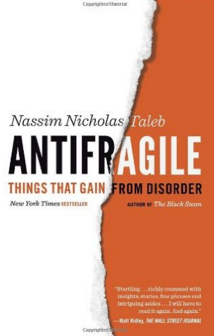
“Some things benefit from shocks; they thrive and grow when exposed to volatility, randomness, disorder, and stressors and love adventure, risk, and uncertainty. Yet, in spite of the ubiquity of the phenomenon, there is no word for the exact opposite of fragile. Let us call it antifragile. Antifragility is beyond resilience or robustness. The resilient resists shocks and stays the same; the antifragile gets better.” (3)
“We can almost always detect antifragility (and fragility) using a simple test of asymmetry: anything that has more upside than downside from random events (or certain shocks) is antifragile; the reverse is fragile.” (5)
“We are witnessing the rise of a new class of inverse heroes, that is, bureaucrats, bankers, Davos-attending members and academics with too much power and no real downside and/or accountability. They game the system while citizens pay the price.” (6)
“You need perfect robustness for a crack not to end up crashing the system. Given the unattainability of perfect robustness, we need a mechanism by which the system regenerates itself continuously by using, rather than suffering from, random events, unpredictable shocks, stressors, and volatility.” (8)
“You cannot say with any reliability that a certain remote even tor shock is more likely than another, but you can state with a lot more confidence that an object or a structure is more fragile than another should a certain event happen.” (9)
“Modernity has replaced ethics with legalese, and the law can be gamed with a good lawyer.” (15)
“If you see fraud and do not say fraud, you are a fraud.” (15)
“the robust or resilient is neither harmed nor helped by volatility and disorder, while the antifragile benefits from them.” (17)
“The sword of Damocles represents the side effect of power and success: you cannot rise and rule without facing this continuous danger – someone out there will be actively working to topple you.” (34)
“Fiscal deficits have proven to be a prime source of fragility in social and economic systems.” (36)
“For society, the richer we become, the harder it gets to live within our means. Abundance is harder for us to handle than scarcity.” (42)
“When I was a pit trader, I learned that the noise produced by the person is inverse to the pecking order: as with mafia dons, the most powerful traders were the least audible. One should have enough self-control to make the audience work hard to listen, which causes them to switch into intellectual overdrive.” (43)
“Loss of bone density and degradation of the health of the bones also causes aging.” (58)
“Much of modern life is preventable chronic stress injury.” (64)
“Some parts on the inside of a system may be required to be fragile in order to make the system antifragile as a result.” (66)
“Evolution is not about a species, but at the service of the whole of nature.” (69)
“When you are fragile, you depend on things following the exact planned course, with as little deviation as possible – for deviations are more harmful than helpful. This is why the fragile needs to be very predictive in its approach, and, conversely, predictive systems cause fragility.” (71)
“If every plane crash makes the next one less likely, every bank crash makes the next one more likely. We need to eliminate the second type of error – the one that produces contagion – in our construction of an ideal socioeconomic system.” (73)
“A loser is someone who, after making a mistake, doesn’t introspect, doesn’t exploit it, feels embarrassed and defensive rather than enriched with a new piece of information, and tries to explain why he made the mistake rather than moving on.” (74)
“Natural and naturelike systems want some overconfidence on the part of individual economic agents, i.e., the overestimation of their chances of success and underestimation of the risks of failure in their businesses, provided their failure does not impact others. In other words, they want local, but not global, overconfidence.” (75)
“People have difficulty realizing that the solution is building a system in which nobody’s fall can drag others down – for continuous failures work to preserve the system. Paradoxically, many government interventions and social policies end up hurting the weak and consolidating the established.” (76)
“This is the central illusion in life: that randomness is risky, that it is a bad thing – and that eliminating randomness is done by eliminating randomness.” (84)
“The problem is that by creating bureaucracies, we put civil servants in a position to make decisions based on abstract and theoretical matters, with the illusion that they will be making them in a rational, accountable way.” (89)
“We can also see from the turkey story the mother of all harmful mistakes: mistaking the absence of evidence (of harm) for evidence of absence, a mistake that we will see tends to prevail in intellectual circles and one that is grounded in the social sciences.” (93)
“When a currency never varies, a slight, very slight move makes people believe that the world is ending. Injecting some confusion stabilizes the system. Indeed, confusing people a little bit is beneficial – it is good for you and good for them. For an application of the point in daily life, imagine someone extremely punctual and predictable who comes home at exactly six o’clock every day for fifteen years. You can use his arrival to set your watch. The fellow will cause his family anxiety if he is barely a few minutes late. Someone with a slightly more volatile – hence unpredictable – schedule, with say, a half -our variation, won’t do so.” (101)
“Stability is not good for the economy: firms become very weak during long periods of steady prosperity devoid of setbacks, and hidden vulnerabilities accumulate silently under the surface – so delaying the crises is not a very good idea.” (101)
“In a computer simulation, Alessandro Pluchino and his colleagues showed how adding a certain number of randomly selected politicians to the process can improve the functioning of the parliamentary system.” (104)
“Absence of political instability, even war, lets explosive material and tendencies accumulate under the surface.” (105)
“The problem with artificially suppressed volatility is not just that the system tends to become extremely fragile; it is that, at the same time, it exhibits no visible risks.” (106)
“While we now have a word for causing harm while trying to help (iatrogenics), we don’t have a designation for the opposite situation, that of someone who ends up helping while trying to cause harm.” (113)
“We tend to over-intervene in areas with minimal benefits (and large risks) while under-intervening in areas in which intervention is necessary, like emergencies.” (119)
“It’s much easier to sell “Look what I did for you” than “Look what I avoided for you.” Of course a bonus system based on “performance” exacerbates the problem.” (121)
“The more data you get, the less you know what’s going on.” (128)
“Political and economic “tail events” are unpredictable, and their probabilities are not scientifically measurable. No matter how many dollars are spent on research, predicting revolutions is not the same as counting cards; humans will never be able to turn politics and economics into the tractable randomness of blackjack.” (133)
“Warren Buffett tries to invest in businesses that are “so wonderful that an idiot can run them. Because sooner or later, one will.”” (137)
“People are cruel and unfair in the way they confer recognition, so it is best to stay out of that game.” (148)
“You can’t predict in general, but you can predict that those who rely on predictions are taking more risks, will have some trouble, perhaps even go bust. Why? Someone who predicts will be fragile to prediction errors.” (150)
“To become a successful philosopher king, it is much better to start as a king than as a philosopher.” (152)
“Stoicism, seen this way, becomes pure robustness – for the attainment of a state of immunity from one’s external circumstances, good or bad, and an absence of fragility to decisions made by fate, is robustness. Random events won’t affect us either way (we are too strong to lose, and not greedy to enjoy the upside).” (153)
“Success brings an asymmetry: you now have a lot more to lose than to gain.” (154)
“For my last job, I wrote my resignation letter before starting the new position, locked it up in a drawer, and felt free while I was there.” (155)
“If you have more to lose than to benefit from events of fate, there is an asymmetry, and not a good one.” (157)
“I initially used the image of the barbell to describe a dual attitude of playing it safe in some areas (robust to negative Black Swans) and taking a lot of small risks in others (open to positive Black Swans), hence achieving antifragility. That is extreme risk aversion on one side and extreme risk loving on the other, rather than just the “medium” or the beastly “moderate” risk attitude that in fact is a sucker game (because medium risks can be subjected to huge measurement errors).” (161)
“Antifragility is the combination aggressiveness plus paranoia.” (161)
“In risky matters, instead of having all members of the staff on an airplane be “cautiously optimistic,” or something in the middle, I prefer the flight attendants to be maximally optimistic and the pilot to be maximally pessimistic or, better, paranoid.” (162)
“Georges Simenon, one of the most prolific writers of the twentieth century, only wrote sixty days a year, with three hundred days spent “doing nothing.” He published more than two hundred novels.” (165)
“The worst side effect of wealth is the social associations it forces on its victims, as people with big houses tend to end up socializing with other people with big houses. Beyond a certain level of opulence and independence, gents tend to be less and less personable and their conversation less and less interesting.” (174)
“No one at present dares to state the obvious: growth in society may not come from raising the average the Asian way, but from increasing the number of people in the “tails,” that small, very small number of risk takers crazy enough to have ideas of their own, those endowed with that very rare ability called imagination, that rarer quality called courage, and who make things happen.” (180)
“The story of the wheel on the suitcase also illustrates the point of this chapter: both governments and universities have done very, very little for innovation and discovery, precisely because, in addition to their blinding rationalism, they look for the complicated, the lurid, the newsworthy, the narrated, the scientistic, and the grandiose, rarely for the wheel on the suitcase. Simplicity, I realized, does not lead to laurels.” (190)
“We see a high degree of academic research in countries that are wealthy and developed, leading us to think uncritically that research is the generator of wealth.” (197)
“Academia is well equipped to tell us what it did for us, not what it did not – hence how indispensable its methods are.” (200)
“Serious empirical investigation shows no evidence that raising the general level of education raises income at the level of a country. But we know the opposite is true, that wealth leads to a rise of education.” (203)
“I am not saying that for an individual, education is useless: it builds helpful credentials for one’s own career – but such effect washes out at the country level.” (204)
“Yogi Berra said, “In theory there is no difference between theory and practice; in practice there is.”” (213)
“An idea does not survive because it is better than the competition, but rather because the person who holds it has survived!” (215)
“He wondered ‘how traders could handle these complicated exotics if they do not understand the Girsanov theorem… Nobody worries that a child ignorant of the various theorems of aerodynamics and incapable of solving an equation of motion would be unable to ride a bicycle.” (218-219)
“I wondered if I was living on another planet or if the gentleman’s PhD and research career had led to this blindness and his strange loss of common sense – or if people without practical sense usually manage to get the energy and interest to acquire a PhD in the fictional world of equation economics.” (219)
“Traders trade -> traders figure out techniques and products -> academic economists find formulas and claim traders are using them -> new traders believe academics -> blowups (from theory-induced fragility)” (220)
“Practitioners don’t write; they do. Birds fly and those who lecture them are the ones who write their story. So it is easy to see that history is truly written by losers with time on their hands and a protected academic position.” (220)
“We don’t put theories into practice. We create theories out of practice.” (221)
“A patent side effect of mathematics is making people over-optimize and cut corners, causing fragility. Just look how the new is increasingly more perishable than the old.” (223)
“Do not invest in business plans but in people.” (238)
“Find a problem first, and figure out the math that works for it, rather than study in a vacuum through theorems and artificial examples, then change reality to make it look like these examples.” (247)
“Much of what other people know isn’t worth knowing.” (248)
“To this day I still have the instinct that the treasure, what one needs to know for a profession, is necessarily what lies outside the corpus, as far away from the center as possible.” (248)
“There is this error of thinking that things always have a reason that is accessible to us – that we can comprehend easily.” (249)
“We practitioners and quants aren’t too fazed by remarks on the part of academics – it would be like prostitutes listening to technical commentary by nuns.” (264)
“What is fragile is something that is both unbroken and subjected to nonlinear effects – and extreme, rare events, since impacts of large size (or high speed0 are rarer than ones of small size (and slow speed).” (270)
“In spite of what is studied in business schools concerning “economies of scale,” size hurts you at times of stress; it is not a good idea to be large during difficult times.” (279)
“Someone with a linear payoff needs to be right more than 50 percent of the time. Someone with a convex payoff, much less. The hidden benefit of antifragility is that you can guess worse than random and still end up outperforming.” (299)
“Being fooled by randomness is that in most circumstances fraught with a high degree of randomness, one cannot really tell if a successful person has skills, or if a person with skills will succeed – but we can pretty much predict the negative, that a person totally devoid of skills will eventually fail.” (303)
“I once testified in Congress against a project to fund a crisis forecasting project. The people involved were blind to the paradox that we have never had more data than we have now, yet have less predictability than ever.” (307)
“As shown from the track record of prophets: Before you are proven right, you will be reviled; after you are proven right, you will be hated for a while, or what’s worse, your ideas will appear to be “trivial” thanks to retrospective distortion.” (310)
“For the perishable, every additional day in its life translates into a shorter additional life expectancy. For the nonperishable, every additional day may imply a longer life expectancy.” (318)
“In general, the older the technology, not only the longer it is expected to last, but the more certainty I can attach to such a statement.” (319)
“We confuse the necessary and the causal: because all surviving technologies have some obvious benefits, we are led to believe that all technologies offering obvious benefits will survive.” (321)
“A writer with arguments can harm more people than any serial criminal.” (384)
“Never ask anyone for their opinion, forecast, or recommendation. Just ask them what they have – or don’t have – in their portfolio.” (389)
“Never ask the doctor what you should do. Ask him what he would do if he were in your place. You would be surprised at the difference.” (389)
“The Romans removed the soldiers incentive to be a coward and hurt others thanks to a process called decimation. If a legion loses a battle and there is suspicion of cowardice, 10 percent of the soldiers and commanders are put to death, usually by random lottery.” (392)
“Myles Burnyeat provides the example of a philosopher who puzzles about the reality of time, but who nonetheless applies for a research grant to work on the philosophical problem of time during next year’s sabbatical – without doubting the reality of next year’s arrival.” (394)
“Only he who has true beliefs will avoid eventually contradicting himself and falling into the errors of postdicting.” (397)
“My experience is that most journalists, professional academics, and other in similar phony professions don’t read original sources, but each other, largely because they need to figure out the consensus before making a pronouncement.” (399)
“Marketing beyond conveying information is insecurity.” (403)
“We accept that people who boast are boastful and turn people off. How about companies? Why aren’t we turned off by companies that advertise how great they are?” (404)
“A simple solution, but quite drastic: anyone who goes into public service should not be allowed to subsequently earn more from any commercial activity than the income of the highest paid civil servant. It is like a voluntary cap (it would prevent people from using public office as a credential-building temporary accommodation, then going to Wall Street to earn several million dollars).” (412)
“More data means more information, perhaps, but it also means more false information.” (416)
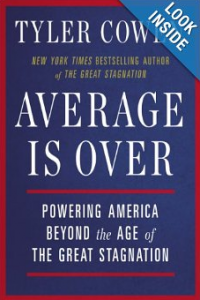
“Technological progress slows down when there are too many people who have the right to say no.” (17)
“The ability to mix technical knowledge with solving real-world problems is the key, not sheer number-crunching or programming for its own sake.” (21)
“At some point it is hard to sell more physical stuff to high earners, yet there is usually just a bit more room to make them feel better. Better about the world. Better about themselves. Better about what they have achieved.” (23)
“For the high earners, life will feel better than ever before, but at the same time life will feel more harried and more overloaded with information than ever before. These phenomena are in fact two sides of the same coin, and this tends to get overlooked.” (24)
“Workers are most likely to apply for disability following a job loss.” (52)
“Ask just about anyone in a human resources department, “What percent of the labor force do you simply not wish to hire, no matter what, no matter how low the wage?” (57)
“Players do their absolute best when they are faced with a slight disadvantage in their position. When players are decisively up or down, they don’t seem to think or concentrate with the same facility. Again, this is a sign of human rationality, at least if there is some need for a conservation of effort.” (103)
“Uniquely creative acts often scare us or intimidate us or make us feel uncomfortable. It means that someone out there is able to act without facing much accountability.” (129)
“it seems that we care more about drama than about perfection.” (157)
“Just as labor market outcomes will move toward the poles of either “very good” or “very bad,” so will the same be true for a lot of cities, states, geographic regions, and countries.” (171)
“When humans and computers work together and cooperate, the rewards flow more readily to top talent, not to the socially well connected. Machine intelligence is the friend of the educational parvenu, albeit the disciplined, gusty parvenu with high IQ.” (190)
“…in ways that make the job harder to outsource. The instructor who teaches human qualities like conscientiousness and who motivates his student needs to be there.” (195)
“In the longer run, professors will need to become more like motivational coaches and missionaries.” (196)
“The professor, to survive, will have to become a motivator and coach in essence and not just accidentally or in his or her spare time.” (196)
“It will become increasingly apparent how much of current education is driven by human weakness, namely the inability of most students to simply sit down and try to learn something on their own.” (197)
“It’s open to debate how much education can boost innate aptitude or IQ, but the trait of “conscientiousness” does consistently predict educational and job success and also subjective happiness.” (201)
“Economics is becoming less like Einstein or Euclid, and more like studying the digestive system of a starfish.” (222)
I thought I’d share a recent example of internet content I gave away, that might help all of us comedians who aren’t world famous understand how internet free works / how to monetize it better.
Reddit is a popular internet website with lots of subsections. I recently posted the below image on /r/standupshots which is dedicated to short stand up jokes with your photo.
In the 22 hours since I posted it, I’ve gotten 34,375 views. It was in the number one spot for 6-10 hours. Which is great. That’s over 34,000 people that would’ve never seen or heard of me otherwise. But let’s dig deeper. (And let’s ignore whether you like the joke or not, objectively, by reddit standards, it did well.)
Out of all those views, 1,619 clicked that they like the joke (up vote), and 673 clicked that they didn’t like it (down vote). So that’s 2,292 people that can be bothered to click. Less than 7% click rate. And that’s just a quick button click on a page that already loaded. It doesn’t require typing in a URL, spending money or any extra steps or page loads. There were 29 comments on the post, not counting my responses (.08% of views).
As you may have noticed from the photo, I have a link for people to download my album for free, if they want. They just have to fill out a quick form so I get an email address and zip code.
24 people filled out the form for a free comedy album (out of 34,375). Even if you only count the people that clicked that they liked that joke, that’s a 1.5% conversion rate. On something that’s free. And out of the 24 email addresses I got, 6 of them were fake. So out of 34,000 views, I got 18 people to care enough to give me their email address and listen to my album. (Of course, this isn’t my first joke here, so some people have previously downloaded my album. I’m just giving one specific example.)
I also have a podcast link in the image. A new episode comes out every Monday night, and I posted this joke Sunday afternoon. So Sunday is the slowest download day as it’s a week old episode at that point. So assuming all Sunday podcast downloads were from the Reddit traffic, I had 15 people download the free podcast. A slightly less than 1% conversion rate of people who click the like button. (Or .04% of overall views.)
Even if you assume the people who got the podcast were all different from the people who got the album, the total people willing to just type in a URL was 39. Or .1% of all views (1 out of 1,000). With no money being spent.
And my Twitter link in the image got 0 new followers, favorites and retweets. (Although other jokes have done better for this.)
Let me state clearly, I’m not complaining. I’ve had a some cool things happen from posting on Reddit. A few of my jokes have been picked up for “Best Jokes” websites were I’ve been listed alongside very famous comedians. I’ve gotten more followers. A couple of user comments have been incorporated into my jokes. My album got put on a streaming internet station. And I’ve even gotten recognized around NYC a few times from it.
But if we focus on JL’s discussion of economics, it seems most of free internet content will lead to actual money way less than 1% of the time. It seems it’ll be somewhere around .01% and .05%. (JL’s 100 album downloads out of 300k YouTube views is a .03% conversion. Similar to my numbers above.) So for those whose eyes are already rolling because of all the math in this post, as a rough estimate, for every 10,000 internet views a free piece of content gets, 1 person will pay money for additional content.
There’s more good TV shows than ever (and still plenty of bad ones)
Because of the segmented market (a.k.a. more and more cable networks), a show can have a lower rating and still stay on the air
A TV show can get (more) popular five years after it goes off the air due to DVD sales and the internet (The Wire, Arrested Development, etc.)
If it’s easy and reliable, consumers will pay some amount of money per month ($10 for Netflix/Hulu Plus to $100+ for a cable/satellite provider ) to watch TV shows on their TV and or other devices
People don’t want to watch TV commercials (or at least wouldn’t complain if they disappeared)
The TV Network financial model is all about selling commercials
For live broadcasts, TV quality is still significantly better and more reliable than the internet
Imagine all advertising stops for non-live shows (everything but the news and sports). How else might TV shows make money?
Here’s my idea: Have each user pay $X a month for unlimited video, then pay each show a percentage, based on how much of it the user watches.
A cable box-like device would measure how many M minutes you watch of each show and add up how much TV you watch each month.
That show’s income could = M (minutes of show watched) / T (Total Minutes of TV this month) * $X (the monthly service fee)
In other words, each show gets the % of your monthly viewing fee which you spent watching that show.
Example: The service costs $40 per month, I watch 5 episodes of The Office with each episode being 20 minutes long, and I watch 800 total minutes of TV in the month. The creators of The Office would receive (20 * 5) / 800 * 40 (1/8 of 40) which is $5. With 9 million viewers, these numbers add up quickly. Of course, the company (most likely cable, satelite or dot com) that creates and adminsters such a system would charge an administrative fee (I’d imagine it around 10% – 20%).
Some Consequences / Impacts:
The more popular your show, the more money it makes.
It’d be more profitable to get users who barely watch TV to watch your show.
Built in residual income — if your show gets popular five years after it comes off the air, you still get paid the same amount and can turn a profit. This is basically The Long Tail effect.
Contracts structure might be changed so that more actors / directors / writers are paid a percentage of the total income, instead of a one time fee. This better aligns everyone’s incentives for a successful, long running, well written series.
Instead of pitching an idea to a TV Network or production company, you could pitch it directly to a venture capitalist (Sillicon Valley Style) or Satellite/Cable/Amazon/Netflix type company. This may lead to more buyers and consequently more shows.
This same cable-like box could also incorporate an Amazon / NetFlix like recommendation system for TV. Users can rate and review shows, and receive recommendations on what shows they may like based on how they’ve rated shows to date.
This could turn into a Pandora type stream, where everyone has their own customized channel(s) with the shows they like to watch. Would networks still be necessary?
Everything but news and sports can become on demand, and there’s no waiting week to week for the next episode of the season.