
Posts Tagged ‘Advice’

Clayton Fletcher: Auditioning Q&A

March 30th, 2010 | By Ben in Comedy | No Comments »

Today I’m talking to Clayton Fletcher about auditioning. Clayton Fletcher has appeared in countless productions for TV, film, stage, and radio over his 16-year career as a comedian, actor, singer, and musician. He headlines The Clayton Fletcher Show at New York Comedy Club every Friday and Saturday at 8PM. He auditions regularly for opportunities across all media, and once in a while, when all the stars align perfectly and the comedy gods are on his side, he gets that magic ‘yes.’ For more info, visit his website.

Who are the different types of people you will audition for in your career?

The three types are jerks, egomaniacs, and wannabes. Just kidding!

The people involved vary depending on the type of audition. If it’s a TV audition, there is a collaboration between the producer, who puts up the money and therefore has the final say; the casting director, whose job is to narrow the talent pool to only those in whom the producer may be interested; and the agents and managers who fight to get the talent in front of the casting director. So as you can see, a lot of people have to say “yes” before you end up on TV.

In a comedy club audition, we audition for the talent booker. It is often done in the form of an “audition spot” in a normal show in front of a paid audience who may or may not know they are watching an audition. Sometimes the talent booker is the owner of the club, as in the case of New York Comedy Club, which is where my show takes place every weekend. Other clubs have a manager or assistant manager act as talent booker, although even in those clubs having the owner on your side doesn’t hurt.

In an audition for a festival, such as the prestigious Montreal Just For Laughs Comedy Festival or Melbourne International Comedy Festival, there is an Executive Director. His or her job is to fill the festival will a wide range of comedians who fit into the themes of the shows lined up. These themes may be “New Faces” or “Alternative Comedy” or even “Hot Gay Comics” to name a few. A festival director typically has a small team of scouts and advisors assisting him/her in finding talent. This team may include bookers, managers, agents, producers, casting directors, and comedy club owners. Many of them also scour the internet and viewing different comedians’ websites.

How do you get an audition?

Getting any audition is much easier with the help of an agent or manager, people who make much of their living through helping comics get auditions! But for comics without representation, there are other means such as contacting the casting director or producer directly for television, submitting a video in the case of a festival, or being referred by another comic in the case of a club.

At New York Comedy Club (home of The Clayton Fletcher Show each Friday and Saturday at 8PM), we have a bimonthly showcase for Al Martin, the owner. New comics who climb the ladder at the club by performing in our Sunday Open Mic and our 8pm weekend shows may be asked to audition for Mr. Martin. Outstanding performers are offered opportunities such as being passed for guest spots and paid spots, entering our groundbreaking Development Program, or even auditioning for The Tonight Show with Jay Leno, as two of our new guys did last month!

What do you do different in an audition set vs a regular set? Does this depend on who you’re auditioning for?

It does not depend. Nobody wants to see you improvise or do crowd work in an audition set. Unless you are specifically asked to do improv, you should stick to your material. Generally audition sets are very short, so you need to make an impression. Pick the jokes that show your point of view, emphasize your persona, and most of all make the crowd laugh their butts off. For most things it is best to keep it clean as very few club owners are impressed nowadays with your thought-provoking revelations about your penis. They have heard it all before, so make sure your stuff is absolutely original.

How do you choose what jokes to do for your audition?

It varies based on the genre. I would do a much different set for Conan than I would for Playboy TV. And NYC-based material could work for a comedy club audition in town but nobody in Canada knows much about the F train so I wouldn’t try that for Montreal. You need to find the balance between being yourself and giving yourself a chance to get the gig, so pick the material that is appropriate for the job. It is a business after all, especially when you are auditioning!

I’ve found I’m more nervous when I know I’m auditioning then when I’m doing a regular set, I’m sure others are the same way. Do you have any tips for how a comic could control their nerves?

I think everyone gets those jitters, Ben, but I’ve learned that those butterflies are actually friends of mine! Being nervous gives me focus and energy, improves my concentration, and lets my brain fire on all cylinders. At this point, I accept that I am nervous and just do my best to turn it into a positive. If I am so nervous that I have no fun onstage, the audience has no fun either! But the good news is typically crowds do not see the nerves, they just feel the energy and sense that the comic is really into giving the performance.

If you’re not sure you’re ready to audition, is it better to say “no” and hold off or try the audition anyway? In other words, how bad is it to be seen too soon versus getting that additional stage time and experience auditioning?

This is a tough question. I never auditioned for anything in my first seven years of comedy! I honestly felt that I wanted to hone my craft and have a big unveiling when my act was ready. I have mixed feelings about this decision, looking back. The positive is that when I do finally get in front of people now, the first impression they get is hopefully a good one. But the downside is that I have been around a long time but many in the industry have never heard of me despite my ten years in stand-up. Still, I have a much better shot at booking something now than I would have years ago due to my growth as an artist over time, so I guess I am happy with the way I played it. Time will tell how much it all ends up paying off for me I suppose…

How To Get Rich

March 8th, 2010 | By Ben in Life Advice | No Comments »

Do you want to get rich? Do you want to have so much money that it’s obscene? Well, it’s easy! Just stop focusing on earning or saving money and focus on creating value and giving to others. Not only will you get rich over time, but by giving value to others, whether it’s valuable advice, laughter or a genuine human connection, you’ll feel better too. And yes, most people won’t reciprocate your gift. That’s okay. It wouldn’t be a gift if it was quid pro quo. You earn good karma for helping others and giving feels better than taking.

moneybagSo here’s my challenge: Give and create one million dollars in value for other people in the next year without expecting anything in return. See what happens and report back.

So how do you create a million dollars in value? Everyone has their own unique skill set that others find valuable, so I can’t tell you something like: “Create a website for every senior citizen you know, they value websites at forty dollars each.” This challenge is not about assigning a specific monetary value to every interaction you have with a person. It’s about doing more than is expected in every interaction you have. All of us, especially me, can always do more. You can give this extra value at work by doing more than what they pay you to do, especially if it won’t get recognized. Or, you can even do it for one of your hobbies: For example, if you love playing tennis, give some free lessons.

Although the focus should not be on the actual monetary sum, discussing the sum can help make my idea clearer. Giving one million dollars in value can occur in various ways. You can give one person a million dollars in value, give a million people a dollar in value, or give something in between. Coming up with one great million dollar gift or a million really small gifts seems really difficult to me. A more realistic goal is to divide up the million dollars by the number of days in the year, which rounds to $2,740. Now try to give $2,740 in value every day. Some days you might give twenty-seven hundred people a dollar of value, other days you give three people a thousand dollars of value. For the internet inclined, if you have a blog with 2,700 readers, and you can give a dollar of value a day to each of your readers, you’ll hit the million dollar mark easily (and probably end up with more readers by the end of the year).

And yes, I feel like a hippy writing this, but my experiences over the past couple of years have me really believing this is true. When I’ve given someone something without expecting anything in return, I’ve been pleasantly surprised. Posting free comedy tips on my website has led to successful comics getting in touch with me. Giving other comics stage time and not asking for anything in return has led to me getting stage time. I didn’t write tips or ask people to do shows so that they’d help me out, I just did it because it seemed like the good thing to do. The things I’ve received back in return were all just nice unintended side effects. However, every time I’ve pitched someone, asked them for something, or expected something in return, I’ve gotten nothing. (And deservedly so!)

So go ahead, take the million dollar challenge.

Tags:

So You’re Not Connecting With The Audience, Now What?

February 2nd, 2010 | By Ben in Comedy | No Comments »
This happens to me more often than I’d like. There’s a few different techniques that I’ve tried, all with limited success:
1) If you bumble your setup, you can just say “oops I got my tongue twisted, we’re gonna rewind time” (make a tape rewind sound, then start your joke again)
2) If your first punch line doesn’t hit, change topics
3) Keep going with the joke, and if three punch lines in a row miss, just acknowledge it, “You’re right, I need to make that funnier” (just don’t get in the habit of always doing this, especially at open mics because it will almost always get a laugh but for the wrong reasons)
4) I have this issue too, but try to commit to the joke more. You might not be connecting because it’s not evident you fully believe what you’re saying. This is particularly true when you’re doing an act out. I have a funny video I need to upload of an open mic I did a couple weeks back where I decided to do the same joke 6 times in a row (it was a 10 minute open mic set) because I decided the joke wasn’t funny and I needed to really commit to it.
5) This is more for a real show than an open mic, but it can work if there’s audience members that aren’t comics: If you notice jokes aren’t working, stop doing jokes and have a conversation with the audience. This is annoying if you’re trying to work out a joke and have limited time, but it will save the set.

You’re in the middle of a joke, or even worse, a set, and you see that the audience isn’t connecting or following what you’re saying. This is bound to happen occasionally (hopefully not too often) and how you deal with it can make or break the set.

Here’s a few different techniques that I’ve tried, all with varying levels of success:

  1. If the problem was you stumbled over your setup, you can just say “oops I got my tongue twisted, we’re gonna rewind time” (make a tape rewind sound) and then start your joke again
  2. If your first punch line doesn’t hit, change topics
  3. If your first punch line doesn’t hit, keep going with the joke. If three punch lines in a row miss, just acknowledge it, “You’re right, I need to make that funnier” (just don’t get in the habit of always doing this, especially at open mics because saying this will almost always get a laugh but for the wrong reasons)
  4. Try to commit to the joke more. You might not be connecting because it’s not evident you fully believe what you’re saying. This is particularly true when you’re doing an act out. There’s an open mic I did a couple weeks back where I decided to do the same joke 6 times in a row (it was a 10 minute open mic set) because I decided the joke wasn’t funny and I needed to really commit to it (video of this is coming soon).
  5. If you notice jokes aren’t working, stop doing jokes and have a conversation with the audience. You don’t even need to try to be funny. Some audiences just want a talk show style therapy session. (I’ve found this tends to happen with smaller crowds of 8 to 15 moreso than with large crowds.) This is annoying if you’re trying to work out new material and have limited time, but it will save the set.

If you have other methods, please share them in the comments.

Dealing With Hecklers

January 27th, 2010 | By Ben in Comedy, Life Advice | 2 Comments »

heckle_and_jeckle

A year ago, a reader asked me how I address heckling. At that point, I hadn’t been heckled nearly enough times to have an opinion or technique on the subject. “Luckily” I’ve been heckled plenty of times over this past year, so now I have some thoughts on the subject.

Different Kinds of Heckling

To start, I like to differentiate between five different kinds of heckling, the first four of which could be considered more of an “interruption” than a “heckle”:

  1. Someone responds to your jokes by saying something out loud that they think is helpful to the joke (but almost always isn’t)
  2. Someone doesn’t realize your statement or question was rhetorical and that they weren’t supposed to actually answer it
  3. Someone says “Jesus Christ” or something like that when you do a meaner or edgier joke
  4. Someone is drunk and just yelling out sounds or words that don’t make any sense
  5. Someone yells out “you suck”, “I’m funnier than you”, etc. This is what most people think of when you mention hecklers.

I’ve had the first 4 kinds happen quite often but have never gotten into #5 with an audience member. (When I’m doing poorly, the audience just stays quiet.) Realizing what kind of heckle you’re dealing with will help you respond to it better.

Here’s what I’ve found to be the best response to each of the five kinds of heckles.

  1. Acknowledge their suggestion and either riff off of it, say something witty or say something standard (see below)
  2. After you acknowledge the comment, take shorter pauses than usual between lines and jokes for the rest of the set. Some audiences are more A.D.D. than others and can’t handle any silence, especially if it’s right after a question.
  3. If this happens once, you can smile and move on without really addressing it. A stronger move is to admit  ”You’re right, that’s bad” and then say something even more offensive. Showing the audience you understand you’re crossing the line, and then crossing it even more causes a laugh because going further after apologizing isn’t expected. If you get the “Jesus Christ” a second time, then make sure to admit the audience is right, and then take the joke even further. I have whole jokes (suicidal girls and the morning after pill, in particular) that are written with this dynamic in mind.
  4. Admit to being genuinely confused about the sound, maybe even mimic the sound, but don’t give them time to respond. If they do respond, it’s usually so nonsensical you can just laugh or stare at them and then move on without another response. You can always make a comment about them needing another drink too. The key here is to get back to your material ASAP. The audience tends to tolerate these kinds of heckles less than any other, so you can ignore it after the first time.
  5. Try to be agreeable while one upping them. Don’t resort to insulting them unless they’ve yelled out negative stuff more than once.

General Heckling Techniques

I’ve found the first key to a heckler not derailing your set is to address the situation as soon as someone says something. If you acknowledge the situation and respond with something that isn’t too mean the first time, they’ll usually stop. The reason not to get mean the first time is because a lot of times the person (and rest of the audience) thinks they’re just being helpful (heckle #1) and doesn’t understand why you went from zero to asshole. If you don’t have a witty in-the-moment response something like “Thank you for your opinion sir, I can take it from here” or “Ok, no more alcohol for that one” usually works for the first interruption.

If you ignore the first comment, then they’ll almost certainly say something else. Plus the audience starts wondering why you haven’t responded to the comment and while they’re thinking about that, they stop listening to you and your next joke. If you respond to the interruption and the audience member says something again, try to not respond directly. Stare at them for a second or two and then say “annnnnd back to me” or just a “that’s nice.” I don’t suggest getting mean, calling the audience member names or telling them to shut up until they interrupt for a third time.

Also, keep in mind that some audiences are just talkative and want you to talk and interact with them instead of just listening to you do material. This isn’t really “heckling,” this is crowd work, even if you’re not the one who decided to start it. When you’re trying to work on new material having to spend time talking to the audience can get annoying but you just gotta go with it. It’s also important to make it seem like the interruptions are “fun” and don’t bother you.

Another tip is to use the improv rule of “yes and” to agree with whatever the audience member says and then add some additional information. This usually works because you don’t want to seem defensive. Even something like, “You suck” can be turned into “Yes, I do suck. And you can’t afford me. Why are you propositioning me anyway?”

To add to the all variables, it makes a big difference if the heckling / interrupting has been going on the whole show before you get on stage or if it’s just the audience’s reaction to your material.

Of course, heckling is just like with the rest of stand up, you can only really learn how to respond by doing it. It still helps to read, ask questions and be prepared, but you need the actual game reps before you really know how to respond. I’m sure my tips will be different and hopefully better a year from now after I get even more reps.

War Stories

I have a feeling a lot of people reading this are less interested in techniques and more interested in “war stories” so here we go.

  • I had one show where there were four drunk girls who interrupted EVERY comedian. The first two or three comics, the audience was enjoying the girls getting ripped apart. (They were constantly interrupting, so the “third interruption” rule kicked in within a minute of the first comic being on stage. After the third comic, the rest of the audience started getting pissed at the comics for not ignoring the girls because they wanted to hear actual jokes. By the time I got up there as the 10th comic, I knew to address the girls once and then ignore them. Doing this got other people in the audience to yell “shut up” at the girls while I was talking.
  • I was doing a bar show, and in the middle of one of my jokes, someone yells out to me, “show us your tits!” Without stopping my joke, I pull up my shirt and flash them, then hit my punch line. Sometimes it’s easier to just go with the flow. (Although thinking back on it, after my punch line, I should’ve said, “The first sample was free, next time, I better see some bills flying.”)
  • Three girls dressed in super tight, really short skirts came in and sat down in the front row when the comic before me was on stage. He proceeded to get them to make out with each other and fondled them (this was a bar show, this doesn’t usually happen in comedy clubs). I get up there and go, “I could be Jerry Seinfeld right now and everyone would rather watch them make out than to hear my jokes.” Which actually got the audience to start listening to my jokes. Until the girls didn’t realize my questions were rhetorical and started interrupting…
  • The comic before me was doing so badly someone in the audience yelled out “Next!” over and over again. The comic then ran his light in order to argue with and insult the audience member. This got ugly and made the room weird. I get up there and say “Well looks like you got your wish.”
  • Aadip recently told me he struggled with a heckler his whole set until he finally told the crowd, “Congratulations, you’ve finally met someone who’s actually inbred.” This funny but mean comment worked because the guy kept talking so the audience was on the comic’s side. If the Aadip had said that same comment when the heckler said his first comment, the audience may not have been with him (unless the same audience member had been heckling other comics before him too).

That’s all for now. Feel free to share your war stories in the comments.

“Stealing Jokes” – My Thoughts

January 11th, 2010 | By Ben in Comedy | 6 Comments »
Ironically, I stole this image from a Google image search

Ironically, I stole this image from a Google image search

You’re waiting your turn to go up on a show and suddenly you hear a bit that sounds real familiar. You’ve never seen this comic before but you know the next three punch lines. Hell you don’t just know ‘em, you wrote ‘em. “Hey, I’ve been doing that joke for weeks. What the hell?”

Many comic fear having their material stolen. I think it’s more rational to fear the microphone exploding in your eyes and blinding you than it is to be afraid that your precious jokes will be stolen. Sure this happens occasionally, but it is not as often as some comics like to think. Two of the most ridiculous statements I’ve heard over the past year are: “I don’t do open mics because they steal my jokes” and “LA open mic comics go on youtube, watch NYC open mic comics and take their material.” Both statements are excuses. The first is to excuse a comic’s laziness or lack of motivation to get on stage as much as possible. (Although I do think open mics become less valuable after you’ve been on stage a few hundred times.) The second quote is an excuse usually said by someone who doesn’t have a good video to post. It’s much easier to say “I’d post a video but I don’t want my material being stolen” instead of saying “I don’t have a video where the audience is laughing for five straight minutes, I need to get funnier.” Which of course begs the question, why are you worried about your unfunny material being stolen? If you’re afraid of getting your jokes stolen, you should put ALL of your videos online. What could make for more convincing evidence that you did a bit first?

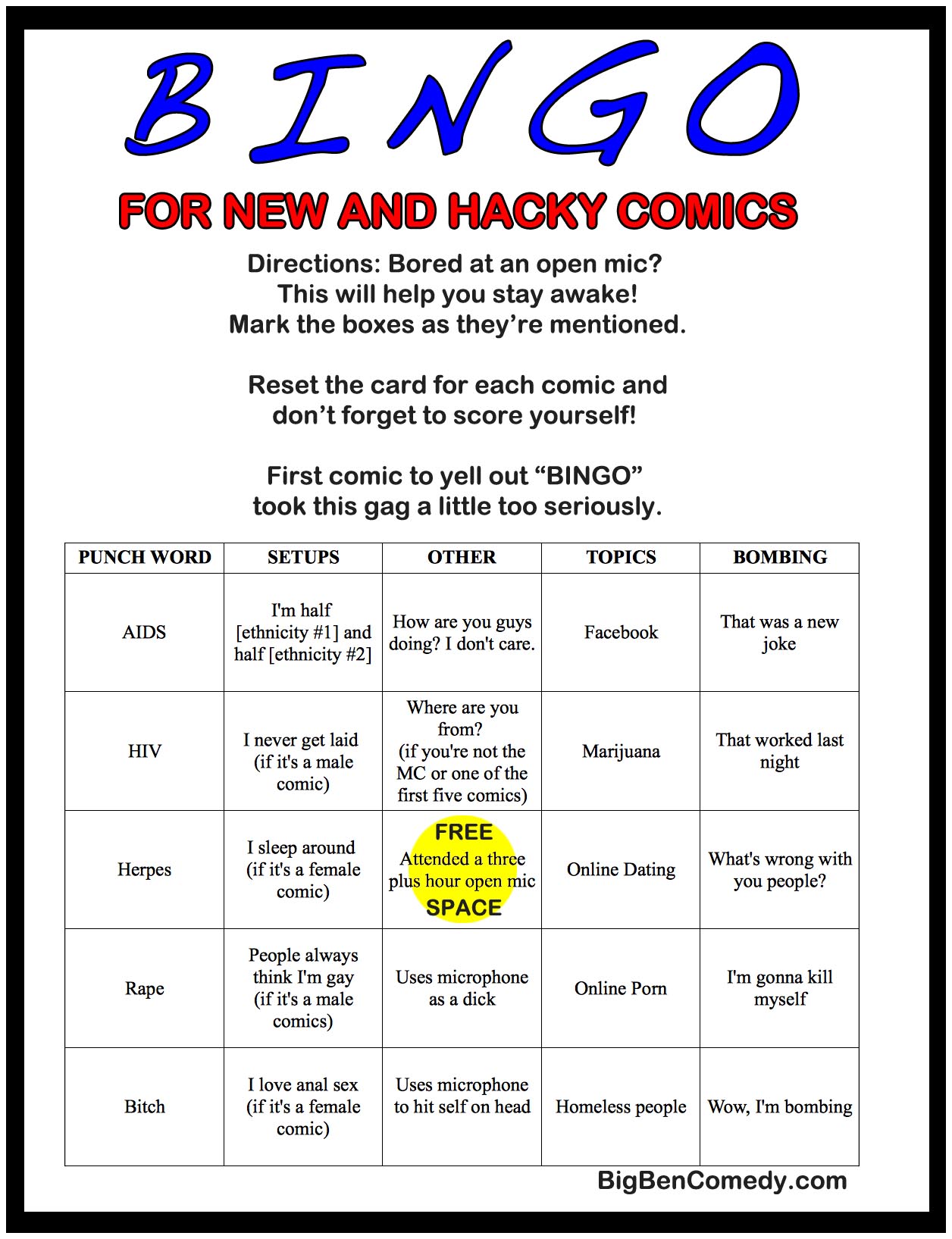
If your jokes are being “stolen” something else might actually be happening: You’re writing hacky material or are being too topical. There’s only so many ways to do a marijuana joke and every comedian and their mother has written a Tiger Woods, Britney Spears and Paris Hilton joke. Your punch line about “eighteen holes” or “a hole in one” wasn’t stolen, it was just so obvious that five other comics thought of a very similar joke. I remember reading Lisa Lampenelli’s book and she mentions how at the Comedy Central Roasts she’d have a pen with her to cross out the jokes on her set list that the other comedians had already done about the guest of honor. Did all those professionals steal each other’s jokes? No! There’s just only so many Pamela Andersen fake tits and Tommy Lee has big cock punch lines one can think up.

So how do you solve this joke overlap? Make your material more personal. Very few comedians can steal my Russian family material because it would be inauthentic and make no sense to their stage persona. So focus on your life and find the funny in it. Hint: It usually involves pain. A comic, I forget who once told me, “comedy = pain + time” and “until you’re at George Carlin’s level, nobody gives a shit about your political opinion.” I agree: focus on your unique life situation and figuring it out how to get the audience to connect with it. Should you still write Tiger Woods jokes? Yes, because that’s still working on writing a joke, and if you get picked up by a TV show, you’ll need to be able to generate topical jokes daily. Just don’t be surprised when you hear three very similar jokes from comics you’ve never met. (And yes, I know I need to make my material more personal too, it’s a work in progress.)

Ok, let’s say your jokes are personal and they’re actually being stolen. In a fucked up way, it’s an honor to get your jokes stolen, that means you’re getting funny! And you should only be afraid of getting jokes stolen if you’re not planning on developing as a writer and performer. Fear of jokes being stolen means your jokes are coming from a place of scarcity, not of abundance. It shows you believe there to be a limited amount of jokes you’ll be able to write and that one of the 10 or 12 jokes you were able to come up with has been taken away. This usually means you’re not writing enough.

Jon Stewart, David Letterman, Conan and all those guys deliver ten to fifteen minutes of new jokes every show (sure they have a whole writing staff, but that’s not the point). If you’re trying to be around the comedy business for a long time you’re going to need write hours and hours of good material. Having one bit stolen here or there won’t make a huge difference. If you’re so funny that all your material is being stolen, start lifting weights, then say something. A comedian may have had your joke go into his subconscious and come out months later as a similar joke. Talk to them first and figure out who’s been doing it first. Comics don’t want to be known as joke thieves because once they have that reputation, everyone avoids them and 95% of your gigs are through other comics.

Feel free to intelligently discuss this in the comments section below.