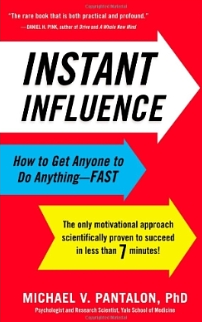
“People usually act for their own reasons, not someone else’s reasons. If they do change a behavior because of something someone else has said, most of the time that change won’t stick. The secret of Instant Influence is that it helps people discover their own reasons for doing something, even something they thought they didn’t want to do.” (5)
“Here are the six steps that will allow you to achieve Instant Influence: Step 1: Why might you change? Step 2: How ready are you to change – on a scale from 1 to 10, where 1 means “not ready at all” and 10 means “totally ready”? Step 3: Why didn’t you pick a lower number? (Or if the influencee picked 1, either ask the second questions again, this time about a smaller step toward change, or ask, what would it atke for that 1 to turn into a 2?) Step 4: Imagine you’ve changed. What would the positive outcomes be? Step 5: Why are those outcomes important to you? Step 6: What’s the next step, if any?” (5)
“If a person is deeply committed to refusing change, no motivational technique will make a difference. When someone genuinely doesn’t want to change, change won’t happen.” (11)
“At almost every turn, your efforts were doomed to fail. That’s because you were using what I like to call the tell-and-sell approach: you tell someone your reasons for doing something, then try to sell her on them.” (18)
“The other person might agree with you, but that won’t spark a desire to take action. That desire – the motivation to act – lives in each one of us. But the only way to unlock it is with our own reasons.” (18)
“Using the wrong type of encouragement can actually make a person want to do something less.” (18)
“People can tell you all day long that they wish they could do something. But when they tell you why they want to do it, that’s when things start to happen.” (19)
“That’s instant influence in a nutshell. Get someone to tell you why he wants to act, and action is almost sure to follow.” (19)
“This kind of question – Why are you even thinking about this? or, Why might you consider it? is another version of Step 1 of the Instant Influence process.” (23)
“Focusing on any tiny bit of motivation works much better than asking about resistance.” (25)
“Hearing ourselves say what we want to do helps us find the motivation to do it.” (31)
“My trainees can’t quite believe that simply saying “I’d really like to do X” will actually make it more likely that the person will, in fact, do X. I assure you that dozens of well respected studies have verified this point, magical as it may sound. The reason we’re so surprised, I think, is because we’re used to hearing people say “I should do X,” and that, of course, has virtually the opposite effect. The more we think we should do something, the less likely we may be to do it, particularly when the law of psychological reactance kicks in.” (31)
“You can modify Step 1 of the Instant Influence technique to focus on actual behavior. Instead of asking, “Why might you change?” you could ask, “Why have you already taken [some action that represents a tiny step toward changing]?” (34)
“People’s actions often show that they have far more motivation than they are aware of. We can use the evidence of those actions to help them find even more motivation.” (34)
“For example, many studies have found that bonuses don’t promote more dedicated performance. Instead, they seem to motivate unethical behavior: shortcuts, cheating, and other ways to get the bonus that don’t involve doing a good job.” (51)
“If you can’t get someone to think, you won’t be able to influence him.” (74)
“Every time those baby steps (placing the manual by the computer) did the trick. Once he’d made even the least bit of progress, his natural motivation took over and carried him along.” (105)
“Choose something that you can literally see or hear yourself doing (an action) rather than something that remains in your mind only (a decision or a new way of thinking).” (107)
“Allow yourself to focus on behavior, and your decisions will take care of themselves.” (107)
“Improving the Process: – Keep looking for smaller and smaller beginning steps until you find one that feels safe or that you can at least visualize doing. – Don’t judge or self-censor. Just be open to the process. – Explicitly remind yourself to ignore the hows and why nots. Focus instead on why you want something. – Expect to get carried away. The tiniest step of sets in motion a series of thoughts, feelings, and ideas that create new momentum. – Prepare to be surprised. You will almost certainly learn something new about your own reasons for wanting something. – Trust the process. You may find yourself taking action almost without realizing it, so don’t feel you need to force yourself.” (116)
“Research suggests that when people are presented with illogical, odd, unrelated, or irrational material – in scientific terms, “meaning-threat” material – they tend to arrive at better solutions in less time.” (117)
“As we’ve seen, we often focus too much on the how when we really should be looking at the why.” (120)
“Occasionally, we take on the wishes of people around us – parents, partners, even friends – instead of acknowledging our true desires. We believe in those false dreams, then wonder why we can never seem to take action to make them come true. All too often, our true desires scare us, either because they seem difficult to attain or because achieving them would shake things up elsewhere in our lives.” (126)
[when dealing with customer service] “You need to detach from any sense of being in a power struggle and instead focus on getting what you want. The person you’re dealing with may never acknowledge your right to what you want – but he may find a way to give it to you. His motivation for doing so, however, will probably not come from a sudden awareness of the correctness of your position. Rather, it will spring from discovering why he wants to help you even though he doesn’t have to. If your goal is to prove to him that he does have to help you, you’re setting yourself up for failure.” (162)
“Need is often just another way of saying should, and anytime the word should is used, we risk triggering the law of psychological reactance.” (178)
“If someone is giving you reasons talk, remember the “five whys.” If you can, keep asking, “And why is that important?” until you hear a response that feels genuinely personal and heartfelt.” (180)
“As hard as it is to believe, such excuses are good news. Giving reasons for not doing something is one of the strongest signs that a person is seriously considering doing it.” (188)
“I know how easy it is to fall into the role of the person with all the answers. But I’ve also seen, time and again, that giving up that authority and genuinely investing in the person’s autonomy can have enormous dividends, as he reveals himself to be a more independent, self-confident, and creative person than we ever might have dreamed.” (201)
“Edwin Locke and Gary Latham found in a landmark study: when workers set their own goals, they set goals that were harder to achieve than the ones supervisors assigned to them – and they were more likely to achieve those goals.” (202)
“People often like the attention that comes from others being concerned about them. Without consciously realizing it, they refuse to change as long as people take an interest in helping them.” (216)
As always, if you found the quotes interesting, please buy the book here.
“The super achievers had ten things in common: Dedication, intelligent persistence, community, listening, telling a story, testing, managing emotions, evolving, patience, happiness.” (i-xliii)
“Know when to pivot, to rethink your plan, while still maintaining the mission.” (xxviii)
“When these emotions compromised their goals, they had the commitment and the skills to examine those emotions and figure out effective ways to cope with them.” (xxxix)
“Because they possess a willingness to challenge their deeply held assumptions and the courage to act on that information, they have been able to overcome obstacles by discarding what doesn’t work and evolving entirely new ways of thinking about their lives and goals.” (xlii)
“George Clinton told us, “If you get to the top and catch up with happy, you got a real problem because you’ll get bored. I’m not trying to catch up with being happy – because it’s the pursuit of happiness I’m after. I want to be so close behind it I can almost touch it. That’s what keeps me looking forward to moving ahead.” (xliv)
“Good writing is not about impressing people with how smart you are but about explaining your subject as simply as possible.’ (xlv)
Laura Linney
“Her goal then is to so thoroughly internalize her role that once she steps on set or stage, she can “throw all the preparation away and let the work bleed through.” (1)
“Most scripts aren’t written to be acted. They’re written to appeal to an executive who doesn’t know how to read a script but has the power to get a film made.” (2)
“Film is a director’s medium, so you need to find out if you share a point of view so you can help them make the movie they want to make.” (3)
Anna Netrebko
“No matter how big you become, you can never be self-satisfied and say, ‘Okay, I’ve made it,’ because the next day you have to go back and prove yourself again.” (10)
“When I started out, I met a lot of extremely talented singers. Everybody thought, “Oh, this one or that one will be a star.” But after a very short time, many of them disappeared. Talent, which is a gift from the gods, isn’t enough. You have to be incredibly smart about your choices.” (10)
“My dreams never went too far. Maybe it would be in my home region of Krasnodar? When I studied, I was not thinking, “I’m going to be the one.” That was not my goal. I loved the music so much that my goal was simply to sing well. That’s it. That’s what I wanted to do. I focused on learning the music, developing my voice and practicing very hard so I could get better.” (11)
“Envy can destroy your soul.” (12)
“Something else has to come through to capture the audience’s attention. It’s soul. Callas had it. You have to find it in yourself. It took me years to find it. I couldn’t even tell someone how I did it except to keep searching for it and allowing it to come out. It’s very difficult to do, but performing with soul is the only way you can move an audience, stun them, shock them, make them cry.” (12)
“Make it (seem like) magic.” (13)
Ken Jennings
“If you let go of the outcome and just enjoy the crazy experience of being on a quiz show, you’ll do much better.” (24)
“No matter how much smarter you think you are than everyone else, you have to first make yourself interesting and TV ready.” (24)
“Overconfidence can kill you. It can be worse than not being confident enough.”( 26)
Yogi Berra
“Play to your strengths and don’t go crazy over weaknesses. The best players improve what they do well.” (32)
Martina Navratilova
“To be a champion you have to play as if every point is a matter of life and death.” (40)
“A lot of players have lost sight of the fact that it’s a game. They’ve lost the joy of playing. They’re so afraid to fail, and with all that pressure, they’re miserable and that affects their play.” (41)
Alec Baldwin and Robert Carlock
“We try to tell emotionally grounded stories in as odd of a way as we can.” (45)
“TV is a medium of limitations. We tell a lot of jokes, but we don’t have a lot of time to mess around. Every joke has to accomplish something, whether it’s smoothing over a transition, telling us something new about a character we’ve known for six years, or progressing the story.” (46)
“In the world of sketch comedy, say on SNL, you can say the most horrible and offensive things and get a laugh, because when the three-minute sketch is over, that world no longer exists and the characters will never see each other again. Whereas, with 30 Rock, we can say things to each other on the edge of being offensive, but you can’t cross that line, because those characters have to continue to live with each other for years.” (47)
“Every character has to have their own voice. On a lot of TV shows there’s no distinction between characters’ voices.” (47)
“Question the script. As we develop a story line, I always ask, what new information have we learned in this scene? How is the story moving forward? How are the stories talking to each other? How is this building? How is the end better than the beginning? Is the end even in the beginning? And most important, am I feeling bored reading this right now? If those questions don’t have satisfactory answers, then, however good the jokes are or acting is, you are failing in your duty to create something funny.” (49)
“The most important question is not “Is this funny?” but “Are we failing at being funny in a larger sense?”” (49)
Simon Doonan
“Reimagine your personal style by uncovering and exaggerating all that is unique about you.” (54)
Tony Hsieh
“The best decisions are made from the bottom up. A manager’s job is to remove obstacles.” (68)
“We try to create an environment where employees feel energized, where work doesn’t feel like work. You’re just living life the way you want to live it, and it happens to make money as well.” (69)
“Ultimately a brand is a shortcut to a set of emotions.” (70)
Will Shortz
“I try to get as many people into the tent as possible by having different “acts” and appealing to everyone at least some of the time.” (76)
Mark Frauenfelder
“The recipe for an excellent blog is to be so deeply obsessed with something that you need to communicate it to others.” (83)
“If you spend too much time obsessing on the minutiae of digital marketing techniques, you’ll lose sight of the mission of a blog, which is to share information with like-minded people.” (84)
Randall Grahm
“The riskiest thing is to stay the course and pretend that things are normal. Nothing is normal; the whole world is upside down. You have to be faily extreme to have any shot at succeeding.” (90)
Constance Rice
“Outlast everyone. There are a lot of folks who are a lot smarter than me. But I am more persistent. I’m more determined and I’ve got more passion. So I outlast everybody.” (102)
Sam Yagan, Chris Coyne, Max Krohn, Christian Rudder
“Getting 99 percent of the people to kind of like you is a waste of time. Accentuate your eccentricities and find the people who will love you as you really are.” (113)
“The three questions that tested above all others in determining if you and someone else have long-term potential are: “Do you like horror movies?” “Have you ever traveled around another country alone?” and Wouldn’t it be fun to chuck it all and go live on a sailboat?” (117)
Average length of time for online daters before tying the knot: 18.5 months. Real-world daters: 42 months.
Barry Levine
“Showing that Hollywood actors and TV stars don’t have perfect lives helps people accept their own problems. As an old Enquirer editor once said, the big news organizations tell people what they think they should be interested in, whereas we try to give them stories they are interested in.” (128)
“Know where you’re headed. My hero, Ernest Hemingway, would always leave off writing at the end of the day at a point in his story where he’d know just where he’d pick up the following morning.” (130)
“Pace yourself. No matter how big a story is, you can’t let it overwhelm you, because you have to be back at your desk at eight o’clock the next morning to work on other stories. Years ago, I was afraid to leave my desk. But these days, no matter how busy I am, every day I’ll leave my office, walk around the block, get lunch or go to the gym. It’s a marathon, not a sprint.” (131)
“You have to embrace your success and think hard about the failures that come your way, but you can’t obsess on either.” (131)
Chad Schearer
“When you practice, simulate the conditions you’ll be facing in your actual hunt. Become familiar. Practice in the clothes you’ll be wearing with the weapon you’ll be using.” (142)
“Injury rates for sports per 100 participants: football (5.3), hunting (0.05)” (147)
Philippe Petit
“Ask a great artist why they do what they do and the answer will be, “Because I have no choice.”” (157)
“Art happens when you work millions of hours not to make it look hard but to make it look effortless. The beauty for an audience is to be inspired and awestruck because you made them forget that the wire was even there.” (160)
Candida Royalle
“Least popular day for viewing online porn, Thanksgiving; state with highest per capita porn subscriptions, Utah.” (174)
OK Go
“Don’t stop trying things because they don’t fit your own stereotype of yourself. If it feels like fun, it is yourself.” (179)
“Listen to your fans. You may have an idea of who you want your fan base to be – throngs in an arena, the hippest kids at school – but they may not be the ones you end up with. When the backward dance video took off, we realized our hardest-core fans were actually the weirdest, nerdiest ones sitting in their offices and bedrooms, trading videos. It might not have been what we expected, but if that’s where the connection was, why not build on it?” (179)
David Chang
“If you do what everybody expects, you’re going to have an exhausted, boring menu, so we were going to just do what we wanted. We started making dishes we thought that the public was going to love or hate.” (194)
“I don’t like to pat myself on the back, because there’s always a place around the corner that’s going to be better and faster. We have to keep our heads down and work.” (197)
Richard Restak
“One a very basic level, you are what you remember – your very identity depends on all of the events, people and places you can recall.” (201)
“If you think outside the box, playfully altering your perceptions, and try to look beyond the obvious, you will improve your imagination, thinking, and other cognitive processes by creating new linkages and new networks. Being open to and experiencing art or music can help us with this.” (204)
“Trying to control everything that happens in your brain can actually be an impediment.” (206)
“E.L. Doctorow writes, “Writing is like driving a car at night. You only see as far as your headlights go, but you can make the whole trip that way.”” (207)
Marc Routh
“Be tenacious. Shows take so long to develop, as long as eight years or more, so we always have at least a dozen projects in the pipeline.” (210)
“There’s a saying on Broadway that musicals are a business and plays are a hobby.” (211)
Michael Sitrick
“Some people worry about having the last word; my concern is getting the first and last word. Get your story out first so you can set the tone for the coverage that follows.” (216)
“Regardless of how actual events occur, journalists believe that the best way to recount these events is in the form of a story with a beginning, a middle and an end, with drama, conflict and surprising twists. This might be a highly stylized – even sensationalized – way of reporting on events, but this way of thinking is so internalized by members of the media that to get your message across to them you have to present that message in the form of a story, sometimes with clearly drawn heroes and villains.” (218)
“Newspeople tend to be skeptical, idealistic, naive and sometimes relentless, with egos larger and more fragile than the average person’s. For example, journalists love to scoop their rivals, so give a reporter exclusive access to your high-profile client and you might have just made a grateful ally for life.” (218)
“Sometimes by working with instead of against the media you acn turn an unmitigated disaster into a success story.” (218)
“Finding a lead steer, a well-regarded reporter from a reputable institution willing to question conventional wisdom, can initiate a positive media stampede or reverse the direction of a negative one.” (219)
Bill Gross
“There are four types of management skills. And you need people with each one of the four skills to complement each other. The Entrepreneur is ahead of his time, sees the future and invents things. The Producer takes the new product and executes. The Administrator is the organizer who puts systems in place, makes sure the orders are filled and the bills are paid. The Integrator is a people person who understands the other three types and helps them get along, because they often hate each other’s guts.” (240)
“As long as people are punished for failing, they’ll be more focused on keeping their jobs than taking risks.” (241)
“Be 10 times better than your competition. Customers don’t’ want to switch to a new product or service that’s 10 percent better. They’ll only switch to something that is radically better than what’s already out there.” (242)
“Markets can change faster than you can imagine. Instead of judging your success by the size of your office, your marketing budget or the number of employees, sometimes you have to immediately scale your company to last as long as it’s going to take until people are ready for it.” (243)
Guy Kawasaki
“”You cannot influence people unless they actually find you likable.” (248)
“A baker believes she can make more and bigger pies. An eater believes that life is a zero-sum game: What others eat, he cannot eat. Bakers are trusted. Eaters are not.” (248)
“The more complex people make something, the less you should trust it.” (248)
“Always be generous. The most powerful favor is the one given with no clear link between the favor and what you want back.” (250)
Helio Castroneves
“It’s not about pushing harder; it’s about knowing when to push harder.” (256)
“Don’t stop learning till you’re six feet in the ground.” (257)
“To get there, you have to work so hard and face so much frustration that you can forget why you even got into racing. But when you stop enjoying yourself. what’s the point?” (258)
“Sometimes you’re the windshield and sometimes you’re the bug.” (260)
Stephen Dubner
“The best way to write a bestseller is not to try to write a bestseller. Write the book that you want to read.” (262)
“Write what you like. I’m convinced that the worst way to write a bestseller is to try to write a bestseller.” (262)
“Every topic needs an idea. As a magazine editor, I learned a topic is nothing without an idea. If you can’t wring out the idea from a topic, then don’t do the story.” (263)
“Keep it simple. One mistake that smart people often make is trying to remind everyone else how smart they are.” (264)
“It’s always better to tell a story simply than to show off.” (264)
“Simplicity allows you to connect with your readers. They trust plain language.” (264)
“If people finish a book, they’re much more likely to tell other people about it.” (265)
“The op-ed was about parenting… It had nothing to do with anything, but TV producers read USA Today, so suddenly we got on the Today show. Matt Lauer said, “oh man, this is really cool – what else is in your book? Why don’t you come back every week?” Then ABC came to us and said, “Why don’t you come back every week on all our shows – Good Morning America, World News Tonight, etc/” So, we started to have a cumulative advantage – once something becomes big, it’s a lot easier for it to get bigger.” (266)
“I’ve always had the good luck to write what I wanted and get paid. But, if I couldn’t write what I wanted, I wouldn’t write. I’d do something else, ‘cause I’ve got to get paid.” (267)
“From sportswriter Red Smith: “There’s nothing to writing. All you do is sit down at the typewriter and open a vein.” (267)
“From Flannery O’Connor: “There’s many a bestseller that could have been prevented by a good teacher.” (268)